

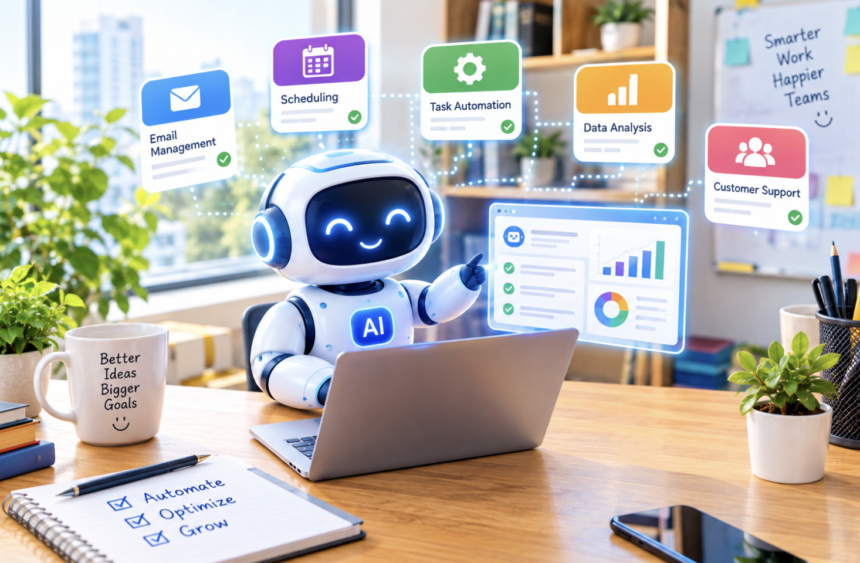
A customer support team at a mid-sized retailer used to spend hours each week manually routing tickets, checking order statuses across three different systems, and drafting near-identical replies to common questions. Then the company deployed an AI agent that could check inventory, pull order history, and draft a reply on its own, only flagging a human when a case fell outside its rules. Support response times dropped by half within a month. This is the practical promise behind AI agents, and this guide explains what separates them from the chatbots and automation tools that came before.
What Makes an AI Agent Different From a Chatbot
A traditional chatbot follows a fixed script or answers questions from a knowledge base, unable to take independent action beyond generating a response. An AI agent, by contrast, is built to pursue a goal across multiple steps, using tools, checking its own progress, and adjusting its approach when a first attempt doesn’t work.
- A chatbot answers a question; an agent completes a task
- Agents can call external tools and APIs, such as a booking system or database
- Agents can break a broad instruction into smaller sub-steps without needing each one specified
- Many agents can evaluate their own output and retry before returning a result to a human
How Agents Decide What to Do Next
Modern AI agents are typically built around a large language model that plans a sequence of actions, executes them one at a time, and reviews the outcome before deciding on the next step. This loop, often described as reasoning and acting, lets an agent adapt when circumstances change partway through a task rather than following one fixed script.
For example, an agent asked to book the cheapest flight might first search available options, notice prices are unusually high for a specific date, check nearby dates instead, and only then present a recommendation, all without a human specifying each individual step in advance.
Common Business Use Cases Already in Production
- Customer support agents that resolve routine tickets and escalate complex ones
- Sales research agents that gather background on a prospect before a call
- Finance agents that reconcile invoices against purchase orders automatically
- IT agents that diagnose and resolve common technical issues without a helpdesk ticket
- Recruitment agents that screen CVs against a role’s specific requirements
Where Human Oversight Still Matters Most
Despite their growing capability, most organisations deploying AI agents keep a human reviewing decisions with financial, legal, or safety consequences, rather than granting full autonomy from day one. A support agent might handle a refund under a set limit automatically but route anything larger to a person. This staged approach lets a business build confidence in an agent’s judgement before expanding its authority.
The Technical Building Blocks Behind an Agent
- A language model that interprets instructions and plans steps
- A set of tools or APIs the agent is permitted to call
- Memory that lets the agent track progress across a multi-step task
- Guardrails that limit what actions the agent can take without approval
Common Pitfalls When Rolling Out an Agent
Poorly scoped agents can produce inconsistent or confidently wrong results, when given tasks too broad or ambiguous for their current capabilities. A business rolling out its first agent typically starts with a narrow, well-defined task, monitors performance closely, and expands scope only once results prove reliable over a meaningful sample of real cases.
Measuring Whether an Agent Is Working
Tracking task completion rate, average handling time, and how often a human needs to intervene gives a clearer picture of an agent’s real performance than anecdotal impressions alone. Teams that skip this measurement step often keep an underperforming agent running simply because nobody has confirmed it, one way or another, whether it’s helping.
How Agents Handle Failure and Uncertainty
A well-designed agent doesn’t simply stop when a step fails; it typically retries with an adjusted approach, asks a clarifying question, or escalates to a human rather than returning a confidently wrong answer. This ability to recognise its own uncertainty, at least to some degree, separates a useful production agent from an early prototype that breaks the moment reality deviates from the happy path it was tested against. Teams building agents for customer-facing tasks often spend more engineering effort on this failure handling than on the core task logic itself, since a single poorly handled edge case can undermine trust built over many successful interactions.
The Cost Structure Behind Running AI Agents
Every action an agent takes, from a single language model call to an external API request, carries a real cost, and a poorly scoped agent that loops unnecessarily or calls expensive tools repeatedly can rack up costs far beyond what a simple task should reasonably require. Organisations running agents at scale typically monitor cost per completed task closely, treating a sudden spike as a signal something in the agent’s logic has gone wrong, much the way a spike in cloud infrastructure costs might signal a runaway process. Setting sensible limits on how many steps or tool calls an agent can take before requiring human review helps keep this cost predictable.
How Agent Platforms Differ From Building Custom Solutions
Businesses evaluating AI agents generally choose between an off-the-shelf platform offering pre-built agent templates for common tasks, or a custom-built solution tailored to a specific internal workflow, and each path carries distinct trade-offs. A pre-built platform gets a business running faster with less upfront investment, while a custom solution offers greater control over exactly how the agent behaves but typically requires more engineering time and ongoing maintenance to keep functioning reliably as underlying systems change.
Integrating Agents With Existing Business Systems
An agent only becomes useful once it can reliably connect to the systems a business already relies on, whether that’s a customer relationship management platform, an inventory database, or an internal ticketing system, and this integration work often takes far longer than building the agent’s core decision-making logic. Legacy systems without modern APIs pose a particular challenge, sometimes requiring a business to build a custom bridge before an agent can interact with data that’s been sitting in an older system for years. Businesses planning their first agent deployment often underestimate this integration timeline, treating it as a minor technical detail rather than the substantial project it frequently turns out to be.
Setting Realistic Expectations for Early Agent Performance
Organisations deploying their first AI agent sometimes expect near-perfect performance from day one, only to find the agent stumbles on edge cases a human would handle without a second thought. This gap between marketing promises and early real-world performance has caused some businesses to
abandon promising agent projects prematurely, when a more patient approach involving careful monitoring and iterative refinement over several weeks would likely have produced a useful tool. Comparing an agent’s performance against a clearly defined baseline, rather than an idealised standard of perfection, gives a fairer picture of whether the deployment is succeeding.
How Agent Capabilities Are Likely to Develop Further
Current AI agents handle well-defined, moderately complex tasks reasonably well but still struggle with ambiguous situations requiring judgement calls a human would make almost instinctively. Industry observers broadly expect steady improvement in agents’ ability to handle longer, more complex task chains and greater ambiguity over the coming years, though the pace of that improvement remains difficult to predict precisely. Businesses building internal expertise with today’s more limited agents now are likely to be better positioned to take advantage of more capable versions as they become available, rather than starting from scratch once the technology matures further.
Security Considerations Specific to Autonomous Agents
Granting an AI agent access to internal systems and the ability to take action introduces a new category of security consideration beyond what traditional software typically requires, since an agent that can be manipulated through cleverly crafted input might take unintended actions using its legitimate system access. Security teams evaluating agent deployments increasingly test for these manipulation attempts specifically, treating an agent’s decision-making process as a potential attack surface rather than assuming its built-in guardrails will hold under determined, creative testing.
How Agents Are Changing Software Development Workflows
Software development has become one of the earliest and most visible areas of agent adoption, with coding agents capable of writing, testing, and even debugging code based on a plain-language description of the desired outcome. Developers using these tools report meaningful time savings on routine tasks like writing boilerplate code or fixing well-understood bugs, while still needing to review and understand the agent’s output carefully rather than merging it blindly into a production codebase.
Building Internal Expertise Before Scaling Agent Use
Organisations that succeed with AI agents typically invest in building internal understanding of how these systems work, rather than treating an agent purely as a black box purchased from a vendor and left to run unsupervised. Having at least one team member who understands an agent’s underlying logic and limitations makes it easier to diagnose problems quickly when something goes wrong, rather than depending entirely on external vendor support for every issue that arises.
How Small Businesses Can Start Experimenting With Agents Cheaply
A small business curious about AI agents doesn’t need a large budget to begin experimenting, since several platforms offer free or low-cost tiers suitable for testing a simple use case like drafting email replies or summarising customer feedback before committing to a larger investment. Starting with a low-stakes, easily reversible task lets a small team build familiarity and confidence with agent-based tools without risking a significant financial or reputational cost if the early experiment doesn’t go smoothly. This gradual approach tends to produce far better long-term outcomes than a larger, more ambitious rollout attempted before the team has developed a real feel for how these tools behave in practice.
Why Documentation and Clear Instructions Matter More Than Expected
An agent’s usefulness depends heavily on the clarity of instructions and context it’s given, and a poorly specified task, left vague or ambiguous, often produces inconsistent or unhelpful results even from an otherwise capable underlying system. Teams that invest time upfront in clearly documenting exactly what an agent should and shouldn’t do, including specific examples of correct behaviour, tend to see noticeably better and more consistent results than teams that deploy an agent with only a brief, general instruction and hope it infers the rest correctly.
How Agents Handle Multi-Language and International Contexts
Businesses operating across multiple markets increasingly need agents capable of handling customer interactions in several languages, and while many underlying language models support this reasonably well out of the box, nuances around tone, cultural expectations, and local business practices often still require additional configuration and testing per market. A support agent trained and tested thoroughly on English-language interactions may still stumble on culturally specific phrasing or expectations in another market, which is why businesses expanding an agent internationally typically run a separate testing and refinement phase for each new language and region rather than assuming a direct, unmodified translation of existing logic will perform equally well everywhere.
Why Some Businesses Choose to Delay Agent Adoption
Not every business benefits from rushing to adopt AI agents immediately, and some industries with strict regulatory requirements, highly sensitive customer data, or processes requiring nuanced human judgement reasonably choose a more cautious, delayed approach while the underlying technology and surrounding regulatory guidance continue to mature. This caution isn’t necessarily a missed opportunity; businesses that wait often benefit from more mature tooling, clearer regulatory guidance, and a wider pool of documented lessons learned from earlier adopters’ mistakes, potentially avoiding costly missteps that come with being among the very first to deploy a new technology at scale.
A Quick Note on Explainability in Agent Decision-Making
Businesses in regulated industries often need to explain why an agent made a specific decision, not just what the decision was, which has driven growing interest in agent designs that log their reasoning steps clearly enough for a human reviewer to reconstruct and audit the decision path afterward, rather than treating the agent’s internal process as an unexplainable black box.
How Agents Are Priced by Different Vendors
Pricing models for AI agent platforms vary widely, from a flat monthly subscription covering unlimited use to usage-based pricing tied to the number of tasks completed or underlying model calls consumed, and comparing these models fairly requires estimating actual expected usage rather than judging purely on a headline price. A business with highly variable, unpredictable task volume may find usage-based pricing better suited to its needs than a flat subscription designed around steady, predictable use, while a business with consistent daily volume might find a flat fee more cost-effective over time.
Why Cross-Functional Buy-In Improves Agent Adoption
Agent deployments that succeed tend to involve input from the actual team members whose daily work the agent will affect, not just a technical team implementing the system in isolation from the people who’ll ultimately use or be affected by it. Frontline staff often spot practical issues or edge cases that a purely technical implementation team might miss entirely, making their early involvement valuable both for catching problems before launch and for building buy-in rather than resentment toward a tool imposed without any real consultation.
Final Thoughts
AI agents represent a meaningful step beyond static chatbots, capable of pursuing a goal across several steps rather than simply answering a single question. Businesses considering their first agent deployment tend to succeed by starting with a narrow, well-defined task, keeping a human in the loop for high-stakes decisions, and measuring results carefully before expanding scope.
Frequently Asked Questions
1. Do AI agents require constant human supervision?
Most production deployments start with close supervision and gradually reduce it as the agent proves reliable on a given task, rather than removing oversight entirely from the outset.
2. Can a small business realistically use AI agents?
Yes. Several off-the-shelf platforms let smaller teams configure a basic agent for tasks like customer support or scheduling without needing an in-house engineering team.
3. What’s the difference between an AI agent and robotic process automation?
Traditional automation follows a fixed, pre-programmed sequence of steps, while an AI agent can adapt its approach based on context, making it better suited to tasks with some variability.
4. How do businesses keep agents from making costly mistakes?
Common safeguards include spending or action limits, mandatory human approval for high-stakes decisions, and detailed logging that lets a team review what an agent did and why.
5. Are AI agents replacing entire job roles?
Most current deployments automate specific tasks within a role rather than replacing the role entirely, freeing staff to focus on the parts of their job that need human judgement.
6. What industries are adopting AI agents fastest?
Customer service, software development, finance operations, and recruitment currently show the fastest adoption, largely because these fields involve repetitive, rule-based tasks well suited to early agent capabilities.