

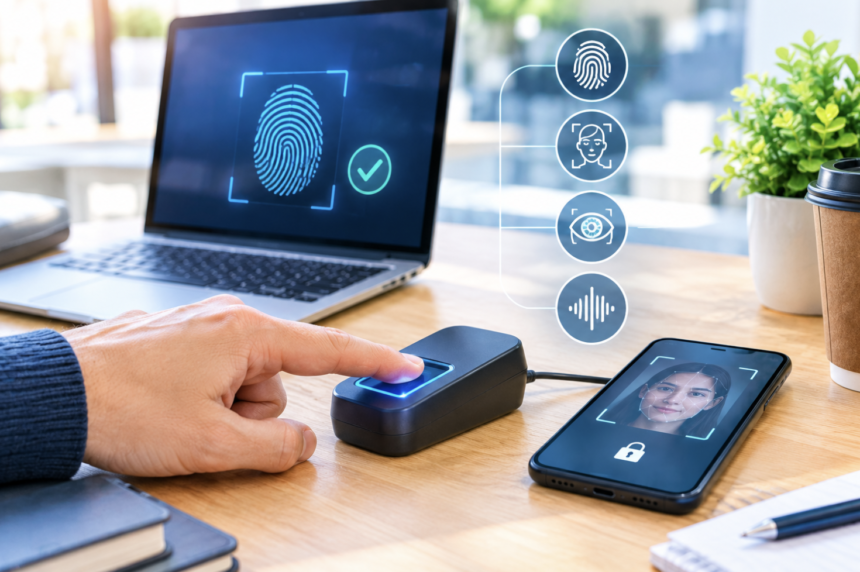
A traveller rushing through an airport barely breaks stride at the passport gate now, glancing briefly at a camera before the barrier opens automatically. No card swipe, no PIN, no paper document handed to an officer. This kind of frictionless verification, once confined to spy films, has quietly become part of daily life, from unlocking a phone with a glance to approving a payment with a fingerprint. This guide explains how biometric authentication works and where its real strengths and weaknesses lie.
What Counts as Biometric Authentication
Biometric authentication verifies identity using a person’s physical or behavioural characteristics rather than something they know, like a password, or something they carry, like a key card.
- Fingerprint scanning, the most widely deployed biometric method
- Facial recognition, used in phones, airports, and increasingly in retail
- Iris and retina scanning, common in high-security facilities
- Voice recognition, used for phone banking and smart assistants
- Behavioural biometrics, such as typing rhythm or how someone holds a device
How a Fingerprint or Face Gets Verified
Rather than storing an actual image of a fingerprint or face, most systems convert the captured biometric into a mathematical representation, often called a template, then compare that template against a stored version each time a person attempts to authenticate. This approach means a data breach exposing biometric templates doesn’t typically hand an attacker a usable fingerprint image, though the risk isn’t eliminated entirely.
Why Biometrics Are Considered More Convenient Than Passwords
Passwords require memorisation and are frequently reused across multiple accounts, creating a security weakness that biometric methods sidestep by relying on a characteristic a person always has with them. A fingerprint can’t be forgotten the way a password can, and unlike a password, it doesn’t need to be typed correctly under pressure or in poor lighting.
The Security Trade-offs Worth Understanding
- A stolen password can be changed; a compromised biometric template cannot be reissued in the same way
- False acceptance rates vary between systems, meaning some biometric methods are easier to fool than others
- Biometric data often carries stricter legal protection than a password under data protection law
- Multi-factor approaches combining a biometric with a second method remain the more secure standard
Where Biometric Authentication Is Expanding Fastest
Banking apps increasingly use fingerprint or facial verification for login and payment approval, while some retailers are piloting palm-scanning payment systems that let a shopper pay without touching a card or phone at all. Workplace access control has also shifted heavily toward biometric methods, in facilities where a lost or shared key card previously posed a real security gap.
Privacy Concerns That Come With Wider Adoption
Because biometric data is permanently tied to a specific individual and can’t be reset the way a password can, privacy advocates have raised concerns about how organisations store, share, and eventually delete this data. Regulations in the UK and EU generally treat biometric data as a special category requiring stronger protection and clearer consent than ordinary personal data.
Choosing Between Different Biometric Methods for a Specific Use
Not every biometric method suits every situation; a fingerprint scanner works well for unlocking a personal device but poorly for verifying identity at a distance, while facial recognition suits contactless scenarios but can struggle with poor lighting or face coverings. Organisations selecting a biometric system typically weigh accuracy, user convenience, and the specific environment where verification will happen before committing to one method.
How Multi-Factor Systems Combine Biometrics With Other Methods
Most security-conscious organisations don’t rely on a biometric method alone, instead pairing it with a second factor like a one-time code or a physical security key, since combining categories of verification, something you are with something you have, closes gaps that either method alone would leave open. A stolen phone with a compromised fingerprint sensor still can’t access an account protected by a second, independent factor, which is why banks and other high-security services increasingly treat biometrics as one layer within a broader verification strategy rather than a complete solution by itself.
Spoofing Attempts and How Systems Defend Against Them
Early biometric systems proved vulnerable to relatively simple spoofing attempts, such as a photograph fooling basic facial recognition or a moulded print fooling a fingerprint sensor, prompting manufacturers to add liveness detection that checks for signs of an actual living person rather than a static reproduction. Modern systems often look for subtle cues like blood flow, micro-movements, or three-dimensional depth that a photograph or simple mould can’t replicate, though determined attackers continue finding new methods, keeping this an ongoing area of active development rather than a solved problem.
The Growing Role of Biometrics in Public Infrastructure
Beyond personal devices and workplace access, biometric verification has expanded into public infrastructure, including airport border control, some public transport payment systems, and select retail environments piloting cashier-less checkout. This expansion raises distinct questions from personal device use, since a person using public infrastructure often has far less choice about whether to participate than someone deciding whether to enable fingerprint unlock on their own phone, putting added pressure on operators to justify data collection and retention practices clearly.
How Biometric Data Is Regulated Under UK and EU Law
Biometric data falls under special category data in UK GDPR, meaning organisations must meet a higher legal bar to collect and process it lawfully compared to ordinary personal information like a name or address. This typically requires explicit consent or another specific legal basis, along with a clear, documented purpose for collection and a defined retention period after which the data must be deleted. Organisations found processing biometric data without adequate legal grounds face significant regulatory penalties, which has pushed many businesses to consult data protection specialists before rolling out any biometric system.
Comparing Biometric Accuracy Across Different Conditions
Biometric systems don’t perform identically under every condition; fingerprint scanners can struggle with wet or dirty fingers, facial recognition can be affected by poor lighting or partial face coverings, and voice recognition can be thrown off by background noise or a person’s illness affecting their voice temporarily. Organisations deploying biometric systems in variable real-world environments, rather than controlled laboratory conditions, typically need a reliable fallback authentication method for situations where the primary biometric method fails to verify someone who is, in fact, who they claim to be.
The Future Direction of Biometric Technology
Emerging biometric methods, including gait analysis that identifies someone by how they walk, and vein pattern recognition using infrared light to map blood vessels beneath the skin, promise even greater accuracy and resistance to spoofing than current mainstream methods. These newer approaches remain largely confined to specialised, high-security applications for now, though the steady trend toward more sophisticated, harder-to-fool biometric verification suggests today’s fingerprint and facial recognition systems represent an intermediate stage rather than the final form this technology will eventually take.
Why Biometric Enrolment Quality Affects Long-Term Accuracy
The quality of the initial biometric enrolment, the process of capturing and storing someone’s fingerprint, face, or other characteristic for the first time, has a lasting effect on how accurately a system recognises that person going forward. A rushed or poor-quality enrolment, captured under bad lighting or with an uncooperative subject, can lead to persistent recognition problems that only become apparent well after the initial setup, which is why organisations deploying biometric systems at scale often invest in proper enrolment procedures and staff training rather than treating this step as a quick formality.
How Biometric Systems Handle Ageing and Physical Change
A person’s face and, to a lesser extent, their fingerprints and voice naturally change over time due to ageing, weight changes, injury, or illness, and biometric systems need some tolerance for this gradual drift to remain useful without requiring constant re-enrolment. Most modern systems address this by periodically updating the stored template based on successful recent verifications, effectively allowing the system’s understanding of a person’s biometric profile to evolve gradually alongside the person themselves, rather than remaining permanently fixed to a single enrolment captured years earlier.
Comparing Public Attitudes Toward Different Biometric Methods
Surveys measuring public comfort with biometric technology consistently find that people generally feel more comfortable with fingerprint authentication than facial recognition, largely due to facial recognition’s association with surveillance and its ability to identify someone without their active participation or awareness. This difference in public perception has shaped how organisations roll out biometric systems, often introducing fingerprint-based options first and facial recognition later, once trust and familiarity with biometric authentication more broadly has had time to develop.
How Biometric Systems Are Tested Before Deployment
Before a biometric system reaches production use, reputable vendors put it through extensive testing across varied conditions, including different lighting, skin tones, ages, and environmental factors, specifically to identify and address accuracy gaps before real users encounter them. Organisations evaluating a biometric vendor should ask directly about this testing process and request evidence of performance across a diverse test population, rather than accepting marketing claims about accuracy without independent verification behind them.
What to Do if Biometric Authentication Repeatedly Fails
Anyone who finds a biometric system repeatedly failing to recognise them, whether due to a skin condition, an injury, or simply an unusually difficult case for the underlying algorithm, should have access to a reasonable alternative verification method rather than being left unable to access an account or facility entirely. Well-designed systems build this fallback in from the start, recognising that no biometric method achieves perfect accuracy for every single person under every circumstance, however rare a persistent failure might be.
How Biometric Authentication Is Evolving for Payment Systems
Payment providers have increasingly explored biometric authentication as a way to reduce fraud while speeding up the checkout process, whether through fingerprint or facial verification built into a mobile payment app, or emerging point-of-sale systems that let a shopper pay using their palm or face directly without a card or phone at all. This shift reflects a broader industry recognition that biometric verification can reduce certain categories of payment fraud that traditional PIN or signature-based verification struggled to prevent, card-not-present fraud that has grown alongside online shopping.
The Role of Biometric Data in Identity Verification for Financial Services
Financial institutions increasingly use biometric verification during account opening and identity checks, comparing a live photo or video against an official identification document to confirm a new customer matches who they claim to be. This approach has helped reduce certain categories of identity fraud that previously relied on stolen or forged documents alone, though it does introduce new considerations around how that sensitive biometric data gets stored and protected once collected during the verification process.
A Quick Note on Biometric Data Portability Between Devices
Most biometric enrolment remains tied to a specific device rather than transferring automatically when someone switches to a new phone or laptop, meaning users typically need to re-enrol their fingerprint or face on each new device separately, a practical inconvenience worth expecting when upgrading hardware.
How Biometric Systems Support Accessibility
Biometric authentication has improved accessibility for some users who find traditional passwords or PINs difficult to manage, including people with certain motor or cognitive disabilities who may struggle with typing complex passwords accurately and consistently. This accessibility benefit is sometimes overlooked in broader conversations about biometric technology, but it represents a real, practical advantage for a meaningful number of users who find a simple fingerprint or glance easier and less frustrating than remembering and correctly entering a traditional password.
Comparing Consumer and Enterprise Biometric Deployments
Consumer biometric systems, like the fingerprint sensor on a personal phone, typically prioritise convenience and store data locally on the device itself, while enterprise biometric deployments, such as workplace access control, often involve centralised storage and more complex compliance requirements given the larger number of people and higher stakes involved. Understanding this distinction helps explain why enterprise biometric rollouts typically take longer to implement properly than simply enabling fingerprint unlock on a personal device.
A Quick Note on Biometric Backup Methods for Travel
Travellers relying on facial recognition for smart border gates should keep a valid physical passport accessible regardless, since occasional lighting, camera, or system issues at a specific checkpoint can require falling back to a manual passport check even for someone normally enrolled and recognised without any difficulty.
How Biometric Verification Is Used in Healthcare Settings
Hospitals and healthcare providers have begun adopting biometric verification to confirm patient identity before procedures, reducing the risk of mismatched records or, in rare but serious cases, a procedure performed on the wrong patient due to confusion between similarly named individuals. This application carries high stakes given the direct connection to patient safety, which is why healthcare biometric deployments typically undergo especially rigorous testing and validation before wider rollout across a hospital system.
A Quick Note on Biometric Consent Withdrawal Rights
Individuals in the UK generally retain the right to withdraw consent for biometric data processing and request deletion of stored templates, and organisations collecting this data are expected to provide a clear, accessible process for exercising that right rather than making withdrawal deliberately difficult or opaque.
Final Thoughts
Biometric authentication offers a level of everyday convenience passwords struggle to match, but it comes with trade-offs around permanence and privacy that deserve careful consideration. Understanding how a specific system stores and protects biometric data, rather than assuming all methods carry identical risk, helps both individuals and organisations make more informed choices about where and how to rely on it.
Frequently Asked Questions
1. Can biometric data be stolen the same way a password can?
Biometric templates can be exposed in a data breach, but because most systems store a mathematical representation rather than a raw image, the practical risk differs from a stolen password, though it remains a concern.
2. Is facial recognition accurate for all skin tones and ages?
Accuracy has historically varied across demographic groups, though newer systems trained on more diverse datasets have narrowed this gap compared to earlier generations of the technology.
3. What happens if someone loses a finger or has facial surgery?
Most systems allow re-enrolment of a new biometric sample, and many also support a backup authentication method like a PIN for exactly this situation.
4. Is it legal for employers to require biometric authentication?
Rules vary by jurisdiction, but UK employers generally need a clear, lawful basis and often explicit employee consent before mandating biometric authentication for workplace access.
5. Can biometric authentication be combined with other security methods?
Yes, and doing so is widely considered best practice, since combining a biometric with a password or one-time code addresses the specific weaknesses of relying on a single method alone.
6. Do all smartphones store biometric data in the same way?
Most modern smartphones store biometric templates in a dedicated, isolated hardware component separate from general storage, specifically to reduce the risk of exposure through a software-level breach.