

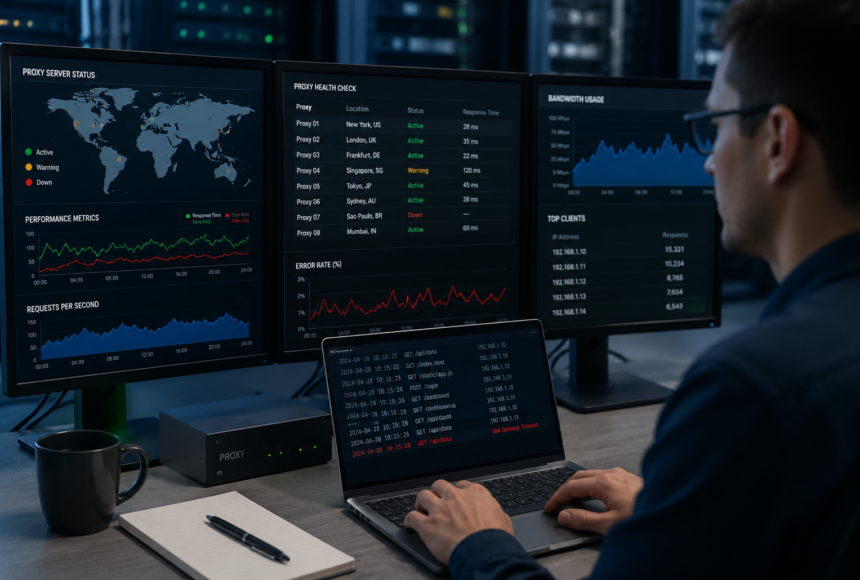
It always starts the same way an innocent log anomaly, a half-working data stream, or the sudden silence of a monitoring system at 2 AM. Networks today depend heavily on proxy infrastructure, yet proxy testing is still treated like a postmortem exercise instead of regular maintenance. The irony? It’s often the single layer separating reliable insights from corrupted chaos. Every automated scraper, API monitor, and security probe relies on proxies to move unseen across the web. When they fail silently, your entire digital ecosystem quietly decays.
The Hidden Cost of Invisible Proxy Failures
A “dead” proxy is easy you spot it, replace it, move on. But the ones that sneak through, replying with perfect 200 status codes while actually serving CAPTCHA pages or garbage HTML, are devastating. Systems log them as clean hits, databases record junk, and metrics drift from reality. By the time anyone notices, business decisions have been made from tainted data. Analysts estimate that large-scale data operations lose around 12% of their usable output to subtle proxy failures that slide past basic monitoring. That’s a silent, expensive bleed no graph will ever warn you about.
Rotating Proxy Pools Can Multiply the Damage
Ironically, scaling up can make things worse. Rotating proxy pools spread the rot evenly, ensuring every few thousand “successful” requests hide small pockets of trash data. Those broken nodes circulate endlessly through the system, infecting accuracy one response at a time. It’s dilution disguised as stability. What looks like a healthy, distributed infrastructure may actually be broadcasting fractured signals across your analytics stack, quietly shaping wrong conclusions.
What Effective Proxy Testing Actually Looks Like
Fixing proxy decay isn’t complicated, but it requires process rather than panic. Good teams schedule routine proxy testing cycles some every 15 minutes, others hourly long before production sees the fallout. Real testing means more than pinging an IP. It checks that the exit IP matches its claimed region, measures latency against expected baselines, and confirms that returned content matches a normal browser view, not a deceptive anti-bot wall. Whether you’re using Prometheus exporters, simple Python scripts, or lightweight cron jobs, the key is consistency, not complexity.
Counting the Financial Fallout of Neglect

Let’s play the numbers: 5,000 proxies. At any moment, about 8% or 400 are malfunctioning. If each runs 200 requests per hour, that’s a mind-numbing 80,000 broken transactions every single day. Each one costs compute time, API quotas, and valuable analyst hours chasing data anomalies downstream. Gartner’s infrastructure studies confirm the pattern unmonitored systems almost always produce the most expensive failures because their faults quietly snowball over time. A retail data firm recently discovered 15% of its pricing intelligence was stale for six weeks, all because one proxy started feeding cached pages.
Why Geography Can’t Be Trusted Blindly
Proxy labels are marketing, not gospel. “London” may actually route through Frankfurt, Paris, or Dublin and for scraping global markets, that’s a nightmare. Geolocation mismatches destroy localized SEO audits, regional price testing, and compliance monitoring. The root of this problem lies in geolocation databases like MaxMind and IP2Location, which carry 2 to 10% error rates at the city level. Every provider borrowing from those databases inherits the same weakness. The solution: run your own geolocation validation script using multiple lookup APIs. It takes minutes and saves hours of post-processing corrections.
Mature Proxy Management: The Quiet Patterns of Professionals
The strongest network operations teams share common DNA. They test proxy pools every 15 to 30 minutes, quarantine IPs after two consecutive failures, and log performance trends for months. They split proxies by use scraping, monitoring, testing to prevent cross-contamination. A proxy blacklisted by one site never affects another task. Their setup isn’t complex; it’s disciplined. Each proxy’s response is compared against expected HTML signatures, ensuring what comes back matches what a human would see. That’s real validation not just “is it alive,” but “is it useful?”
Content Validation: The Most Ignored, Most Crucial Step
Network verification has always been about assurance, not just uptime. The IEEE’s research on network consistency highlights one principle connection without context is meaningless. The same applies here. Testing a proxy’s response must go deeper than headers or codes. CAPTCHAs, redirects, and login prompts can all masquerade as success. Verifying response content ensures your system sees reality, not illusions. It’s the piece most companies skip and the reason so many suffer from “healthy” dashboards feeding bad data.
Automation: The Cure for Human Forgetfulness
Proxy testing must evolve from manual checks into an automated feedback loop. Full automation requires one deployment: small, repeatable tasks that constantly verify health, flag anomalies, and feed results back into orchestration tools. Whether achieved with a Prometheus exporter, scripted checks, or a CI/CD hook, the point is to ditch human dependency. Consistent monitoring systems don’t need to be fancy they just need to exist. Teams automating validation reduce debugging time and cut proxy costs simultaneously by identifying dead weight early.
The Clock Is Ticking Faster Than Ever
Web fingerprinting technology evolves weekly. Bot detection engines by Cloudflare, Akamai, and DataDome constantly refresh their machine-learning models. A proxy that passed all checks last Friday may already be flagged today. You must verify faster than threats can be detected. Monthly checks aren’t enough sometimes even hourly verification is the bare minimum. Constant proxy checks aren’t optional; they’re how you stay alive online.
Segmentation: The Secret to Preventing Domino Failures
Using the same proxies for different tasks is asking for trouble. When one gets blacklisted, others follow as traffic patterns overlap. By assigning dedicated pools one for scraping, one for monitoring, one for testing you create containment zones. This isolation ensures that a failure in one department doesn’t contaminate another. Proper proxy segmentation acts like circuit breakers in infrastructure: when one line burns out, the rest stay lit.
The Overlooked Geography Cross-Check
Few realize how simple it is to confirm real proxy origin against provider claims. By querying multiple trusted lookup databases such as MaxMind, Google API, and IP2 you can create a triangulated truth. Automating this process every 24 hours prevents long term data distortion. Companies depending on regional accuracy can’t afford the lazy assumption that “London” means London. A 10 minute geo verification setup can save a 10 week credibility crisis later.
Automation Tools to Simplify the Process
You don’t need enterprise grade tools to maintain proxy hygiene. A simple combination of Python, cron scheduling, and an exporter into Grafana or Datadog is enough. Focus on tracking three metrics: response rate, latency drift, and content variance. Build a simple rule anything outside baseline parameters auto flags and rotates out. This lean approach requires fewer resources than you’d think while drastically improving stability. Once automation begins, it will quietly defend your network day and night.
AI Is Redefining Proxy Validation
Artificial intelligence is starting to reshape network management from reactive to predictive. Machine learning models can now learn normal proxy behavior such as response times, content fingerprints, and DNS routes and detect anomalies before they break production. In the near future, AI-driven systems will forecast proxy failure probabilities, allowing teams to replace IPs before symptoms appear. This predictive approach transforms proxy management from a firefighting discipline into a preventative science.
When Neglect Turns Into Financial Fallout
Most IT teams underestimate how much untested proxies drain budgets. Compute power wasted on bad data processing, inflated cloud bills from retries, and staff time spent debugging corrupted datasets all add up. When you tally monthly operating costs, neglecting proxies can easily consume 10 to 15% of your infrastructure budget. Regular, structured testing drastically reverses that drain, ensuring every paid IP address delivers legitimate, verifiable output. Proxy validation isn’t a cost its cost control disguised as maintenance.
Future of Proxy Testing: From Luxury to Standard Practice
With the internet’s complexity accelerating, proxy testing won’t remain optional for long. As regulatory frameworks tighten and businesses demand traceable data integrity, standardised proxy validation will become part of compliance checklists. Early adopters already treat it as a KPI measuring proxy uptime, regional accuracy, and response quality as core reliability indicators. Within a few years, not testing proxies will be viewed the same way as ignoring SSL renewals today reckless and indefensible.
Conclusion: Why Testing Keeps Your Network Honest
Proxy testing might lack glamour, but it’s the guardrail that keeps every automated workflow from derailing. In a networked world where proxies dictate visibility and control, ignoring their health is like flying blind through a thunderstorm. Testing confirms truth ensuring your system’s sources, responses, and conclusions reflect reality instead of illusion. The process isn’t complex, only ignored. Teams embracing this quiet science build networks that stay resilient, trustworthy, and efficient amid digital turbulence. In the age of invisible infrastructure, proactive proxy testing is the ultimate act of control.
Frequently Asked Questions
1. What is proxy testing, and why is it important?
It’s the process of verifying proxy performance, accuracy, and authenticity to prevent bad data and downtime.
2. How often should proxies be tested?
Ideally every 15 to 30 minutes; frequent checks catch early failures before they infect production.
3. What are the main metrics to monitor in proxy health?
Exit IP accuracy, latency consistency, and actual content validation are the key factors.
4. Can proxy geolocation labels be trusted?
Not entirely, Always cross-check with multiple geolocation APIs to confirm real-world accuracy.
5. How can automation improve proxy maintenance?
Automation ensures consistent, round the clock verification without human oversight.
6. What role does AI play in proxy testing?
AI models detect abnormal proxy behaviour early and can predict future failures.
7. What happens if proxies remain untested too long?
You risk data contamination, wasted compute cycles, and costly corrections later.
8. Does segmentation of proxy pools really help?
Yes, it prevents cross-contamination of bans and isolates failures for faster recovery.
9. Are commercial tools necessary for proxy testing?
No, Lightweight scripts, basic monitoring systems, and open-source dashboards are enough.
10. Will proxy validation become mandatory in network management?
Absolutely, As compliance and data accuracy tighten, standardized proxy testing will be essential.