

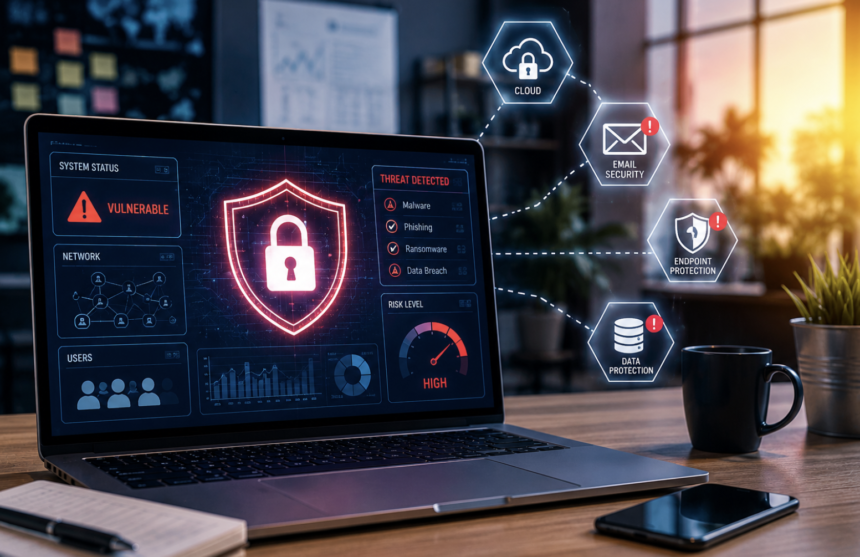
A business can look secure while remaining dangerously exposed. Security tools may run every day. Firewalls may block suspicious traffic. Employees may complete annual training. However, attackers only need one overlooked weakness to enter. Therefore, asking whether your business has avoided a breach is not enough. The better question concerns how your organization would respond after an attack begins. Modern cyber resilience focuses on preparation, detection, response, recovery, and adaptation.
Today, ransomware groups operate like businesses. Supply chains create additional entry points. Meanwhile, phishing campaigns increasingly target employees with convincing messages. As a result, organizations need more than cybersecurity products. They need measurable resilience supported by strong processes, skilled teams, and tested recovery plans.
This guide explains how to evaluate cyber resilience and uncover weaknesses before attackers exploit them.
What Does Cyber Resilience Really Mean?
Cyber resilience represents an organization’s ability to withstand and recover from cyber incidents. Traditional cybersecurity mainly focuses on preventing unauthorized access. Cyber resilience takes a broader approach. It assumes that some attacks may eventually bypass preventative controls. Therefore, businesses prepare for disruption instead of relying on prevention alone. A resilient organization can identify unusual activity quickly. It can contain damage before the situation spreads further.
Furthermore, employees understand their responsibilities during a security incident. Technical teams also know which systems require immediate attention. Business leaders need this visibility because cyber incidents can affect revenue, customers, compliance, and reputation. In simple terms, resilience asks four important questions:
- Can you anticipate threats?
- Can you withstand an attack?
- Can you recover operations quickly?
- Can you improve after every incident?
The answers reveal far more than a basic vulnerability scan.
Why Traditional Security Measures Are No Longer Enough
Many organizations still judge security through isolated measurements. They count installed security tools. They review completed audits. They examine vulnerability reports. Although these activities remain useful, they cannot reveal the entire security picture. For example, a company might have advanced endpoint protection. Yet its backup system could remain poorly protected. Another organization might have excellent monitoring. Similarly, a business could maintain strong technical controls.
Nevertheless, third-party providers might introduce unmanaged security risks. Therefore, effective resilience requires organizations to examine technology, people, processes, and external dependencies together. This broader perspective exposes weaknesses that conventional security checks often miss.
The Biggest Cyber Resilience Risks Facing Businesses
Cyber threats continue evolving quickly. Consequently, businesses must evaluate risks beyond traditional malware and network attacks.
Ransomware and Extortion Threats
Ransomware remains a serious operational threat for organizations. Attackers can encrypt systems and steal sensitive information before demanding payment.
Modern campaigns may also threaten public data exposure. Therefore, resilient businesses protect backups and regularly test restoration procedures. A backup that cannot restore critical systems provides limited protection during a crisis.
Third-Party and Supply Chain Exposure
Businesses increasingly depend on cloud platforms, vendors, contractors, and software providers. This interconnected environment creates additional security dependencies. An attacker may target a smaller supplier instead of attacking a heavily protected enterprise directly.
Consequently, organizations should evaluate supplier security controls, access permissions, data handling, and incident notification procedures.
Human Error and Social Engineering
Technology cannot eliminate every human mistake. Employees may click malicious links, approve fraudulent requests, or accidentally expose confidential information. Attackers understand this weakness and continuously improve social engineering techniques. Regular awareness training, simulated phishing exercises, strong authentication, and clear reporting procedures can reduce this exposure.
Cloud and Identity Risks
Cloud environments introduce flexibility and scalability. However, misconfigured permissions can create serious vulnerabilities. Excessive privileges also increase potential damage after account compromise. Therefore, organizations should regularly review identities, permissions, authentication methods, and privileged accounts.
How to Measure Your Current Cybersecurity Posture
Understanding your current position represents the first major step toward stronger resilience. A useful assessment should examine several interconnected areas. First, review your preventative controls. These include endpoint protection, network security, identity controls, encryption, and access management.
Next, examine detection capabilities. Determine whether your teams can identify suspicious behavior quickly. Then, evaluate response procedures. Employees should know who makes decisions during an incident. Recovery also deserves careful attention. Organizations should understand how quickly critical applications and data can return to normal operation.
Finally, examine how lessons from previous incidents influence future improvements. This approach provides a much clearer picture than checking whether individual security products are installed.
Security Benchmarking Turns Complex Findings Into Business Insight
Security benchmarking provides a structured way to measure cybersecurity maturity. Instead of focusing only on technical vulnerabilities, benchmarking evaluates broader organizational capabilities. A strong assessment can examine people, processes, technology, governance, risk management, and incident response. Organizations can also compare their capabilities against recognized frameworks. Common references include NIST CSF, ISO 27001, and the UK’s Cyber Assessment Framework. These frameworks provide useful structures for identifying weaknesses and measuring progress.
However, benchmarking should not become another compliance exercise. The real objective involves understanding which weaknesses could create meaningful business consequences. For example, a minor technical issue may deserve immediate attention if it affects a critical production system. Meanwhile, another vulnerability may carry lower business impact despite appearing technically serious. Therefore, context matters when prioritizing security improvements.
Why Cyber Risk Needs Board-Level Attention
Cybersecurity decisions increasingly affect business strategy. A major incident can interrupt operations, delay services, damage customer confidence, and create regulatory consequences. Therefore, executives need understandable security information rather than complicated technical reports. Leadership teams should know which business services face the greatest cyber risk. They should also understand recovery priorities, financial exposure, critical dependencies, and current resilience maturity. This information helps executives allocate resources more intelligently.
Additionally, clear reporting allows boards to challenge assumptions and track improvements over time. Cyber resilience becomes stronger when security decisions connect directly with business objectives.
Incident Response Should Be Tested Before an Attack
Having an incident response plan does not automatically create resilience. Teams must understand how the plan works under pressure. Tabletop exercises provide a practical way to test decision-making. During an exercise, participants can simulate scenarios such as ransomware, data theft, cloud compromise, or supplier disruption. These exercises often reveal communication problems and unclear responsibilities. They can also expose weaknesses in escalation procedures and recovery decisions.
Afterward, organizations should document lessons and assign specific improvement actions. Regular testing creates confidence because employees become familiar with their responsibilities before a real emergency occurs.
Backups Are Essential, But Recovery Matters More
Many businesses proudly maintain backups. However, the existence of backups does not guarantee successful recovery. Therefore, organizations should protect backups through appropriate isolation and access controls. Recovery tests should also verify whether systems can actually return to operational condition. Businesses need to understand recovery time objectives and recovery point objectives for critical services. These measurements help establish realistic expectations during major disruptions.
Moreover, recovery plans should prioritize essential business functions rather than restoring everything simultaneously. That approach can help organizations resume critical operations faster.
Identity Security Is a Core Part of Cyber Resilience
Compromised credentials remain a common pathway into business environments. For that reason, identity protection should form a central part of resilience planning. Multi-factor authentication can reduce the impact of stolen passwords. Least-privilege access can also limit what compromised accounts can reach.
Furthermore, organizations should monitor privileged accounts closely. Inactive accounts should receive regular reviews and appropriate removal. Access should also change when employees move roles or leave the organization. Strong identity governance reduces opportunities for attackers to move through internal systems.
How Security Leaders Can Prioritize Cyber Risks
Not every security weakness requires the same response. Effective resilience programs prioritize risks according to business impact. Critical systems should receive greater protection and monitoring. Sensitive information should also receive appropriate safeguards based on its value.
Meanwhile, high-risk weaknesses should have clear owners and realistic remediation deadlines. Risk registers can help organizations track these priorities. However, leaders should avoid creating enormous lists that nobody actively manages. A smaller number of clearly prioritized risks often produces better results. Each major risk should have an accountable owner, mitigation strategy, deadline, and measurable outcome.
What a Strong Cyber Resilience Assessment Should Include
A comprehensive assessment should examine more than technical vulnerabilities. It should review governance structures and security responsibilities. It should evaluate employee awareness and security culture. Furthermore, it should examine identity management, endpoint security, network controls, cloud configurations, and data protection. Incident detection and response capabilities should receive equal attention. Backup protection and disaster recovery procedures also require validation.
Third-party relationships should be assessed because external dependencies can create unexpected exposure. Finally, organizations should compare their current maturity with desired future capabilities. This process transforms scattered findings into a practical improvement roadmap.
Turning Assessment Results Into a Security Roadmap
First, leadership should identify the most important gaps. Next, teams should rank those gaps according to business impact and urgency. Then, organizations can assign responsibilities and establish realistic deadlines. Quick improvements should receive attention where they can significantly reduce risk.
Meanwhile, complex projects should receive proper planning and funding. Progress should also be measured regularly. For example, organizations can track improvements in detection time, recovery readiness, privileged access, employee reporting, and control maturity. Consequently, cyber resilience becomes an ongoing program rather than a one-time assessment.
The Importance of Continuous Cyber Resilience
Threats change constantly, so resilience cannot remain static. New technologies create new opportunities and new risks. Business acquisitions can introduce unfamiliar systems and security practices. Cloud migrations can change access models and data flows. Likewise, new regulations may create additional security expectations.
Therefore, organizations should reassess resilience periodically. Continuous monitoring can help identify changes between formal assessments. Security teams should also review lessons from incidents affecting their industry. This proactive approach helps businesses adapt before emerging threats become serious operational problems.
How to Strengthen Your Cyber Resilience Today
Businesses do not need to transform their entire security environment overnight. Instead, they can begin with a structured evaluation. Start by identifying critical business services and sensitive information. Then, map the systems and suppliers supporting those services.
Review identity controls and privileged access next. Afterward, test incident response and backup recovery procedures. Compare the results against recognized security frameworks. Finally, create a prioritized roadmap with measurable outcomes. Organizations seeking deeper insight can also explore professional security posture benchmarking services.
For additional cybersecurity context, businesses can review guidance on understanding your true cybersecurity posture and emerging security risks. Organizations can also consult the UK’s Cyber Assessment Framework for additional guidance.
Conclusion:
No organization can eliminate every cyber threat. However, businesses can dramatically improve how they prepare, respond, recover, and adapt. Cyber resilience provides the structure needed to manage uncertainty.
Instead of asking whether an organization has experienced an attack, leaders should ask how prepared it remains. Can critical services continue during disruption? Can teams identify suspicious activity quickly? Can executives make informed decisions under pressure? Can systems recover within acceptable timeframes? Most importantly, can the organization learn from every incident? A structured cyber resilience assessment can answer these questions with evidence.
Ultimately, resilience is not about claiming perfect security. It is about creating an organization that can withstand disruption and keep moving forward.
Frequently Asked Questions
1. What is cyber resilience?
Cyber resilience is the ability to prevent, withstand, respond to, recover from, and adapt after cyber incidents.
2. Why is cyber resilience important for businesses?
It helps organizations reduce disruption, protect critical services, recover faster, and maintain customer confidence during cyber incidents.
3. How does cyber resilience differ from cybersecurity?
Cybersecurity focuses heavily on preventing threats, while cyber resilience also emphasizes response, recovery, continuity, and adaptation.
4. What is a security benchmarking assessment?
It is a structured evaluation that measures cybersecurity maturity, risk exposure, controls, response capabilities, and improvement opportunities.
5. Which frameworks can support cyber resilience assessments?
Common frameworks include NIST CSF, ISO 27001, and the UK’s Cyber Assessment Framework.
6. How often should businesses assess cyber resilience?
Organizations should reassess resilience regularly and after major changes, incidents, acquisitions, or significant technology deployments.
7. Are cybersecurity tools enough to ensure resilience?
No, because resilience also depends on people, processes, governance, recovery capabilities, and third-party relationships.
8. Why should businesses test incident response plans?
Testing reveals communication gaps, unclear responsibilities, and recovery weaknesses before a real incident creates pressure.
9. How can businesses improve ransomware resilience?
They should protect critical backups, limit privileged access, strengthen identity security, monitor systems, and regularly test recovery procedures.
10. What role does employee training play in cyber resilience?
Training helps employees recognize threats, avoid common mistakes, and report suspicious activity before damage spreads.
11. Can small businesses benefit from cyber resilience assessments?
Yes, because smaller organizations often face significant threats while having fewer resources for detection and recovery.
12. What should happen after a resilience assessment?
Organizations should prioritize findings, assign responsible owners, establish deadlines, and track measurable improvements.
13. How does benchmarking help business leaders?
Benchmarking converts complex security findings into structured information that supports investment and risk decisions.
14. Is cyber resilience a one-time project?
No, because evolving threats, technologies, regulations, and business changes require continuous evaluation and improvement.