

Cyberattacks no longer target only large corporations or government agencies. Every connected device, cloud application, employee account, and business network has become a potential entry point for cybercriminals. As organizations embrace remote work, cloud computing, artificial intelligence, and digital collaboration, protecting valuable information has become more challenging than ever.
Modern attackers constantly develop sophisticated techniques that easily bypass outdated security tools, making traditional cybersecurity strategies increasingly ineffective. This changing landscape has made Cyber Defense Systems one of the most essential components of digital infrastructure. These intelligent security frameworks work around the clock to detect suspicious activity, prevent unauthorized access, and respond to threats before they disrupt operations. Instead of waiting for attacks to happen, advanced cyber defense focuses on prediction, prevention, continuous monitoring, and automated response.
Whether a company operates entirely in the cloud, maintains hybrid infrastructure, or manages thousands of remote employees, investing in advanced cyber defense creates a strong security foundation. Throughout this guide, you’ll discover how modern cyber defense systems work, why they outperform traditional security solutions, and how they protect cloud environments and enterprise networks against today’s evolving cyber risks.
Why Cyber Defense Systems Have Become Essential in the Digital Age
The digital transformation of businesses has introduced incredible opportunities. Companies can now serve customers globally, automate operations, and collaborate across continents in real time. However, this convenience has also expanded the number of vulnerabilities that cybercriminals can exploit. Every cloud platform, mobile device, IoT sensor, remote workstation, and software application increases the attack surface. As a result, organizations require security solutions that protect every connection rather than only defending network boundaries.
Cyber Defense Systems provide this comprehensive protection by continuously monitoring every layer of the digital environment. Instead of relying on static security rules, these systems adapt to changing threats and respond immediately whenever suspicious activity appears. Consequently, businesses reduce downtime, protect customer information, maintain regulatory compliance, and strengthen overall digital resilience.
Why Traditional Cybersecurity Solutions No Longer Meet Modern Challenges
Several years ago, installing antivirus software and configuring a firewall offered reasonable protection. Unfortunately, today’s cybercriminals use highly sophisticated techniques that easily evade these traditional defenses. Modern attacks often include:
- Advanced ransomware campaigns
- AI-powered phishing attacks
- Credential theft
- Cloud account hijacking
- Insider threats
- Supply chain compromises
- Zero-day exploits
- Fileless malware
- Multi-stage cyber intrusions
Traditional security tools mainly depend on signature-based detection. Unfortunately, they struggle against new attacks that have never been seen before. Modern Cyber Defense Systems solve this limitation through behavioral analytics, artificial intelligence, automation, and continuous monitoring rather than depending only on known malware signatures.
How Modern Cyber Defense Systems Actually Work
Cyber Defense Systems combine multiple security technologies into one intelligent ecosystem. Rather than functioning independently, every component shares threat intelligence and coordinates defensive actions automatically. This integrated approach allows organizations to detect attacks early while minimizing damage.
The core objective is simple: identify suspicious behavior, verify risks, contain threats immediately, and restore secure operations without interrupting business activities.
Artificial Intelligence Makes Threat Detection Faster Than Ever
Artificial Intelligence has transformed cybersecurity from reactive defense into proactive protection. Instead of waiting for known malware signatures, AI continuously analyzes millions of security events every second. Machine learning algorithms recognize unusual behavior that may indicate an attack long before visible damage occurs. For example, if an employee suddenly downloads thousands of confidential files at midnight from an unfamiliar country, AI immediately identifies the activity as suspicious.
Rather than depending solely on predefined rules, machine learning continuously improves as it analyzes additional network activity. Consequently, detection becomes more accurate while false alarms decrease significantly. Organizations also benefit because security analysts spend less time reviewing harmless alerts and more time investigating genuine threats.
Behavioral Analytics Detect Hidden Cyber Attacks
Many attackers successfully steal legitimate login credentials. Therefore, simply verifying usernames and passwords is no longer enough. Behavioral analytics studies how users normally interact with business systems. The system monitors:
- Login locations
- Device usage
- Access times
- File activity
- Data transfer patterns
- Application behavior
Whenever unusual behavior appears, security teams receive immediate alerts. This approach helps identify compromised accounts before attackers gain full control of business resources.
Zero Trust Architecture Has Become the New Security Standard
One of the biggest changes in cybersecurity is the widespread adoption of Zero Trust Architecture. Instead of automatically trusting users inside the network, Zero Trust assumes that every request requires verification. Every user, device, application, and network connection must continuously prove its identity before receiving access. This security model follows several important principles:
- Verify every identity.
- Limit user privileges.
- Authenticate continuously.
- Monitor every session.
- Inspect every connection.
Because trust is never assumed, attackers cannot easily move across enterprise networks even after compromising one device. This dramatically reduces the impact of security breaches.
How Cyber Defense Systems Secure Cloud Environments
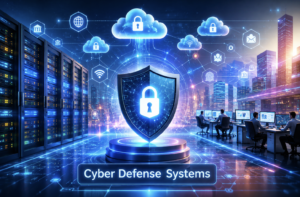
Cloud computing has transformed business operations. Organizations now store applications, customer information, financial records, and confidential documents across multiple cloud providers. Although cloud platforms provide strong infrastructure security, businesses remain responsible for protecting their own data.
Cyber Defense Systems provide several additional security layers that strengthen cloud protection.
Advanced Data Encryption Protects Sensitive Information
Encryption remains one of the strongest defenses against unauthorized access. Modern Cyber Defense Systems encrypt sensitive information while it travels across networks and while it remains stored inside cloud environments. Even if attackers intercept encrypted data, they cannot understand its contents without the proper encryption keys.
Many organizations now combine encryption with tokenization, replacing valuable information with meaningless identifiers that cannot be exploited. Together, these technologies dramatically reduce the value of stolen information.
Identity and Access Management Prevents Unauthorized Entry
Most successful cyberattacks begin with stolen credentials. Identity and Access Management (IAM) significantly reduces this risk. Modern IAM platforms enforce strict authentication before granting access to company resources. Security features often include:
- Multi-factor authentication
- Single sign-on
- Adaptive authentication
- Biometric verification
- Role-based access control
- Conditional access policies
Users receive only the permissions necessary for their responsibilities. Consequently, compromised accounts cannot access sensitive systems beyond their assigned roles.
Enterprise Network Protection Requires Multiple Security Layers
Enterprise networks have become extremely complex. A typical organization may include corporate offices, cloud servers, remote workers, mobile devices, industrial equipment, IoT sensors, and third-party vendors.
Cyber Defense Systems secure every layer through coordinated protection rather than isolated security products.
Next-Generation Firewalls Offer Intelligent Traffic Inspection
Traditional firewalls mainly block or allow traffic using predefined rules. Next-Generation Firewalls perform much deeper analysis. They inspect applications, encrypted traffic, user identities, and network behavior simultaneously. As a result, they identify sophisticated threats that older firewalls completely miss.
These intelligent firewalls can also detect command-and-control communication, advanced malware, ransomware activity, and suspicious application behavior before significant damage occurs.
Endpoint Protection Stops Threats Before They Spread
Every laptop, smartphone, desktop, tablet, and server connected to a network represents a potential attack target. Endpoint Protection Platforms continuously monitor these devices for suspicious behavior. If malware appears, the infected device can automatically isolate itself from the rest of the network. This immediate response prevents ransomware and other malicious software from spreading across the organization.
Additionally, automated patch management keeps operating systems and applications updated against newly discovered vulnerabilities.
Network Segmentation Limits the Impact of Security Breaches
No organization can guarantee perfect security. Therefore, modern Cyber Defense Systems assume breaches may eventually happen. Network segmentation divides large infrastructures into smaller security zones. If attackers compromise one section, they cannot freely access the entire enterprise.
This containment strategy significantly reduces financial losses while simplifying incident recovery.
Security Automation Accelerates Incident Response
Cyberattacks unfold within seconds. Human analysts simply cannot investigate thousands of alerts fast enough. Security automation fills this gap. Advanced Cyber Defense Systems automatically:
- Block malicious IP addresses
- Disable compromised accounts
- Isolate infected devices
- Apply security policies
- Launch investigations
- Generate compliance reports
Automation dramatically reduces response times while allowing security professionals to focus on complex investigations.
SIEM and SOAR Create a Unified Security Ecosystem
Organizations often use dozens of cybersecurity products. Without integration, security teams struggle to analyze enormous amounts of information. Security Information and Event Management (SIEM) platforms collect logs from every connected device. Meanwhile, Security Orchestration, Automation, and Response (SOAR) platforms automate incident handling. Together, they provide centralized visibility across cloud infrastructure, enterprise networks, applications, endpoints, and user accounts.
This unified approach improves efficiency while reducing security blind spots.
The Human Factor Still Determines Cybersecurity Success
Technology alone cannot eliminate cyber risks. Employees remain one of the largest cybersecurity challenges because attackers frequently exploit human mistakes. Regular cybersecurity awareness training helps employees recognize phishing emails, fake websites, malicious attachments, and social engineering attempts. Organizations should also establish clear security policies, encourage strong password practices, and regularly simulate cyberattack scenarios.
A well-trained workforce becomes an active layer of cyber defense rather than a vulnerability.
How Organizations Measure the Effectiveness of Cyber Defense Systems
Cybersecurity investments should produce measurable improvements. Organizations commonly evaluate Cyber Defense Systems using performance indicators such as Mean Time to Detect (MTTD), Mean Time to Respond (MTTR), incident recovery speed, compliance performance, vulnerability remediation rates, endpoint health, user authentication success, phishing simulation results, and overall security posture.
Monitoring these metrics helps organizations identify weaknesses while continuously improving their defensive capabilities.
Emerging Technologies Shaping the Future of Cyber Defense
Cybersecurity continues evolving as attackers develop increasingly advanced techniques. Future Cyber Defense Systems will rely even more on predictive artificial intelligence, quantum-resistant encryption, autonomous threat hunting, behavioral biometrics, decentralized identity verification, confidential computing, self-healing networks, and AI-assisted security operations. These technologies will identify potential attacks before they occur while strengthening resilience against future cyber threats.
Organizations that embrace these innovations today will remain significantly better prepared for tomorrow’s digital challenges.
Best Practices for Building a Strong Cyber Defense Strategy
Every organization should develop a cybersecurity strategy that combines technology, processes, and employee awareness. A strong security framework includes continuous monitoring, Zero Trust implementation, regular vulnerability assessments, endpoint protection, cloud security controls, automated incident response, encrypted communications, employee training, network segmentation, routine software updates, identity management, and ongoing compliance reviews. Rather than relying on a single security product, organizations should build multiple defensive layers that work together seamlessly.
This layered approach significantly improves resilience against both external attacks and insider threats.
Conclusion
Cyber threats continue evolving at an unprecedented pace, making traditional security approaches insufficient for today’s digital world. Modern Cyber Defense Systems provide intelligent, adaptive, and automated protection that secures cloud platforms, enterprise networks, remote workforces, and connected devices simultaneously.
By combining artificial intelligence, Zero Trust principles, behavioral analytics, encryption, endpoint security, network segmentation, and automated response, organizations gain the ability to detect threats earlier, contain attacks faster, and recover more efficiently. Businesses that invest in advanced cyber defense not only reduce cybersecurity risks but also build greater trust, maintain operational continuity, and create a stronger foundation for long-term digital growth.
Frequently Asked Questions
1. What are Cyber Defense Systems?
They are advanced security frameworks that detect, prevent, and respond to cyber threats across digital environments.
2. Why are traditional cybersecurity tools no longer enough?
Modern attacks easily bypass signature-based security that lacks intelligent threat detection.
3. How does Artificial Intelligence improve cybersecurity?
AI detects suspicious behavior quickly and automates threat analysis with greater accuracy.
4. What is Zero Trust Architecture?
It continuously verifies every user, device, and application before granting access.
5. Why is cloud security important?
Cloud environments store valuable business data that requires continuous protection from cyber threats.
6. What is Identity and Access Management (IAM)?
IAM controls user authentication and limits access based on approved permissions.
7. How does network segmentation improve security?
It confines cyberattacks to smaller sections of the network, reducing overall damage.
8. What role does endpoint protection play?
It monitors and secures individual devices against malware, ransomware, and unauthorized access.
9. What are SIEM and SOAR platforms?
They centralize security monitoring and automate incident detection and response.
10. Can small businesses benefit from Cyber Defense Systems?
Yes, businesses of every size need advanced protection against evolving cyber threats.
11. Why is employee cybersecurity training necessary?
Well-trained employees are less likely to fall victim to phishing and social engineering attacks.
12. How can organizations measure cybersecurity performance?
They monitor metrics such as MTTD, MTTR, compliance rates, and incident response efficiency.