


A cyberattack rarely announces itself when it begins. Instead, attackers often enter quietly and remain invisible for weeks. They exploit weak credentials, compromised devices, exposed services, or stolen access tokens. Then, they move through the environment while appearing like legitimate users. Meanwhile, security alerts may only reveal isolated warning signs.
However, those alerts rarely explain the complete attack story. This is where network forensic tools become essential. They provide security teams with deeper visibility into network communications. They also help investigators reconstruct suspicious activity after an incident occurs.
Most importantly, these tools transform scattered evidence into a readable timeline. Therefore, organizations can understand how an attack started, where it traveled, and what it affected.
What Are Network Forensic Tools?
Network forensic tools examine network communications to uncover suspicious or malicious activity. They collect traffic, analyze connections, reconstruct sessions, and identify unusual communication patterns. Unlike basic monitoring systems, network forensics focuses heavily on investigation. For example, an alert might report suspicious traffic from an internal workstation.
Network forensic analysis can reveal what happened before that connection appeared. It can also identify which systems communicated afterward. As a result, investigators gain valuable context surrounding the original alert. Network forensic tools may analyze packet captures, network flows, session metadata, DNS requests, protocols, and encrypted traffic indicators.
Furthermore, advanced platforms can connect network evidence with endpoint and identity information. This creates a broader view of the incident.
Why Network Visibility Matters During Cyberattacks
Modern networks have become increasingly complicated. Employees now connect from offices, homes, mobile devices, and public networks. Businesses also depend on cloud applications, SaaS platforms, remote services, and third-party infrastructure.
Consequently, attackers have more opportunities to hide their activities. Traditional perimeter security cannot provide complete visibility anymore. Instead, security teams must understand communication across multiple environments. Network forensic tools help provide that missing visibility. They can reveal unusual connections between internal systems. They can also identify unexpected communication with external destinations.
Therefore, investigators can detect relationships that traditional alerts might overlook.
Network Forensics Creates an Attack Timeline
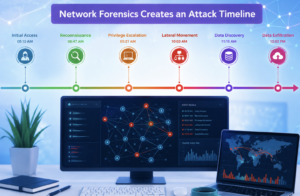
One of the biggest advantages of network forensics involves timeline reconstruction. Attackers rarely perform every action at once. Instead, they typically progress through several stages. First, they establish an initial foothold. Next, they attempt to gain additional privileges. Afterward, they search for valuable systems and information. They may then move laterally across the environment. Finally, they can attempt data theft or further disruption. Network evidence can connect these activities together.
For instance, investigators might identify an unusual login followed by internal scanning. Later, they could discover connections to a file server. Afterward, they might find unusual outbound transfers. Together, these events can expose a much clearer attack sequence.
Packet Capture Provides Deep Investigation Evidence
Packet capture remains one of the most detailed forms of network evidence. It records network packets moving through monitored locations. Security analysts can examine packet information during serious investigations. This capability becomes particularly valuable when analysts need detailed communication evidence. Packet data can help investigate malware behavior, suspicious transfers, protocol abuse, and unusual connections. However, storing complete packet data can require significant resources. Therefore, organizations should carefully determine where full packet capture provides the greatest value. Critical network segments often deserve higher collection priority.
Network Flow Analysis Finds Suspicious Communication Patterns
Flow analysis provides another useful investigation method. Instead of storing every packet, flow records summarize communication between network endpoints. These records can include source addresses, destination addresses, ports, protocols, and connection volumes.
Consequently, flow analysis requires less storage than full packet capture. It can also reveal unusual communication patterns quickly. For example, an internal device might suddenly communicate with several unfamiliar external destinations.
Similarly, one workstation could begin contacting hundreds of internal systems. Such behavior may indicate scanning, lateral movement, or compromised infrastructure. Therefore, flow analysis can help analysts identify suspicious behavior across large networks.
DNS Forensics Can Reveal Hidden Threat Activity
DNS traffic often provides valuable clues during investigations. Malware frequently needs domain names to communicate with external infrastructure. Attackers may also register domains that resemble legitimate services.
Therefore, unusual DNS activity can become an important investigation signal. Analysts can examine repeated queries, newly observed domains, unusual domain patterns, and unexpected DNS destinations. They can also compare DNS behavior with other network evidence.
For example, a workstation repeatedly contacting an unfamiliar domain deserves closer examination. If that activity follows suspicious process behavior, the investigation becomes even stronger.
Encrypted Traffic Does Not Make Forensics Impossible
Encryption creates challenges for network investigations. However, encrypted traffic still produces useful metadata. Security teams can examine connection timing, destination information, traffic volume, certificates, and communication frequency. They can also identify unusual patterns involving encrypted sessions.
For example, malware may repeatedly establish connections with the same external destination. Those connections can occur at predictable intervals. Although analysts cannot always inspect encrypted content, behavioral evidence can remain valuable. Therefore, encryption should not be treated as complete investigative blindness.
Network Forensic Tools Help Detect Lateral Movement
Attackers often move beyond their first compromised system. They may search for administrative accounts, databases, file servers, backup systems, or directory services. This movement can generate unusual network activity. For example, a workstation may suddenly communicate with multiple servers.
Likewise, a compromised account may access systems it rarely contacted previously. Network forensic analysis can connect these activities together. Consequently, investigators can determine how far an attacker traveled. They can also identify potentially compromised systems requiring immediate attention.
Detecting Data Exfiltration Through Network Evidence
Data theft represents one of the most serious consequences of cyberattacks. However, attackers do not always transfer massive amounts of information at once. They may slowly move smaller quantities of data. This approach can help them avoid obvious volume-based alerts. Network forensic tools can identify unusual outbound communication patterns. They can also compare current traffic with historical behavior.
For instance, a server that suddenly uploads unusual volumes deserves investigation. Similarly, unexpected communication with unfamiliar cloud storage destinations can raise concerns. Therefore, network evidence can help security teams investigate potential data exfiltration.
Network Forensics Supports Malware Investigation
Malware rarely operates completely independently. Many malicious programs communicate with external infrastructure. They may download additional components, receive instructions, or send collected information. Network forensic tools can investigate these communications.
Analysts can examine domains, destinations, connection frequency, protocols, and traffic patterns. They can then compare those findings with threat intelligence. This approach helps investigators understand malware behavior beyond the infected endpoint. As a result, teams can search for similar activity elsewhere.
Network Evidence Strengthens Incident Response
Incident response depends heavily on reliable evidence. Without evidence, security teams may isolate systems without understanding the complete incident. That approach can leave additional compromised systems unnoticed. Network forensic tools provide investigators with another layer of visibility. They can help determine the attacker’s entry point. They can also reveal affected systems and suspicious communications. Furthermore, network evidence can support containment decisions.
For example, analysts may discover that multiple systems communicate with the same suspicious destination. Security teams can then block that destination across appropriate controls. Therefore, network forensics can support faster and more informed response decisions.
How Network Forensic Tools Work With SIEM Platforms
Network forensic platforms become more useful when they integrate with existing security technologies. Security information and event management platforms collect information from many sources. These sources can include endpoints, authentication systems, applications, firewalls, and cloud services. Network evidence can add another important dimension.
For example, a SIEM may identify a suspicious account login. Network forensic data can reveal what that account did afterward. This correlation helps analysts move from an alert toward an investigation. Therefore, integration can reduce investigation time and improve accuracy.
The Role of Threat Intelligence in Network Forensics
Threat intelligence can make network evidence more meaningful. Security teams can compare observed destinations with known malicious infrastructure. They can also investigate suspicious domains, IP addresses, certificates, and behavioral indicators.
However, threat intelligence should support investigation rather than replace it. A destination appearing on a threat list provides an important clue. Yet analysts still need context surrounding the communication. Network forensic evidence supplies that context. Consequently, teams can make better decisions about whether activity represents a genuine threat.
Challenges Organizations Face With Network Forensics
Network forensics offers powerful visibility, but implementation requires planning. The first challenge involves data volume. Large environments can generate enormous amounts of network information. Therefore, organizations need practical collection and retention strategies. The second challenge involves encrypted traffic. Encryption can limit direct content inspection.
However, metadata and behavioral analysis can still provide valuable clues. The third challenge involves analyst expertise. Tools cannot automatically replace experienced investigation. Analysts must understand protocols, network behavior, attack techniques, and evidence relationships.
Finally, organizations must address integration. Disconnected security tools can create additional investigation delays. Therefore, network forensic platforms should fit naturally into existing security workflows.
What Features Should Network Forensic Tools Provide?
Organizations should evaluate several capabilities before selecting a platform. First, strong packet and metadata visibility remains important. Second, fast search capabilities can significantly improve investigation speed. Third, session reconstruction helps analysts understand complete communications. Fourth, protocol analysis can reveal suspicious behavior hidden inside legitimate services. Fifth, flow analysis supports large-scale behavioral monitoring. Sixth, threat intelligence integration can add valuable context.
Finally, cloud and hybrid infrastructure support has become increasingly important. A modern platform should also support automation where appropriate. Automated investigation workflows can reduce repetitive analyst tasks. However, automation should still provide transparent evidence for human review.
Network Forensics and Zero-Day Threats
Network forensics can also support investigations involving previously unknown threats. Traditional detection often depends on known signatures or indicators. Zero-day attacks may not match those known patterns. However, suspicious behavior can still appear in network communications. For example, unusual internal scanning or unexpected outbound connections can create investigation leads.
Therefore, behavioral network analysis can provide value even when signatures are unavailable. This makes network visibility especially important against evolving attack techniques.
Building a Stronger Network Forensics Strategy
Organizations should begin by identifying their most valuable assets. These assets may include databases, identity infrastructure, financial systems, and critical applications. Next, teams should identify the network segments requiring stronger visibility. They should then establish practical retention requirements. Afterward, teams can integrate network evidence with endpoint, identity, cloud, and SIEM data.
Regular investigation exercises can also improve analyst skills. Furthermore, organizations should review their collection strategy after major infrastructure changes. This keeps network visibility aligned with the changing attack surface.
The Future of Network Forensic Investigation
Network forensics continues to evolve alongside modern infrastructure. Cloud environments now generate massive amounts of distributed traffic. Remote work has also expanded the number of connections security teams must understand. Meanwhile, attackers increasingly use legitimate tools and encrypted channels.
Consequently, future network forensic platforms will need stronger behavioral analysis. Artificial intelligence can also help analysts prioritize suspicious communication patterns. Machine learning can identify unusual behavior across large datasets. However, human investigation will remain essential. Security teams still need context, judgment, and verification. Therefore, the strongest future approach will combine automation with detailed network evidence.
Conclusion: Visibility Turns Cybersecurity Clues Into Answers
Cyberattacks often leave behind evidence. The real challenge involves finding, preserving, and understanding that evidence. Network forensic tools help security teams accomplish exactly that. They reveal communication patterns that endpoint alerts may not fully explain. They also help reconstruct attack timelines and identify lateral movement.
Additionally, they support investigations involving malware, insider threats, and data exfiltration. Most importantly, network forensics changes investigations from speculation into evidence-based analysis. As networks become more distributed, visibility becomes increasingly important. Organizations that invest in stronger network evidence can investigate incidents with greater confidence.
Ultimately, attackers benefit from uncertainty. Security teams gain an advantage when they can clearly see what happened.
Frequently Asked Questions
1. What are network forensic tools?
Network forensic tools analyze network traffic and evidence to investigate suspicious or malicious activity.
2. Why are network forensic tools important?
They help security teams reconstruct attacks and understand activities that traditional alerts may not explain.
3. Can network forensics detect data exfiltration?
Yes, network analysis can identify unusual outbound traffic, destinations, volumes, and communication patterns.
4. Can network forensic tools detect lateral movement?
Yes, they can reveal unusual connections between internal systems that may indicate attacker movement.
5. Do network forensic tools work with encrypted traffic?
Yes, they can analyze metadata and behavioral patterns even when traffic content remains encrypted.
6. What is packet capture in network forensics?
Packet capture records network packets, providing detailed evidence for deeper security investigations.
7. How does flow analysis differ from packet capture?
Flow analysis summarizes communications, while packet capture provides much deeper traffic-level details.
8. Can network forensics help investigate malware?
Yes, it can reveal suspicious command-and-control communications and unusual malware-related traffic.
9. How long should network forensic data be retained?
Retention should match organizational risk, investigation requirements, regulatory needs, and available storage.
10. Does network forensics replace endpoint security?
No, network forensics complements endpoint, identity, cloud, firewall, and SIEM security technologies.
11. Can network forensics detect insider threats?
Yes, unusual internal and outbound communication patterns can provide valuable evidence during insider investigations.
12. What should organizations consider when choosing these tools?
Organizations should evaluate visibility, search speed, integrations, scalability, retention, analytics, and cloud support.