

Imagine an ordinary Tuesday morning about ten years from now. You step out of your front door and your wristband flashes a soft halo on the underside of your arm. It is a gentle reminder that your first meeting is in nine minutes and the traffic is clear. A quiet voice murmurs through bone conduction audio in your ear telling you that your coffee order is placed and ready for pickup at the corner cafe. You nod in acknowledgment and a translucent arrow only you can see hovers above the pavement steering you toward your rendezvous. No phone ever leaves your pocket because in this scenario a phone is strictly optional.
This vision is not some distant wishful science fiction story. Industry titans like Apple Google Meta Samsung and Amazon are currently channeling billions of dollars into a post smartphone ecosystem. In this new world screens shrink while sensors grow and computing power dissolves into the environment around us. The glass slab that has dominated our palms since 2007 is slowly moving toward a supporting role rather than holding the star billing. We are entering an era of digital air where the computer is something you breathe rather than something you carry.
The Smartphone Plateau Why Innovation Is Moving Outdoors
For nearly two decades smartphones have been the center of our digital universe. They merged the camera the computer and the communal lifeline into one singular device. This was a cultural earthquake. However deliveries of new models have started to flatten globally. Processor bumps now feel incremental and bezels cannot get much slimmer than they already are. Most major markets have reached a point of total penetration where everyone who wants a phone already has one.
Even the most modern hardware shows that we are reaching a physical limit. When you examine a Samsung Galaxy S26 Ultra Review Powerful Slimmer and Smarter Than Ever you realize that we are looking at the absolute peak of what a rectangle of glass can achieve. It is an incredible machine with cutting edge processing power and an elegant form factor but it still requires you to look down and away from the world. Users are no longer just chasing raw power. They are chasing frictionless interaction. The average person taps a phone over 2600 times every single day. The resulting eye strain and screen addiction headlines are pushing many to crave technology that serves quietly rather than shouting for attention.
Future Connectivity And The Next Wave Of Entry Devices
As we move toward this invisible future the transition hardware is already appearing on the horizon. We see this in the excitement surrounding the Apple iPhone 17e 2026 Expected Release Date Pricing Details Full Specifications and Latest Features. This device represents a shift toward a more efficient and connected entry point into the Apple ecosystem. It is designed to be a hub that manages your peripherals rather than just a standalone screen.
The focus is moving away from the phone as the only interface. Instead it is becoming a background processor. It handles the heavy lifting while your watch your glasses or your ear buds handle the interaction. Silicon Valley needs a fresh canvas because the handheld market is mature. They want to move the internet from your hand to your eyes and ears. This transition must be incremental because people love what they know. The iPhone 17e will likely be one of the last great bridge devices that helps us cross over into the era of ambient computing.
Wearables Strapping Computing To Your Pulse
The first major successor to the handheld throne is the wearable. The Apple Watch already proved that a heart monitor could outsell traditional Swiss timepieces. Next generation wearables aim to go much further. They will spot early illness via continuous temperature reads or coach your posture through haptic nudges on your skin. Some will even translate foreign speech in real time through ear buds.
Snapdragon chips are now bringing phone level power to tiny circuit boards while flexible batteries extend runtime beyond a single day. Right now most wearables still tether to a phone for connectivity. However tech giants are racing to invert that hierarchy. Rumored 5G bands integrated into watch straps may soon let a wearable handle calls maps and payments autonomously. This wrist first era could demote handsets to occasional content hubs. Much like laptops today complement but no longer dominate daily digital life these smaller devices will handle the micro tasks of our day.
Companion Screens The Evolution Of The Tablet
As the phone moves to the background our need for larger canvases for work and play remains. We still need surfaces for reading and designing and watching movies. This is where the debate of iPad Mini vs iPad Air Which Apple Tablet Should You Buy in 2026 becomes relevant. In a post smartphone world the tablet takes on a new meaning.
The iPad Mini is evolving into the ultimate portable controller for an ambient home or office. It is small enough to carry easily but large enough to manage complex tasks that a watch cannot handle. Meanwhile the iPad Air serves as a lightweight modular workstation for those who need more power and screen real estate. These tablets are becoming the primary screens while the smartphone becomes the invisible engine in your pocket or bag. The choice between them depends on whether you want a portable companion or a productivity powerhouse to replace your laptop.
Augmented Reality Glasses That Paint Data On The Real World
Augmented reality or AR is the true contender for the smartphone crown. Unlike virtual reality which requires total immersion AR layers snippets of information on top of what you already see. Directions notifications and even live subtitles appear as if they are floating in the air.
Hardware hurdles are finally being cracked. Early smart glasses failed because they were bulky and the batteries died too quickly. Today micro LED displays and custom silicon have shrunk the weight of these glasses below 100 grams. Eye tracking sensors let menus hover exactly where you are looking. Privacy shutters blur outward facing cameras when they are not in use which addresses the criticisms that stopped earlier attempts like Google Glass. When you can see your text messages floating in the corner of your glasses the need to pull a heavy device out of your pocket starts to vanish.
Virtual Reality When A Room Becomes The Interface
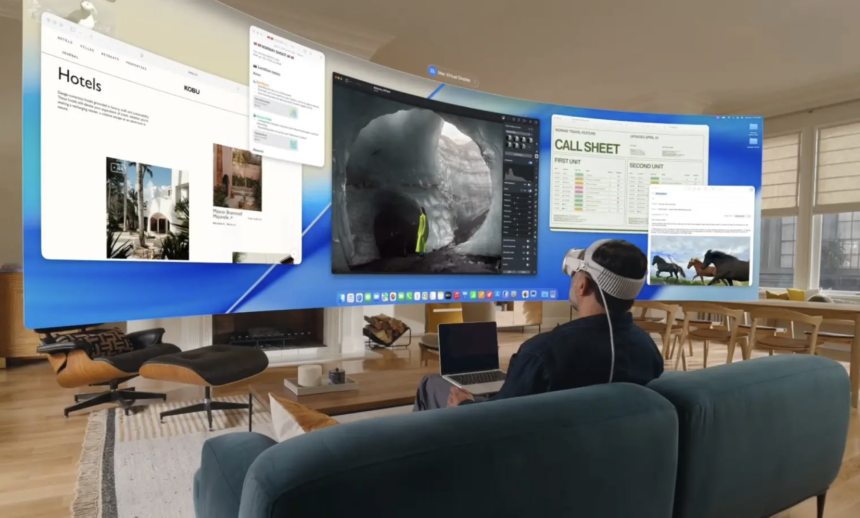
While AR is for the street VR is for the room. Virtual reality still evokes gaming first but enterprise adoption is snowballing. Architecture walk throughs and trauma therapy sessions are now happening in digital spaces. Headsets now offer laptop grade processing without any cords attached. This unlocks telepresence meetings that simulate eye contact through face tracking avatars.
Imagine a medical intern practicing surgery on a digital cadaver or a designer reviewing a life size car model in a virtual studio. For tasks that benefit from total immersion VR sidesteps the limitations of a small phone screen entirely. It turns the space around you into the interface. It allows us to travel without moving and to collaborate without being in the same building. This is a level of engagement that a six inch screen can never provide.
Ambient Computing The Computer Melts Into The Air
Ambient or ubiquitous computing is the final stage of this evolution. It involves stitching sensors and AI into our walls furniture and even city lights. Systems like Amazon Astro or Google Nest hint at environments that anticipate your needs. They might dim the lamps as you nod off to sleep or pre cool your car when your calendar shows a grocery run is next.
You will interact with these systems through gestures voice or a subtle glance rather than by unlocking a device. The smartphone as a remote control for life gives way to an orchestra of mini computers quietly reading context cues. Experts predict that the installed base of internet connected endpoints will top 40 billion within the next few years. Each one is a puzzle piece in the post phone mosaic. Your home becomes the computer and you simply live inside it.
Artificial Intelligence The Silent Conductor
Voice assistants were only the first act. Generative models and multimodal AI are the second act. Soon AI will recognize objects you point at and predict tasks based on your location and history. It will recognize that you are near a service station and ask if you want to schedule a tire rotation. It will synthesize AR overlays on the fly providing real time language subtitles floating beside the lips of a person speaking a different language.
AI reduces the friction of commands. Instead of opening six different apps to plan a trip a single sentence to an ambient agent triggers a chain of services. This conductor works in the background ensuring that your iPhone 17e or your Galaxy S26 Ultra remains in your bag while the work gets done. The intelligence is no longer inside the box it is in the network.
Barriers On The Road To A Screenless Future
Despite the excitement the transition beyond smartphones faces several major challenges.
Battery Life Micro devices still rely on the limits of lithium. We need solid state breakthroughs or wireless over the air charging to truly tip the scales.
Comfort and Style Wearable face computers must look like fashion accessories not lab goggles to win over the general public.
Privacy More sensors mean more data. Regulators and companies must guarantee that data processing happens on the device and that users have granular control over their permissions.
Ecosystem Lock In If your smart glasses only work with one brand of cloud storage consumer choice will shrink. Cross platform standards will be the deciding factor.
Habit Inertia People love what they already know. The transition must be incremental. We see this with AirPods easing us into voice first interactions rather than a sudden phone funeral.
How The Post Smartphone World Changes Daily Life
The impact on our work life will be massive. Holographic screens will float over any desk. Team brainstorms will happen in mixed reality rooms where sticky notes are pixels instead of paper. Productivity will shift from asking where is my device to asking which surface shall I use.
Socially the change is even more profound. Instead of doom scrolling through feeds friends will appear as lifelike mini avatars on your coffee table for a quick catch up. Spatial audio will mimic real conversation and the nuance of human interaction will revive as screen fatigue plummets.
In terms of health and fitness continuous monitoring will be integrated into our clothing. Preventive care will replace many reactive doctor visits which could save billions in global healthcare costs. Even travel will change. Airport signage will translate automatically before you even blink. Rental cars will recognize your face adjust the seat and stream your playlist without you ever touching a Bluetooth menu.
Tech Titan Playbooks Same Goal Different Routes
Each company is taking a unique path toward this screenless future. Apple is betting on tight vertical integration where your watch pods and glasses all work under one chip family and a unified privacy brand. Google is wielding the power of Android Everywhere trying to fuse search and maps into everything from Pixel wearables to autonomous cars.
Meta is doubling down on social presence and avatars trying to turn social networking into a spatial network. Samsung is leveraging its lead in flexible displays and battery technology to blur the boundaries between the phone the tablet and the watch. Amazon is flooding our homes with cost effective gadgets banking on Alexa as the ambient operating system. While their hardware differs their mission is the same: loosen the smartphone monopoly on human attention.
Final Thoughts Prepare For The Era Of Digital Air
The future beyond smartphones is not about swapping one shiny gadget for another. It is about diffusing intelligence into every object and every moment of our lives. When a watch can detect your stress and dim the house lights or glasses can translate a street sign instantly technology stops being a demanding toddler and becomes an unobtrusive concierge.
For consumers the best move right now is curiosity. Try out a fitness tracker or experiment with smart home lighting. Each new experience chips away at our phone dependence and nudges our habits toward the next paradigm. For businesses the goal is clear. You must design services that can roam across eyes ears wrists and walls rather than just living on a six inch screen.
The glass rectangle will still be in our pockets for a few more years but its reign as the supreme gatekeeper is coming to a close. The age of digital air where computing is something you barely notice yet endlessly benefit from is ready to breathe new life into how we work heal and connect. Whether you are choosing between an iPad Mini and an iPad Air or waiting for the newest iPhone or Samsung flagship remember that these are just steps toward a much larger and more invisible future. Technology is finally learning to disappear.
Frequently Asked Questions
Will smartphones disappear completely in the next ten years?
It is very unlikely they will vanish entirely. They will remain as high resolution media viewers and portable powerhouses for complex tasks. However the daily micro tasks we perform will migrate to wearables and ambient systems.
Are smart glasses safe for long term use?
Manufacturers are now using low brightness high contrast micro LEDs that are positioned away from direct pupil alignment to reduce strain. While clinical studies are ongoing the technology is designed to be much safer than earlier prototypes.
How soon can I replace my phone with a watch?
Standalone cellular watches already exist but mass adoption is waiting for better battery life and more robust apps. Analysts expect this transition to accelerate in the late 2020s.
Is my data more vulnerable in an ambient world?
Edge computing ensures that a lot of the data processing stays on the actual device rather than being sent to the cloud. Still users must demand transparent privacy dashboards and end to end encryption on all hardware.
Will older generations be able to use this tech?
Voice and gesture interactions are often more natural than navigating small icons on a screen. This can actually improve accessibility for older users as long as the design remains intuitive and simple.