

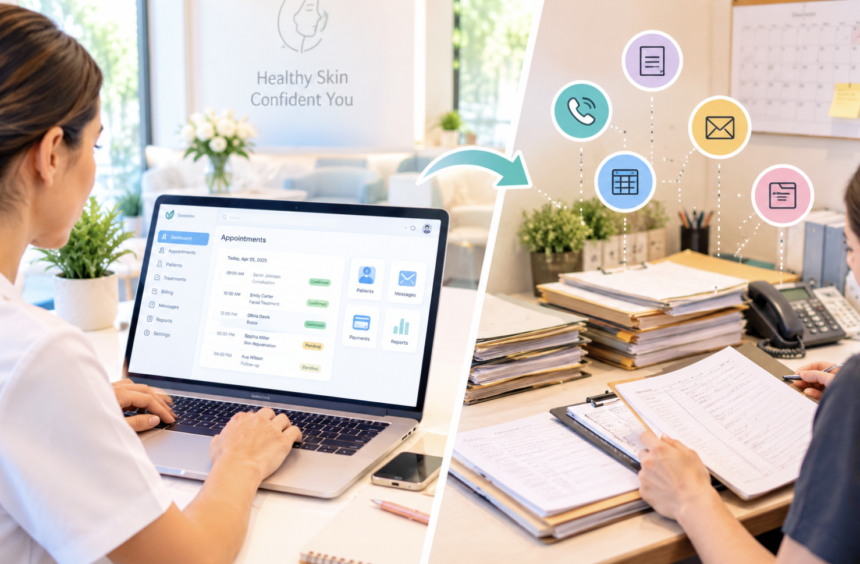
Aesthetic clinics compete on more than treatments and technology. They compete on speed, convenience, trust, and memorable patient experiences. However, many practices still manage daily operations with disconnected tools and manual processes. That approach may appear manageable at first. Yet, growing patient volumes can quickly expose its weaknesses. Meanwhile, Aesthetic Practice Management Software is changing how modern clinics handle their operations. It connects appointments, patient records, payments, communications, reporting, and administrative workflows.
As a result, teams can spend less time managing paperwork and more time serving patients. But does modern software always outperform traditional practice systems?
The answer depends on how efficiently each system handles everyday challenges. Therefore, comparing their capabilities can help clinic owners make a smarter technology decision.
What Is Aesthetic Practice Management Software?
Aesthetic Practice Management Software provides a centralized platform for managing clinic operations. It brings multiple administrative functions into one connected environment. For example, teams can manage appointments, patient profiles, treatment information, payments, reminders, and communications from one system. Moreover, specialized platforms often support aesthetic-specific workflows. These may include treatment tracking, consultation management, before-and-after photographs, consent documentation, and practitioner scheduling.
Consequently, staff members can access relevant information without searching through multiple systems. Modern software can also support automated workflows. For instance, the platform can send appointment reminders before scheduled visits.
It can also trigger follow-up communications after treatments. Therefore, employees spend less time completing repetitive administrative tasks. Most importantly, centralized information can improve operational visibility. Managers can monitor appointments, revenue, cancellations, treatment activity, and other important metrics.
Why Traditional Practice Systems Still Remain Popular
Traditional practice systems have not disappeared completely. Many clinics continue using spreadsheets, paper records, standalone calendars, email, and separate payment tools. These methods can work for smaller practices with limited operational complexity. Furthermore, employees may already understand these processes. Therefore, switching systems can initially seem unnecessary.
However, traditional systems often depend heavily on manual coordination. A receptionist might maintain appointments in one application. Another employee may update patient information elsewhere. Meanwhile, financial records could remain inside a separate accounting system.
This separation creates information gaps. It can also force employees to repeatedly enter the same information. As patient numbers increase, these limitations become more noticeable. Consequently, a system that once seemed convenient can become an operational bottleneck.
Centralized Patient Management Creates a Major Advantage
Patient information represents one of the most valuable resources inside an aesthetic clinic. Modern software can centralize essential patient information within one secure platform. Staff can potentially access consultation details, treatment histories, appointment information, and relevant notes from a unified record.
As a result, employees spend less time searching for information. Practitioners can also review patient histories more efficiently before consultations. Additionally, centralized records can reduce duplicate data entry.
Traditional systems often require staff to transfer information between separate documents or applications. Every manual transfer creates another opportunity for mistakes. By contrast, integrated systems can connect information across different workflows. Therefore, centralized patient management can improve both efficiency and consistency.
Online Scheduling Can Transform the Patient Journey
Appointment scheduling remains one of the most time-consuming administrative responsibilities. Traditional systems often require patients to call or message the clinic. Staff members then check availability and manually confirm appointments. This process can create unnecessary delays.
Modern practice management platforms can provide online booking capabilities. Patients can select available services and appointment times without contacting reception. Furthermore, automated scheduling can reduce back-and-forth communication. Patients receive faster confirmation, while employees gain valuable time.
Online booking can also operate outside normal clinic hours. Consequently, potential patients can request appointments when the reception desk is closed. That convenience can create a smoother patient experience.
Automated Reminders Help Reduce Missed Appointments
No-shows can negatively affect clinic productivity and revenue. Traditional systems often rely on employees to remember and send appointment reminders manually. That process consumes valuable staff time.
Modern software can automate reminders through supported communication channels. Patients may receive notifications before their scheduled appointments. Some systems can also support confirmation or rescheduling workflows.
As a result, staff can focus on higher-value responsibilities. Furthermore, automated communication creates a more consistent patient experience. Instead of relying on individual employees, the system follows predefined workflows. That consistency becomes particularly useful as a clinic grows.
Billing and Payments Become Easier to Manage
Financial administration can become complicated when clinics use disconnected systems. Staff may need to create invoices manually and reconcile payments separately. Meanwhile, practitioners may need additional reports to understand financial performance. Integrated practice management software can connect your billing software with appointments and patient records.
Therefore, employees can reduce repetitive data entry. The system may also provide clearer visibility into payments, outstanding balances, and transaction activity. Additionally, centralized financial information can simplify reporting.
Managers can use these insights to identify revenue patterns and operational opportunities. Traditional systems can still support financial management. However, they often require more manual coordination between separate tools.
Treatment Planning and Documentation Support Better Organization
Aesthetic treatments often involve multiple consultations and follow-up appointments. Patients may also receive different procedures over extended periods. Therefore, maintaining an accurate treatment history becomes increasingly important.
Specialized software can organize treatment plans, consultation notes, photographs, and related documentation. Practitioners can review previous information before discussing future treatments. This organization can support more personalized consultations.
Furthermore, staff can reduce the risk of overlooking important administrative details. Traditional systems may store these records across folders, paper files, or unrelated applications. Consequently, retrieving complete patient histories can take longer.
Before-and-After Images Can Strengthen Treatment Tracking
Visual documentation plays an important role in many aesthetic practices. Clinics frequently use before-and-after photographs to track treatment progress and support consultations.
Specialized software can organize these images alongside relevant patient records. This arrangement can make historical comparisons easier. Additionally, organized photography workflows can reduce confusion between files.
However, clinics should always follow applicable privacy, consent, security, and data-retention requirements. Technology should simplify documentation without compromising patient confidentiality.
Inventory Management Adds Another Layer of Efficiency
Inventory management often receives less attention than scheduling or billing. Nevertheless, clinics rely on products, consumables, devices, and treatment supplies every day. Traditional tracking methods can involve spreadsheets or manual stock counts. These approaches can become difficult as inventory expands.
Practice management software may provide inventory monitoring and usage tracking. Consequently, clinics can gain better visibility into available supplies. Managers can also identify frequently used products and potential shortages.
This information supports more informed purchasing decisions. Ultimately, better inventory control can reduce waste and prevent avoidable disruptions.
Staff Scheduling Becomes More Organized
Aesthetic clinics may employ multiple practitioners, nurses, receptionists, and support staff. Coordinating everyone manually can become increasingly challenging. Modern software can connect staff schedules with appointment calendars.
Therefore, employees can identify availability more quickly. The system can also help prevent scheduling conflicts. For example, a treatment requiring specific equipment or practitioner expertise can be assigned appropriately.
Traditional calendars may require staff members to cross-check several schedules. That process creates unnecessary administrative work. Integrated scheduling reduces those steps and supports smoother daily operations.
Better Reporting Supports Smarter Business Decisions
Running an aesthetic clinic requires more than managing appointments. Owners need to understand which services perform well and where operational problems exist. Modern practice management software can provide dashboards and reports. These reports may cover appointment activity, cancellations, revenue, patient retention, treatment demand, and staff performance.
Consequently, managers can make decisions using operational data. Traditional systems can also generate reports. However, employees may need to collect information manually from multiple sources.
That process can take significant time. Furthermore, manual reporting increases the possibility of inconsistent information. Integrated reporting provides a more connected view of clinic performance.
Patient Communication Becomes More Consistent
Patients expect quick and professional communication from modern healthcare businesses. Delayed responses can create frustration and weaken the overall patient experience. Aesthetic practice software can support automated and personalized communication. Clinics can send appointment confirmations, reminders, follow-up messages, and other relevant notifications.
Moreover, centralized communication can reduce information gaps between departments. Patients receive more consistent interactions throughout their journey. Traditional systems often depend heavily on individual employees.
Therefore, communication quality may vary depending on workload and availability. Automation creates greater consistency without eliminating the human element.
Marketing Integration Can Support Patient Retention
A modern aesthetic clinic needs more than new patient acquisition. It must also encourage existing patients to return. Practice management systems can provide useful information about appointment history and treatment preferences. Clinics can use appropriate data to create more relevant engagement strategies.
For example, follow-up communications can encourage patients to schedule recommended consultations. Additionally, businesses can identify inactive patients and develop suitable re-engagement campaigns.
However, marketing communications should always respect applicable privacy and consent requirements. Traditional systems may provide limited visibility into patient engagement patterns. Therefore, integrated software can offer stronger opportunities for relationship management.
Security and Access Control Matter More Than Ever
Patient information requires careful protection. Traditional paper-based systems can create physical security risks. Meanwhile, scattered digital files can become difficult to manage consistently. Modern software may provide controlled user access, authentication features, backups, audit trails, and other security capabilities.
These tools can help clinics manage information more systematically. However, software alone does not guarantee complete security. Clinics must also establish strong internal policies.
Employees need appropriate training and access permissions. Regular updates and secure passwords also remain essential. Therefore, technology and responsible management should work together.
Scalability Separates Growing Clinics From Struggling Ones
A system that works for ten appointments daily may struggle with fifty. Growth introduces additional practitioners, patients, locations, treatments, and administrative responsibilities. Traditional systems often require more manual work as complexity increases.
Consequently, businesses may need additional spreadsheets and disconnected applications. Modern practice management software can scale workflows more efficiently. Many platforms support multiple users, locations, services, and operational processes.
Therefore, clinics can expand without completely rebuilding their administrative infrastructure. Scalability becomes especially important for businesses planning rapid growth.
Traditional Systems May Still Make Sense in Certain Situations
Modern software offers substantial advantages. However, traditional systems are not automatically wrong for every clinic. A small practice with minimal appointments may manage effectively with simpler tools. Furthermore, businesses with highly customized legacy workflows may hesitate to change immediately. Budget considerations can also influence technology decisions.
However, clinics should calculate the total operational cost rather than focusing only on subscription fees. Manual work consumes employee time. Errors create additional costs.
Missed appointments can reduce revenue. Disconnected systems can also slow decision-making. Therefore, the cheapest system initially may not remain the most economical option long term.
The Real Cost of Manual Administration
Manual administration often hides behind ordinary daily activities. An employee may spend several minutes confirming appointments. Another employee might transfer patient information between systems. Someone else may prepare reports manually.
Individually, these tasks appear insignificant. Collectively, they can consume hundreds of hours each year. Modern automation reduces repetitive administrative work.
Consequently, employees can redirect their time toward patient service and revenue-generating activities. This shift can create meaningful operational improvements without necessarily increasing staff numbers.
Which System Improves Aesthetic Clinic Efficiency More?
For most growing aesthetic practices, integrated management software provides the stronger efficiency advantage. It connects essential workflows and reduces unnecessary manual processes. Moreover, it improves visibility across appointments, patients, payments, staff, and business performance. Traditional systems remain useful for very small or simple operations.
However, their limitations become increasingly apparent as the practice grows. Therefore, the better choice depends on operational complexity, growth plans, budget, and workflow requirements. Clinics should evaluate their current processes before choosing a platform.
They should identify repetitive tasks, information gaps, scheduling problems, reporting challenges, and communication delays. Then, they can compare software features against those specific problems.
How to Choose the Right Aesthetic Practice Management Software
Choosing software requires more than comparing feature lists. First, identify the workflows that consume the most employee time. Next, determine which processes need automation. Then, evaluate scheduling, patient management, billing, communication, reporting, security, and integration capabilities. Ease of use should also receive serious attention. A powerful system becomes less valuable when employees struggle to use it.
Furthermore, clinics should investigate training and customer support options. Data migration also deserves consideration when replacing an existing system.
Finally, review pricing alongside long-term scalability. The ideal solution should support today’s requirements while accommodating tomorrow’s growth.
The Future of Aesthetic Practice Management
Aesthetic clinics are becoming increasingly digital. Patients expect convenient booking, fast communication, personalized experiences, and efficient service. At the same time, clinic owners need stronger operational control. Therefore, practice management technology will continue playing an important role.
Future systems will likely place greater emphasis on automation, analytics, artificial intelligence, integrations, and personalized patient experiences. These developments can help practices reduce administrative friction. They can also provide deeper insights into business performance.
However, successful technology adoption will still depend on people. Clinics need well-designed workflows, trained employees, clear policies, and responsible data management. Technology works best when it supports a strong operational strategy.
Conclusion: Efficiency Starts With the Right System
The comparison between Aesthetic Practice Management Software and traditional practice systems reveals a clear operational difference. Traditional systems provide familiarity and simplicity. However, they often depend on manual processes and disconnected information. Modern software brings essential clinic operations into a more centralized environment. It can streamline scheduling, patient records, billing, communication, reporting, inventory, and staff coordination.
Furthermore, automation can reduce repetitive work while improving consistency. For growing aesthetic clinics, these benefits can translate into better productivity and smoother patient experiences. The smartest decision involves evaluating current problems rather than simply following technology trends.
When a clinic needs stronger integration, automation, scalability, and visibility, modern practice management software can provide a significant advantage. Ultimately, efficient technology does more than organize administrative tasks. It gives aesthetic practices more time to focus on what matters most: delivering exceptional patient care and building lasting relationships.
FAQ’s
1. What is Aesthetic Practice Management Software?
Aesthetic Practice Management Software centralizes scheduling, patient records, billing, communication, and other clinic operations.
2. Is practice management software better than traditional systems?
For growing clinics, integrated software usually provides greater efficiency and automation than traditional systems.
3. Can software reduce appointment no-shows?
Automated reminders and confirmations can help clinics reduce missed appointments and improve schedule utilization.
4. Does aesthetic software support online booking?
Many modern platforms provide online booking features that allow patients to request appointments without calling reception.
5. Can practice software manage patient records?
Yes, many platforms organize patient information, treatment histories, consultation notes, and related documentation.
6. Does aesthetic software help with billing?
Integrated billing features can simplify invoices, payment tracking, financial records, and reporting.
7. Can software improve patient communication?
Automated confirmations, reminders, follow-ups, and notifications can make patient communication more consistent.
8. Is traditional practice management still useful?
Traditional systems can remain suitable for small clinics with simple workflows and limited operational complexity.
9. Can aesthetic software manage multiple practitioners?
Many platforms can coordinate practitioner schedules, appointments, services, and availability within one system.
10. Does practice management software improve clinic growth?
Scalable software can support growth by reducing administrative workloads and improving operational visibility.
11. Is patient data secure in practice management software?
Security depends on the platform and clinic practices, including access controls, authentication, backups, and compliance procedures.
12. How should a clinic choose management software?
Clinics should compare workflow needs, automation, usability, integrations, security, support, scalability, and total costs.
13. Can software manage inventory?
Some aesthetic platforms include inventory tools for monitoring supplies, product usage, and stock levels.
14. Does software help with patient retention?
Centralized patient information can support timely follow-ups and more personalized engagement strategies.
15. What is the biggest benefit of practice management software?
Its biggest advantage is connecting multiple clinic workflows into one system while reducing repetitive administrative work.