
Marketing is no longer a simple race for attention. Today, brands compete for relevance, speed, consistency, and customer trust. Meanwhile, audiences expect personalized experiences across every digital channel. That pressure creates a serious challenge for marketing teams. They must produce more content while maintaining quality and protecting their brand identity. This is where Flow AI and AI marketing are changing the game.
Instead of treating artificial intelligence as another isolated software tool, marketers can connect intelligent systems across their entire creative workflow. Consequently, one idea can move from research to strategy, content creation, optimization, and distribution with far less manual effort.
Modern platforms such as Flowvideo.ai demonstrate how AI can bring creative production and workflow automation closer together. Therefore, marketing teams can spend less time managing repetitive tasks and more time developing ideas that genuinely connect with customers.
What Is Flow AI in Modern Marketing?
Flow AI refers to using artificial intelligence across connected marketing processes. Rather than automating one isolated task, it creates a continuous workflow between multiple activities. For example, a marketer may begin with a campaign concept. AI can then help transform that concept into a script, visual content, voiceover, social post, and promotional video.
Afterward, the system can support optimization for different platforms. This approach reduces unnecessary handoffs between separate applications. Traditional marketing workflows often involve multiple disconnected tools. A team might write copy in one application, design visuals elsewhere, edit videos separately, and analyze performance on another platform.
Flow AI aims to connect those stages. As a result, marketers gain a smoother content pipeline. They can also reduce repetitive work that previously consumed valuable creative hours.
Why AI Marketing Is Moving Beyond Simple Automation
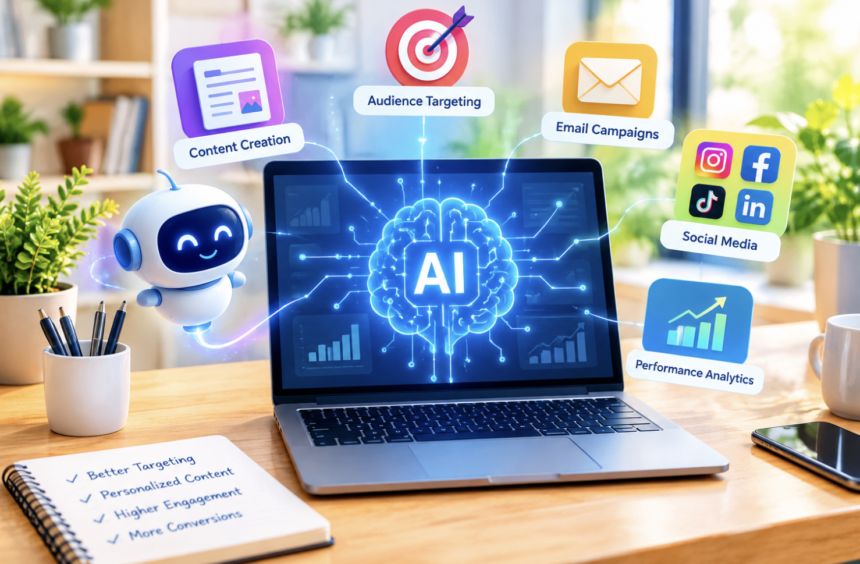
AI marketing has evolved significantly in recent years. Earlier automation focused mainly on repetitive activities such as scheduling emails or publishing social posts. Modern AI can support much more complex processes. For instance, intelligent systems can analyze customer behavior, identify content opportunities, generate creative concepts, personalize messaging, and assist with campaign optimization.
Furthermore, AI can recognize patterns across large amounts of information much faster than humans can. However, successful AI marketing does not remove human creativity. Instead, it gives marketers more time to use their judgment.
Human teams still define brand personality, campaign objectives, emotional direction, and ethical boundaries. AI then helps execute and refine those decisions at greater speed.
How Intelligent Marketing Workflows Actually Work
An effective AI workflow begins with a clear objective. Suppose a company wants to promote a new product. The marketing team can define its audience, campaign message, desired platforms, and expected outcome. Next, AI can support research and content planning. It may suggest topics, content formats, customer segments, and creative angles. The workflow can then move toward production.
AI-assisted tools can help create scripts, images, videos, captions, voiceovers, and supporting assets. Afterward, marketers can review and refine those materials before publishing. Finally, performance data can inform future campaigns. This creates a continuous marketing loop:
Research -> Strategy -> Creation -> Distribution -> Measurement -> Optimization
Therefore, every campaign can contribute insights to the next one.
Major Benefits of AI Marketing Workflows
1. Faster Content Production
Speed has become a major competitive advantage. AI can accelerate tasks that traditionally require hours of manual work. Consequently, marketing teams can respond to trends and opportunities much faster.
A campaign concept can become a collection of digital assets within a significantly shorter timeframe. However, speed should never replace quality control. Human review remains essential before publishing customer-facing content.
2. Stronger Brand Consistency
Large marketing teams often struggle with inconsistent messaging. Different writers may use different tones. Designers may interpret visual guidelines differently. Social teams may also create messages that feel disconnected. AI workflows can help maintain predefined brand guidelines.
Marketers can establish preferred language, tone, visual direction, terminology, and communication standards. These guidelines can then influence future content creation. As a result, customers receive a more recognizable brand experience across multiple channels.
3. Personalized Customer Experiences
Personalization is another major opportunity. Customers increasingly expect brands to understand their interests and needs. AI can help marketers organize audiences according to behavior, preferences, engagement, or purchasing patterns.
For example, different customer segments can receive different creative messages. However, personalization should remain useful rather than intrusive. Brands must respect privacy expectations and applicable data regulations.
4. Lower Production Friction
Marketing teams often lose time switching between applications. One tool handles writing. Another manages graphics. A third supports video editing. Additional platforms handle audio and analytics.
Connected AI workflows can reduce this friction. When multiple creative tasks exist within a more unified process, teams can move between stages more efficiently.
5. Better Marketing Scalability
A small team cannot always produce the same volume as a large department. AI can narrow that gap.
Marketers can create multiple variations of campaign assets without manually producing every version from scratch. Consequently, smaller teams can experiment with more ideas. This scalability becomes especially valuable when businesses operate across several platforms and markets.
AI-Powered Content Creation Is Changing the Creative Process
Content creation represents one of the strongest applications of AI marketing. Previously, producing a promotional video could require writers, designers, editors, voice artists, and other specialists. Today, AI-assisted platforms can support several stages of that process.
A marketer can start with a concept and develop a script. Then, visual assets can complement the message. Voiceovers and background audio can further improve the final production.
However, AI-generated content still benefits from human direction. The strongest results usually come from combining machine efficiency with human storytelling. AI can produce possibilities quickly. Humans decide which possibilities deserve attention.
The Role of AI in Marketing Personalization
Personalization goes beyond adding someone’s name to an email. Modern personalization can involve different messages, visuals, offers, and content formats for different audience groups. AI can help identify these differences.
For example, a returning customer may receive content focused on advanced product features. Meanwhile, a first-time visitor may receive educational information.
Therefore, AI marketing can help brands create more relevant customer journeys. Nevertheless, marketers should avoid excessive automation. Customers still value authentic communication and meaningful interactions.
Using AI for Marketing Analytics and Optimization
Marketing does not end when content goes live. Teams need to understand what happened afterward. AI can help marketers evaluate engagement patterns, conversion behavior, audience responses, and campaign performance.
Instead of examining every metric manually, marketers can use intelligent analysis to identify important trends. For example, a system may highlight that one video format generates stronger engagement than another.
Marketers can then adjust future campaigns accordingly. This creates an important advantage: AI marketing becomes a learning system rather than a simple production system.
How Flow AI Can Improve Social Media Marketing
Social Media Marketing requires constant content production. Every platform has different audience expectations, formats, dimensions, and communication styles. An AI-powered workflow can help adapt one campaign idea into several platform-specific assets. A single creative concept could become a short video, social graphic, caption, story, and promotional snippet.
Therefore, teams can maintain campaign consistency without copying identical content everywhere. AI can also help generate variations for testing. Marketers can compare different hooks, messages, visuals, and calls to action. This supports faster experimentation.
AI Marketing for Email Campaigns
Email marketing also benefits from intelligent workflows. AI can assist with subject lines, content variations, audience segmentation, visuals, and personalization.
For example, a campaign can use different messaging for prospects and existing customers. AI can also help marketers test multiple creative approaches.
However, marketers should focus on relevance instead of producing excessive emails. Quality communication remains more valuable than unnecessary volume.
AI Marketing for Product Launches
Product launches require coordinated communication. A business may need landing-page copy, promotional videos, social content, email campaigns, advertisements, and supporting graphics. Without an organized workflow, these assets can become inconsistent. Flow AI can help connect the production process.
The same campaign strategy can guide different creative formats. Consequently, every marketing channel can communicate a unified message. This consistency can make product launches feel more organized and professional.
How to Build a Successful AI Marketing Workflow
Start With a Clear Marketing Goal
Do not begin with technology. First, identify the business objective. You may want more leads, stronger engagement, higher conversions, or better customer retention. A clear goal gives AI a useful direction.
Identify Repetitive Tasks
Next, examine your current workflow. Find tasks that consume time without requiring significant strategic judgment. These may include resizing content, creating variations, organizing assets, drafting repetitive copy, or preparing platform-specific formats. Those tasks often provide good opportunities for AI assistance.
Create Strong Brand Guidelines
AI performs more effectively when marketers provide clear instructions. Define your brand voice, audience, visual identity, terminology, and communication style. These guidelines help reduce inconsistent outputs.
Keep Humans in the Approval Process
Automation should not mean publishing everything automatically. Human review remains important for accuracy, originality, brand alignment, and sensitive messaging. Therefore, build approval checkpoints into your workflow.
Measure Results Continuously
Finally, measure the impact. Track production time, engagement, conversions, content performance, and campaign efficiency. Then use those insights to improve future workflows.
Common Mistakes to Avoid With AI Marketing
AI marketing can deliver impressive results, but poor implementation creates problems. One common mistake involves automating everything immediately. Instead, teams should start with a manageable workflow and expand gradually.
Another mistake involves publishing AI-generated content without review. AI can produce inaccurate, repetitive, or unsuitable material. Furthermore, brands should avoid relying on generic prompts. Specific instructions usually produce more useful outputs.
Finally, marketers should not measure success through content volume alone. More content does not automatically mean better marketing. The real objective remains meaningful business results.
The Future of Flow AI and AI Marketing
The future of marketing will likely involve increasingly connected AI systems. Instead of using separate tools for isolated activities, businesses will build intelligent ecosystems around their marketing operations. In this evolving landscape, a marketing analyst will play an important role in analyzing audience behavior, measuring campaign performance, and guiding social media strategies. Social media also requires constant content production, with every platform having different audience expectations, formats, dimensions, and communication styles.
Consequently, marketing workflows could become increasingly adaptive. A campaign may automatically identify strong-performing content and recommend new creative directions. Teams could then approve those recommendations and launch improved variations.
However, human creativity will remain important. Technology can accelerate production, but strategy gives marketing its purpose. The brands that succeed will likely combine both strengths.
Conclusion: Turning Marketing Workflows Into Intelligent Systems
Flow AI represents a major shift in how businesses approach marketing operations. Instead of treating artificial intelligence as another isolated tool, companies can connect AI across research, strategy, creation, distribution, and analysis. That approach can reduce repetitive work while improving speed, consistency, scalability, and experimentation.
Moreover, platforms such as Flowvideo.ai show how AI-assisted video, image, audio, and strategic workflows can support modern content teams. The real opportunity is not simply creating more content. It is creating better marketing systems.
When automation handles repetitive production and humans guide strategy, brands can move faster without losing their creative identity. Ultimately, the smartest AI marketing workflow is not the one that removes people. It is the one that gives talented people more time to think, create, experiment, and connect with their audiences.
FAQ’s
1. What is Flow AI in marketing?
Flow AI connects multiple marketing tasks through intelligent automation and AI-powered workflows.
2. How does AI improve marketing workflows?
AI reduces repetitive work while helping teams create, personalize, analyze, and optimize marketing content faster.
3. Can AI replace marketing teams?
AI can automate tasks, but human strategy, creativity, judgment, and brand leadership remain essential.
4. What types of content can AI marketing create?
AI can assist with videos, images, captions, scripts, emails, advertisements, audio, and other marketing assets.
5. Is Flow AI useful for small businesses?
Yes, small teams can use AI workflows to increase content output without proportionally increasing production resources.
6. How does AI support social media marketing?
AI can help marketers create platform-specific content variations while maintaining consistent campaign messaging.
7. Can AI personalize marketing campaigns?
Yes, AI can support personalized content by analyzing audience characteristics, behavior, and engagement patterns.
8. Why is human review important in AI marketing?
Human review helps maintain accuracy, originality, brand consistency, and appropriate communication.
9. How should businesses start using AI marketing?
Businesses should begin with one repetitive workflow, measure its results, and expand gradually.
10. What is the future of AI marketing?
AI marketing will increasingly connect strategy, content creation, personalization, distribution, analytics, and optimization.