
Quantum computing regularly appears in technology headlines with dramatic claims about revolutionising everything from medicine to cryptography, yet the actual underlying concept remains genuinely confusing for most people outside specialised physics and computer science fields. Understanding what quantum computing actually involves, and why it genuinely differs from the computers we use every day, helps cut through the hype to understand its real, significant potential.
What Makes Quantum Computing Fundamentally Different
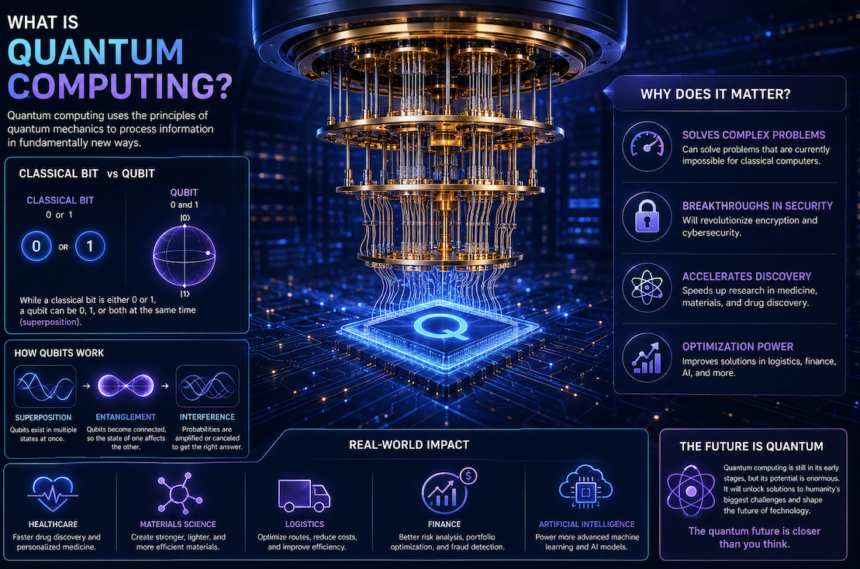
Traditional computers, including the one you are likely using right now, process information using bits, which exist in one of two definite states, either a zero or a one, at any given moment. Every calculation your computer performs, no matter how complex, ultimately breaks down into countless operations on these simple binary values.
Quantum computers use something fundamentally different called quantum bits, or qubits, which take advantage of genuine quantum mechanical properties, allowing them to exist in a combination of both states simultaneously, a phenomenon called superposition. This is not simply a faster or more efficient version of traditional computing, but a fundamentally different approach to processing information altogether.
Understanding Superposition and Why It Matters
Superposition represents one of the genuinely strange, counterintuitive properties of quantum mechanics that quantum computing specifically harnesses for computational advantage, and grasping even a basic understanding of this concept helps explain why quantum computers hold such significant theoretical potential.
- A traditional bit exists in one definite state, either zero or one, at any given moment
- A qubit can exist in a superposition, representing a combination of both zero and one simultaneously
- This allows a quantum computer to explore multiple possible solutions to a problem simultaneously
- As more qubits work together, this potential for parallel exploration grows exponentially rather than linearly
This exponential growth in computational possibility is precisely what gives quantum computers their theoretical advantage for certain specific types of problems, since a sufficiently powerful quantum computer could explore an enormous number of possible solutions simultaneously, rather than needing to check each possibility one at a time the way a traditional computer must.
Another Key Quantum Property: Entanglement
Beyond superposition, quantum computing also relies on another genuinely strange quantum property called entanglement, where two or more qubits become linked in such a way that the state of one instantly correlates with the state of another, regardless of the physical distance separating them.
- Entangled qubits maintain a correlated relationship even when physically separated
- This property allows quantum computers to coordinate calculations across multiple qubits in ways traditional computers cannot replicate
- Entanglement contributes significantly to the computational power quantum systems can theoretically achieve
- Maintaining stable entanglement represents one of the genuine engineering challenges in building practical quantum computers
Why Quantum Computers Are Not Simply “Faster” Than Traditional Computers
A genuinely common misconception involves thinking of quantum computers as simply faster versions of the computers we already use, when in reality, they excel specifically at certain types of problems while offering no particular advantage, and sometimes even underperforming, for many everyday computing tasks.
- Quantum computers excel at problems involving searching through enormous numbers of possibilities simultaneously
- They show particular promise for certain types of optimisation, simulation, and cryptography-related problems
- For many everyday tasks, like word processing or web browsing, traditional computers remain genuinely more practical
- Quantum computing represents a specialised tool for specific problem types, not a universal replacement for traditional computing
Real-World Applications Where Quantum Computing Shows Genuine Promise
- Drug discovery, where quantum computers could simulate molecular interactions considerably more efficiently than traditional computers
- Cryptography, both in potentially breaking certain current encryption methods and developing new, quantum-resistant approaches
- Financial modelling, where complex optimisation problems could benefit from quantum computing’s unique capabilities
- Materials science, simulating the behaviour of new materials at a quantum level before physical production
- Logistics and supply chain optimisation, solving genuinely complex routing and scheduling problems more efficiently
Why Practical Quantum Computers Remain a Genuine Engineering Challenge
Despite significant theoretical potential and genuine research progress, building quantum computers that are reliably powerful enough for widespread practical use remains a considerable ongoing engineering challenge that researchers continue actively working to solve.
- Qubits are genuinely fragile, easily disrupted by minor environmental interference, a problem called decoherence
- Current quantum computers require extremely specialised, often extremely cold, operating conditions to function
- Error rates in current quantum systems remain considerably higher than in traditional computing systems
- Building quantum computers with enough stable qubits for genuinely significant practical applications remains an active area of research
What This Means for the Near-Term Future
Given these genuine engineering challenges, most experts suggest that widely accessible, broadly practical quantum computing likely remains a meaningful way off, though specific specialised applications and continued research progress are expected to continue advancing steadily in the coming years.
- Near-term quantum computing applications will likely focus on specific, narrow problem domains rather than general use
- Continued research investment from both private companies and governments suggests steady, ongoing progress
- Understanding this technology now provides useful context as practical applications gradually emerge over time
- Businesses in fields like pharmaceuticals and finance are already exploring early experimental applications
How Governments and Companies Are Currently Investing in Quantum Research
Understanding the scale of current investment in quantum computing research provides useful context for gauging how seriously this technology is genuinely being taken by both public and private sector organisations, despite the significant remaining engineering challenges discussed earlier.
Major technology companies have established dedicated quantum computing research divisions, while numerous governments have launched national quantum research initiatives, recognising both the significant economic potential and, in some cases, the genuine strategic and security implications this technology could eventually carry. This substantial, sustained investment from multiple well-resourced sources suggests the field will likely continue attracting genuine talent and funding, even though the specific timeline for widespread practical applications remains genuinely difficult to predict with precision.
- Major technology companies maintain dedicated quantum computing research divisions with significant investment
- Numerous governments have launched national quantum research initiatives given strategic and economic considerations
- This sustained, multi-source investment suggests continued genuine progress despite remaining engineering challenges
- The specific timeline for widespread practical application nonetheless remains genuinely difficult to predict precisely
Final Thoughts
Quantum computing represents a genuinely fundamental departure from how traditional computers process information, harnessing strange but real quantum mechanical properties to tackle specific categories of problems considerably more efficiently than traditional approaches ever could. While practical, widely accessible quantum computing remains a genuine engineering challenge still being actively solved, understanding its core concepts now provides valuable context for a technology that is likely to meaningfully shape several important industries in the years ahead.
For most readers, the genuinely practical takeaway is not to expect quantum computers on desks any time soon, but rather to understand that this technology is quietly progressing through sustained research investment, and that its eventual applications in fields like medicine and materials science could meaningfully affect everyday life well before consumer quantum devices ever become a realistic possibility.
Frequently Asked Questions
1. Will quantum computers eventually replace the computer I use every day?
Unlikely for most everyday purposes. Quantum computers excel at specific, specialised types of problems, while traditional computers remain genuinely more practical and efficient for the vast majority of everyday computing tasks like browsing, writing, or basic calculations.
2. Is quantum computing a genuine threat to current online security?
Quantum computers powerful enough to break current encryption methods do not yet practically exist, though this genuine future possibility has already prompted researchers to develop new, quantum-resistant encryption approaches in anticipation.
3. How close are we to widely available quantum computers?
Genuinely widespread, broadly practical quantum computing remains a meaningful way off, given significant ongoing engineering challenges, though specialised applications in specific fields continue advancing steadily through ongoing research and development.
4. Do I need to understand quantum physics to understand quantum computing’s implications?
Not deeply, though grasping the basic concepts of superposition and entanglement provides genuinely useful context for understanding why this technology holds such significant, if still developing, potential for certain specific applications.
5. Which industries should watch quantum computing developments most closely?
Pharmaceuticals, finance, cybersecurity, materials science, and logistics are widely considered the industries most likely to see meaningful early practical benefit as quantum computing technology continues to mature and become more accessible.