
Manufacturing plants, city planners, and even hospitals have quietly begun relying on a genuinely fascinating technology that creates a virtual, continuously updated replica of a physical object, system, or process. This concept, called a digital twin, allows organisations to test changes, predict problems, and optimise performance without ever touching the actual physical asset it represents. This article explains what a digital twin actually is and how businesses are genuinely putting it to use today.
What a Digital Twin Actually Means
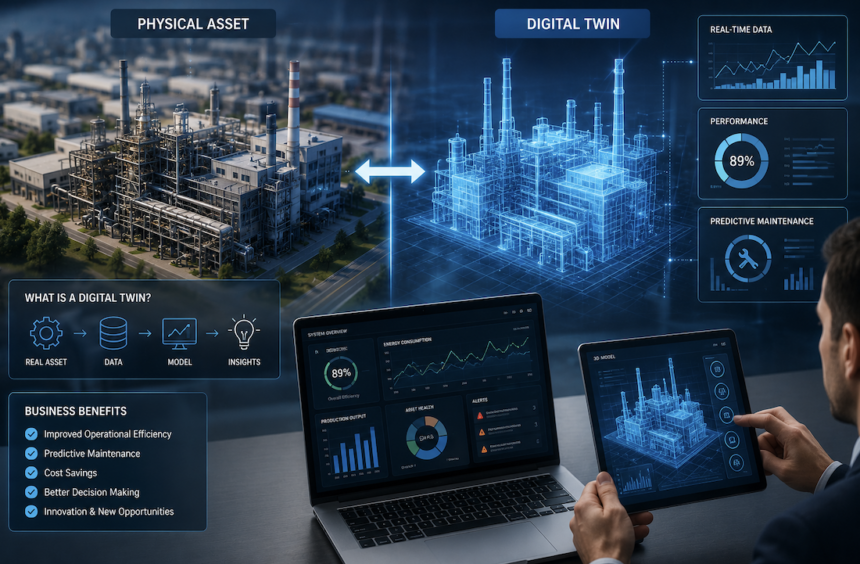
A digital twin is a virtual representation of a physical object, system, or process that stays continuously synchronised with its real-world counterpart through a steady stream of live data. Unlike a static 3D model or blueprint, which represents a fixed snapshot at one point in time, a digital twin updates continuously, reflecting the actual current condition and behaviour of whatever physical asset it mirrors.
This continuous synchronisation is precisely what separates a digital twin from earlier simulation technologies. A traditional simulation might model how a machine theoretically should behave under certain conditions, while a genuine digital twin reflects how that specific machine is actually behaving right now, based on real sensor data flowing from the physical asset itself.
How a Digital Twin Actually Gets Built and Maintained
Creating a functional digital twin involves connecting a physical asset to a network of sensors that continuously capture relevant data, then feeding that data into a virtual model specifically designed to mirror the asset’s behaviour and characteristics accurately.
- Sensors attached to the physical asset continuously capture data like temperature, vibration, or performance metrics
- This data streams in real time to the corresponding virtual model
- The virtual model updates continuously to reflect the actual current state of the physical asset
- Analysts and automated systems can then study this virtual model to understand and predict the physical asset’s behaviour
This ongoing data connection means a digital twin genuinely becomes more valuable and accurate over time, as it accumulates a richer history of how the physical asset actually behaves under various real-world conditions, rather than relying solely on theoretical predictions made before the asset was ever deployed.
Why Businesses Genuinely Value Digital Twin Technology
The core appeal of digital twins comes from allowing organisations to test scenarios, identify problems, and optimise performance within a virtual environment, considerably reducing the cost, risk, and disruption involved compared to experimenting directly with expensive or critical physical assets.
- Testing potential changes virtually avoids the cost and risk of disrupting actual physical operations
- Predictive maintenance becomes possible by identifying early warning signs within the virtual model before failures occur
- Performance optimisation can be explored virtually, identifying improvements before implementing them physically
- Training and planning can happen using the virtual twin, without requiring access to the actual physical asset
This predictive maintenance capability deserves particular attention, since it represents one of the most immediately valuable applications for many businesses, allowing maintenance teams to address emerging problems before they cause an expensive, disruptive equipment failure, rather than reacting only after something has already gone wrong.
Real-World Industries Actively Using Digital Twin Technology
Manufacturing companies use digital twins to monitor equipment health and optimise production line efficiency
- Aerospace companies model aircraft components to predict maintenance needs and identify potential failures early
- City planners use digital twins of urban infrastructure to model traffic patterns and plan future development
- Healthcare organisations are exploring digital twins of individual patients to personalise treatment approaches
- Energy companies use digital twins of power grids and equipment to optimise distribution and predict maintenance needs
How Digital Twins Support Better Decision Making
Beyond specific operational benefits, digital twins genuinely change how organisations approach decision making, allowing leaders to base significant decisions on data-driven simulation rather than intuition or
historical precedent alone.
- Decisions about equipment upgrades or process changes can be tested virtually before committing real resources
- Historical data accumulated within the digital twin provides genuine evidence for identifying long-term trends
- Scenario planning becomes considerably more concrete when grounded in an accurate virtual model
- This data-driven approach can meaningfully reduce costly mistakes that might otherwise only become apparent after physical implementation
The Genuine Challenges Involved in Implementing Digital Twins
Despite genuine benefits, building and maintaining an effective digital twin involves real challenges worth understanding before an organisation commits significant resources to this kind of implementation.
- Building an accurate virtual model requires genuine technical expertise and significant upfront investment
- Maintaining a continuous, reliable data connection between the physical asset and its virtual twin requires robust infrastructure
- Data quality directly determines the digital twin’s accuracy, meaning poor sensor data undermines the entire system’s value
- Ongoing maintenance and updates are required as the physical asset itself changes or ages over time
Practical Considerations for Businesses Exploring Digital Twin Technology
- Start with a specific, well-defined use case rather than attempting an overly ambitious initial implementation
- Ensure reliable sensor infrastructure exists before investing heavily in the virtual modelling component
- Consider the genuine return on investment for your specific industry and use case before committing significant resources
- Evaluate whether existing staff have the technical expertise required, or whether specialised partners are genuinely needed
How Digital Twins Are Expected to Evolve in the Coming Years
As sensor technology becomes cheaper and more widely deployed, and as data processing capabilities continue advancing, digital twin technology is genuinely expected to become considerably more accessible and sophisticated over the coming years, extending well beyond the large-scale industrial applications that currently dominate its use.
Emerging developments include increasingly integrating artificial intelligence directly within digital twins, allowing these virtual models to not just reflect current conditions but to genuinely predict future behaviour with
growing accuracy, and to autonomously recommend optimisations rather than simply presenting data for human analysts to interpret manually. This trajectory suggests digital twin technology will likely become an increasingly standard tool across a broader range of industries and business sizes, rather than remaining primarily the domain of large, well-resourced enterprises.
- Sensor technology becoming cheaper and more widespread is expanding digital twin accessibility
- Artificial intelligence integration is enabling digital twins to move from reflection toward genuine prediction
- Some systems are beginning to autonomously recommend optimisations rather than only presenting raw data
- This trajectory suggests broader adoption across more industries and business sizes going forward
Final Thoughts
Digital twin technology offers businesses a genuinely powerful way to test, predict, and optimise using a continuously updated virtual replica of physical assets, reducing cost and risk compared to experimenting directly with the real thing. As sensor technology becomes more affordable and data infrastructure continues improving, this approach is likely to become an increasingly standard part of how businesses across many industries plan, maintain, and optimise their physical operations.
For businesses still evaluating whether this technology genuinely fits their operations, starting with a focused pilot project targeting one specific, well-understood asset or process offers a genuinely sensible way to build internal expertise and demonstrate concrete value before committing to a broader, more ambitious implementation across the wider organisation.
- You Might Be Curious: How AI and Automation Are Quietly Transforming Local Digital Marketing!
Frequently Asked Questions
1. Is a digital twin the same thing as a 3D model?
No, a 3D model typically represents a static visual representation, while a digital twin continuously updates based on real, live data from its physical counterpart, reflecting actual current behaviour rather than a fixed snapshot.
2. Do only large enterprises benefit from digital twin technology?
While large enterprises with significant, complex physical assets have been early adopters, the technology has become increasingly accessible, and smaller businesses with specific, well-defined use cases can genuinely benefit as well.
3. How accurate does a digital twin actually need to be?
This depends considerably on the specific use case, though generally, the more critical the decisions being made based on the digital twin, the more accuracy and reliable data quality genuinely matter for trustworthy results.
4. Can a digital twin completely replace physical testing?
Not entirely, since digital twins are genuinely valuable for narrowing down possibilities and predicting outcomes, but critical decisions often still benefit from some physical validation before full implementation, particularly for safety-critical applications.
5. What industries are expected to adopt digital twin technology most going forward?
Manufacturing, healthcare, urban planning, and energy sectors are widely expected to continue expanding their use of digital twin technology, given the genuine, demonstrated value these industries have already found in predictive maintenance and scenario planning applications.