

I’ll be honest with you, the first time I heard the term “quantum computing,” I completely zoned out. It sounded like something straight out of a science fiction movie, and I assumed it was only relevant to people with PhDs in physics. But after actually digging into it, my view completely changed. In my opinion, quantum computing is one of those rare technologies that has the potential to reshape the entire world, not in some vague, distant future, but within our lifetimes. I genuinely believe that understanding at least the basics of quantum computing is becoming as important as understanding the internet was in the 1990s and the sooner you get familiar with it, the better prepared you’ll be for what’s coming.
In this article, we will cover what quantum computing actually means and, how it works, the core ideas behind it like qubits, superposition, and entanglement, how it compares to the computers we use today, real-world applications that are already taking shape, the major challenges still holding it back, and where things stand heading into 2026.
What Is Quantum Computing? (In Plain English)
Let’s cut through the jargon. Quantum computing is a completely different way of processing information, one that takes advantage of the strange and fascinating rules of quantum physics, which govern how particles behave at the tiniest scales imaginable.
Your regular computer, whether it’s a laptop, a smartphone, or even a massive supercomputer, processes everything using bits. A bit is simply a switch that’s either OFF (0) or ON (1). Everything you do on a computer, from sending a message to streaming a video, is ultimately just billions of those tiny switches flipping back and forth incredibly fast.
Quantum computers swap out those regular bits for something called qubits (quantum bits). And qubits play by completely different rules, they can be 0, 1, or both at the same time. That might sound impossible, but that’s exactly what makes quantum computing so powerful and so different.
The simplest way to think about it: A regular computer tries solutions to a problem one at a time, very quickly. A quantum computer can explore a massive number of possible solutions all at once.
Classical Computing vs. Quantum Computing
Before going deeper, it helps to understand what regular computers are really good at and where they start to struggle.
How Your Everyday Computer Works
Everything a classical computer does comes down to bits, billions of tiny transistors switching between 0 and 1. It’s incredibly fast and handles most tasks we throw at it without breaking a sweat. But when problems get enormously complex, involving huge numbers of variables all interacting with each other, even the most powerful supercomputers in the world can get completely overwhelmed.
Here’s a simple example: finding the best route between 10 cities is manageable. But scale that up to 50 cities, and the number of possible route combinations becomes larger than the number of atoms in the entire observable universe. A classical computer would need billions of years to check every option.
How Quantum Computers Handle It Differently
Rather than checking one possibility at a time, quantum computers use the properties of quantum physics to work through huge numbers of possibilities simultaneously. For certain types of problems, especially ones involving massive complexity and optimization, this is an absolute game-changer.
The Three Big Ideas Behind Quantum Computing
You don’t need a physics degree to understand these concepts. Here’s how they actually work:
1. Qubits – The Quantum Building Block
A qubit is the quantum version of a regular bit, but with a superpower. While a normal bit must be either 0 or 1, a qubit can be 0, 1, or both at the same time (before you look at it). This opens the door to processing power that grows exponentially as you add more qubits.
Qubits can be physically built from several different materials depending on the approach:
- Superconducting circuits – used by IBM and Google
- Trapped ions – used by IonQ and Honeywell
- Photons (particles of light)
- Topological qubits – Microsoft’s experimental approach
2. Superposition – Existing in Multiple States at Once
Superposition is the quantum property that lets a qubit be in multiple states at the same time, until the moment you measure it.
Think of it like a coin spinning in the air. While it’s spinning, it’s neither heads nor tails, it’s kind of both. The moment it lands and you look at it, it becomes one or the other. A qubit works the same way. It exists in a blend of 0 and 1 until you measure it, at which point it “collapses” into a definite state.
Here’s why this matters so much:
| Number of Qubits | Number of Simultaneous States | Human-Readable Explanation |
| 1 qubit | 2 states | Can represent either 0 or 1 at a time. |
| 2 qubits | 4 states | Can be in any combination of 00, 01, 10, or 11 simultaneously. |
| 10 qubits | 1,024 states | Capable of representing over a thousand states at once. |
| 300 qubits | More than the number of atoms in the observable universe | An astronomically high number of states, showcasing immense potential. |
That exponential growth is what gives quantum computers their extraordinary potential power.
3. Entanglement – The “Spooky” Connection
Quantum entanglement happens when two qubits become linked in such a way that whatever happens to one instantly affects the other, no matter how far apart they are. Einstein himself called this “spooky action at a distance” because it seems to break the rule that nothing travels faster than light.
For computing, entanglement means that qubits can coordinate with each other instantaneously, dramatically increasing the ability to handle complex calculations across many qubits at the same time.
4. Quantum Interference – Steering Toward the Right Answer
Quantum interference is how quantum computers avoid wasting time on wrong answers. Quantum algorithms are designed to amplify the paths that lead toward correct solutions (constructive interference) while canceling out paths that lead to wrong ones (destructive interference). It’s like the computer is naturally guided toward the right answer rather than blindly checking everything.
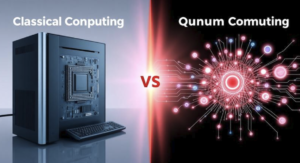
Classical vs. Quantum Computing: Side-by-Side
| Feature | Classical Computing | Quantum Computing |
|---|---|---|
| Basic unit | Bit (0 or 1) | Qubit (can be 0, 1, or both simultaneously) |
| Processing Method | Processes one state at a time | Handles many states at once through superposition |
| Scale of Improvement | Increases linearly with hardware | Grows exponentially for specific complex problems |
| Error Rate | Generally very low | Currently higher and more challenging to manage |
| Operating Temperature | Works at room temperature | Requires temperatures close to absolute zero |
| Ideal Use Cases | Everyday computing tasks | Optimization problems, simulations, cryptography |
| Availability | Widely accessible | Limited to major companies like IBM, Google, select researchers |
| Cost | Ranges from $500 to $1 million | Typically $10 million to $15 million per machine |
How Are Quantum Computers Actually Built?
Building a quantum computer is one of the hardest engineering challenges humanity has ever taken on. Here’s why:
The Temperature Problem
Most quantum computers need to operate at temperatures close to absolute zero, around -273°C, which is actually colder than outer space. At room temperature, even the tiniest vibrations from heat destroy the fragile quantum states of qubits. This is called decoherence, and it’s one of the biggest obstacles engineers face.
This is also why quantum computers currently require massive cooling systems and cannot be shrunk down into a laptop or phone anytime soon.
The Error Problem
Qubits are incredibly sensitive and error-prone. Any slight disturbance from the environment can corrupt their quantum state. To deal with this, engineers use quantum error correction, essentially using many physical qubits together to represent one reliable, stable “logical qubit.”
Here’s how qubit counts have grown over the years:
| Year | IBM Quantum Processor Model | Number of Qubits | Description |
| 2016 | IBM Q | 5 | The initial quantum processor launched by IBM. |
| 2019 | IBM Q System One | 27 | A more advanced system aimed at commercial use. |
| 2021 | IBM Eagle | 127 | Significantly increased qubit count for more complex tasks. |
| 2022 | IBM Osprey | 433 | A major step forward with a large-scale processor. |
| 2023 | IBM Condor | 1,121 | A high-performance quantum processor with over a thousand qubits. |
| 2024 | IBM Heron | 133 (higher quality) | Focused on qubit quality to improve performance. |
| 2026 | IBM (Future Roadmap) | 4,000+ | Planned development to reach over four thousand qubits. |
One important note: more qubits doesn’t automatically mean more power. The quality of qubits and how low the error rate is matters just as much, sometimes more.
Real-World Applications of Quantum Computing
Quantum computing isn’t just a lab experiment anymore. Here are the areas where it’s already making a real difference, or will very soon.
1. Drug Discovery and Healthcare
Simulating how molecules interact with each other is computationally brutal for classical computers. Even a molecule with just 50 atoms involves more quantum states than any classical machine can handle. Quantum computers can simulate these interactions naturally, which could slash drug development timelines from over a decade down to just a few years. The potential impact on diseases like Alzheimer’s and cancer is enormous.
2. Cybersecurity and Encryption
This is both the most exciting and the most concerning application. A powerful enough quantum computer could theoretically break RSA encryption, the system protecting most of the internet, banking transactions, and sensitive communications. It does this using an algorithm called Shor’s algorithm, which can factor huge numbers far faster than any classical computer.
The good news: the world isn’t sitting still. NIST finalized the first post-quantum cryptography standards in 2024, and organizations are already beginning to transition toward quantum-resistant encryption.
3. Financial Services
Banks and investment firms are actively exploring quantum computing for:
- Portfolio optimization – finding the best investment mix across thousands of assets at once
- Risk modeling – running complex financial simulations with far more variables
- Fraud detection – spotting patterns in massive transaction datasets
- Derivative pricing – calculating complex financial instruments faster
Major players like JPMorgan Chase, Goldman Sachs, and BBVA are already running quantum research programs.
4. Logistics and Supply Chain
Figuring out the most efficient delivery routes, warehouse layouts, or supply chain structures involves mind-boggling numbers of possible combinations. Quantum optimization algorithms can find near-perfect solutions to these problems in a fraction of the time. Volkswagen has already used quantum computing to optimize traffic flow, and companies like Airbus and DHL are exploring similar applications.
5. Artificial Intelligence
AI and quantum computing are becoming increasingly connected. Quantum computers could speed up the training of AI models, improve pattern recognition, and solve the optimization problems that slow down machine learning. In many ways, these two technologies are going to grow together and amplify each other’s capabilities.
6. Climate Science and New Materials
Modeling complex climate systems, discovering new materials for solar panels and batteries, and optimizing chemical processes for carbon capture are all areas where quantum computing can provide a massive leap forward. Even small improvements in areas like fertilizer production, which currently consumes 1-2% of global energy, could have huge environmental and economic impacts.
7. Quantum Secure Communications
Using a technique called Quantum Key Distribution (QKD), quantum mechanics can be used to share encryption keys in a way that makes eavesdropping physically detectable. China has already deployed a quantum communication network stretching over 2,000 kilometers, giving a sense of how seriously governments are taking this.
Where Does Quantum Computing Stand in 2026?
Right now, we are in what experts call the NISQ era, Noisy Intermediate-Scale Quantum. That means:
- Quantum computers exist and can be accessed online
- They have enough qubits to run experimental applications
- But they’re still too error-prone for most real-world practical use
- Quantum “advantage”, genuinely outperforming classical computers on a useful task, has been demonstrated in narrow, specific cases
Here’s a snapshot of who’s leading the race:
| Company/Country | Approach | Key Developments / Status |
|---|---|---|
| IBM | Superconducting qubits | Over 1,000 qubits available via cloud access. |
| Superconducting qubits | Achieved claimed quantum supremacy in 2019. | |
| Microsoft | Topological qubits | Announced a major breakthrough expected around 2025. |
| IonQ | Trapped ions | Focuses on high-quality qubits; publicly traded company. |
| China | Multiple quantum approaches | Heavy government investment driving progress. |
| USA | Government and private sector | Combined efforts with over $1.8 billion through the National Quantum Initiative. |
| European Union | Quantum Flagship program | Invested around €1 billion to advance quantum research and development. |
Want to try it yourself? IBM offers free cloud access to real quantum computers at quantum.ibm.com. You can write and run actual quantum programs without spending a penny.
Common Myths About Quantum Computing – Debunked
Myth: Quantum computers are just faster regular computers. Not quite. They’re not universally faster, they’re dramatically better at specific types of problems. For browsing the web or editing a document, your laptop will always win.
Myth: Quantum computers will replace classical computers. They won’t. These two technologies are complementary. Quantum computers handle specialized complex calculations; classical computers handle everything else. They’ll work side by side.
Myth: “Quantum supremacy” means quantum computers have won. It just means a quantum computer performed one specific task faster than a classical computer in a controlled test. It’s a milestone, not a finish line.
Myth: Quantum computers will break all encryption any day now. Realistically, breaking modern encryption would require millions of stable, error-corrected qubits. Today’s machines have thousands of noisy ones. We’re likely looking at 10–20 years before this becomes a genuine threat and quantum-resistant encryption is already being developed.
Myth: Quantum computing is still just science fiction. Completely false. Real quantum computers are operating right now and are accessible to the public through cloud platforms.
What to Expect in the Coming Years
| Timeframe | Expected Developments |
|---|---|
| 2026–2028 | Over 10,000 qubit processors coming online, bringing us closer to practical quantum advantages. |
| 2028–2032 | Fault-tolerant quantum computers will start to emerge, enabling breakthroughs in fields like pharmaceuticals. |
| 2030–2035 | Fully deploy post-quantum cryptography systems and conduct experimental quantum internet projects. |
| 2035–2040 | Large-scale quantum computers tackling problems once thought impossible. |
| 2040 and beyond | Potential revolutionary advances in AI training, new materials discovery, and other scientific fields. |
Final Thoughts
Quantum computing is one of those technologies that feels distant and abstract right now, but its impact is going to be very real, very significant, and closer than most people expect. We’re at a point similar to the early days of the internet: the infrastructure is being built, the standards are being set, and the first real applications are starting to emerge.
You don’t need to become a quantum physicist. But having a clear understanding of what quantum computing is, how it works, and why it matters puts you well ahead of the curve. The businesses, professionals, and individuals who understand this technology early are the ones who will be best positioned to navigate the world it creates.
FAQ’s
1. How does quantum computing differ from traditional computers?
Traditional computers rely on bits that are either 0 or 1. In contrast, quantum computers use qubits, which can be 0, 1, or both simultaneously. This allows quantum machines to explore many possibilities at once, making them incredibly powerful for tackling complex tasks like optimization problems and simulations.
2. Will quantum computers replace the computers we use daily?
Not in the foreseeable future. Quantum computers are designed for specialized, high-level calculations. Everyday devices like laptops and smartphones will still operate on classical computing technology. Ultimately, both types of computers will coexist, each serving their own purpose.
3. Is quantum computing currently a cybersecurity threat?
Not at this moment. Cracking modern encryption standards would require millions of stable, error-free qubits, far beyond the capabilities of today’s quantum machines, which have only thousands of noisy qubits. Experts believe this threat is still 10 to 20 years away, and efforts to develop quantum-resistant encryption are already underway.
4. Can ordinary people access quantum computers today?
Absolutely! Companies like IBM provide free cloud access to real quantum computers at quantum.ibm.com, and Amazon offers pay-per-use access through Amazon Braket. No special hardware or expertise is needed to experiment with quantum computing.
5. Which industries will experience the biggest changes from quantum computing?
Fields such as healthcare, finance, logistics, cybersecurity, and climate science are expected to benefit the most. Additionally, quantum computing is poised to accelerate advancements in artificial intelligence and data analysis across many sectors.