

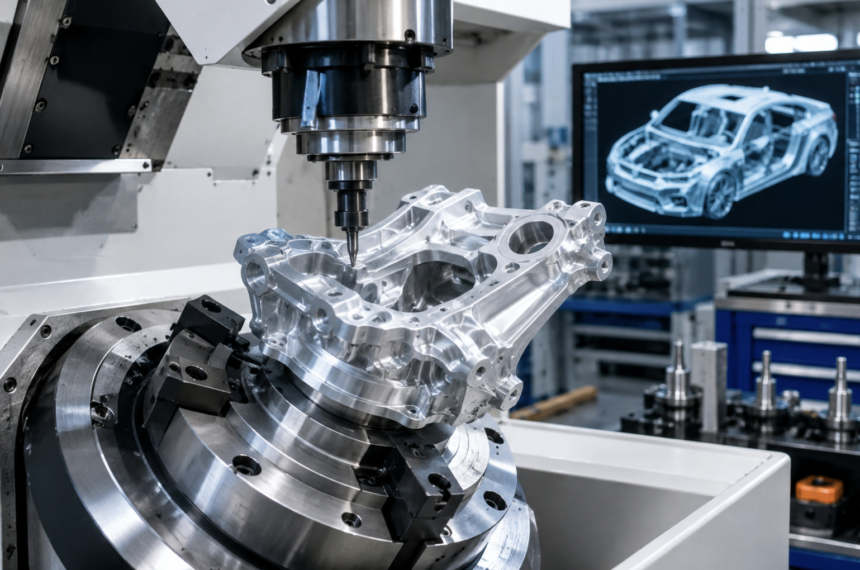
The automotive industry is evolving at an unprecedented pace. Electric vehicles, autonomous driving systems, and lightweight vehicle designs continue to reshape modern transportation. Consequently, manufacturers must develop complex components faster without compromising quality. Every day saved during product development creates a significant competitive advantage. Traditional machining methods struggle to meet these growing demands. Multiple machine setups often increase production time, introduce dimensional errors, and raise manufacturing costs. These limitations become even more noticeable when producing intricate automotive components with complex curves and tight tolerances.
Fortunately, Precision 5-Axis CNC Services have changed the entire manufacturing process. Instead of repositioning a workpiece several times, engineers can machine every surface in one continuous setup. As a result, production becomes faster, accuracy improves dramatically, and overall prototyping expenses decrease.
In 2026, automotive manufacturers are embracing digital manufacturing technologies alongside advanced CNC machining. Artificial intelligence, digital twins, automated inspection, and smart factories now work together to streamline prototype development from design to production.
This manufacturing evolution allows automotive companies to reduce prototype costs by nearly 25%, shorten product development cycles, and launch new vehicle technologies much faster than ever before. Whether designing lightweight electric vehicle battery enclosures, precision transmission housings, suspension systems, or turbocharger impellers, modern 5-axis machining provides unmatched flexibility, repeatability, and engineering precision.
Why Precision 5-Axis CNC Services Matter More Than Ever
Automotive components continue becoming more sophisticated every year. Engineers now design lighter parts while demanding greater structural strength and tighter dimensional tolerances. Conventional machining methods often require several repositioning operations. Unfortunately, every additional setup increases the possibility of alignment errors. Precision 5-axis CNC machining eliminates this challenge by allowing simultaneous movement across five different axes. Consequently, manufacturers complete complicated geometries during a single machining cycle. The advantages include:
- Superior dimensional accuracy
- Faster machining cycles
- Lower labor costs
- Better surface finishes
- Reduced material waste
- Fewer quality inspections
- Improved repeatability
These benefits explain why automotive manufacturers increasingly rely on advanced CNC machining for both prototype development and low-volume production.
How Single-Setup Machining Improves Dimensional Accuracy
Every additional setup creates opportunities for measurement errors. Even microscopic positioning variations may cause assembly failures when manufacturing transmission housings or battery mounting structures. Single-setup machining removes this risk. Instead of moving the workpiece repeatedly, the machine automatically rotates both the spindle and workpiece to reach every machining angle. This process offers several major benefits.
Consistent Precision Across Every Surface
Each machined feature references the same coordinate system. Therefore, hole positions, mounting faces, sealing surfaces, and internal cavities remain perfectly aligned throughout production. Many automotive suppliers consistently achieve tolerances as tight as ±0.01 mm using modern 5-axis machining centers. That level of precision becomes essential for electric vehicle drivetrains, gearbox housings, steering assemblies, and high-performance engine components.
Lower Scrap Rates
Incorrect positioning frequently causes expensive prototype failures. Single-setup machining greatly reduces rejected components because every operation follows one highly accurate machining sequence. Lower scrap rates directly reduce production costs.
Manufacturing Complex Automotive Parts Has Never Been Easier
Modern vehicles contain components that were nearly impossible to manufacture efficiently only a decade ago. Today’s engineers create organic shapes designed through advanced CAD software and topology optimization. Examples include:
- EV battery housings
- Turbocharger impellers
- Lightweight suspension arms
- Steering knuckles
- Differential carriers
- Motor housings
- Cooling manifolds
- Chassis brackets
These parts feature deep pockets, curved surfaces, undercuts, and difficult machining angles. Fortunately, 5-axis CNC machines approach every feature from the most efficient cutting direction. Consequently, manufacturers avoid specialized fixtures while maintaining exceptional machining quality.
The Role of Digital Manufacturing in Automotive Production
Modern CNC machining extends far beyond cutting metal. Today’s smart factories combine digital technologies throughout the manufacturing process. Before production begins, engineers create digital simulations of every machining operation. This virtual manufacturing environment predicts potential issues before any raw material enters the machine. Digital manufacturing dramatically reduces development risks while improving production efficiency.
Digital Twins Are Revolutionizing Prototype Development
A digital twin is a virtual representation of a physical component. Engineers simulate every machining operation using this digital model before manufacturing begins. The software analyzes:
- Tool collisions
- Cutting forces
- Heat generation
- Tool wear
- Material removal rates
- Machine movement
- Surface finish quality
Consequently, manufacturers optimize machining strategies before production starts. This significantly lowers development costs while shortening project timelines.
Artificial Intelligence Is Making CNC Machining Smarter
Artificial intelligence now assists manufacturers throughout the machining process. Instead of relying solely on operator experience, AI continuously monitors machining performance. Smart manufacturing software automatically detects:
- Excessive spindle vibration
- Tool wear
- Temperature changes
- Cutting instability
- Surface quality variations
When abnormalities appear, machining parameters adjust automatically. This predictive approach reduces downtime while extending tool life. AI also helps schedule preventive maintenance before unexpected equipment failures occur. As a result, production remains highly efficient.
Industry 4.0 Creates Fully Connected Smart Factories
Industry 4.0 connects machines, engineers, software, and inspection systems into one intelligent manufacturing network. Each machine communicates production data in real time. Managers instantly monitor:
- Machine utilization
- Cycle times
- Production efficiency
- Energy consumption
- Quality performance
- Tool inventory
- Maintenance schedules
This continuous flow of information improves decision-making throughout the factory. Manufacturers respond faster to production challenges while maintaining exceptional product quality.
How Precision 5-Axis CNC Services Accelerate Electric Vehicle Development
Electric vehicles introduce entirely new manufacturing challenges. Battery enclosures require lightweight construction without sacrificing structural integrity. Motor housings demand exceptional concentricity. Cooling plates contain highly complex internal channels. Meanwhile, lightweight aluminum and magnesium alloys require specialized machining strategies.
Fortunately, advanced 5-axis machining handles these demanding applications with remarkable efficiency. Manufacturers produce thinner walls, stronger structures, and smoother finishes while maintaining strict engineering tolerances. This capability significantly shortens electric vehicle development cycles.
Advanced Materials Require Advanced Machining
Modern automotive engineering increasingly depends upon high-performance materials. Each material presents unique machining challenges. Common automotive materials include:
- Aluminum 6061-T6
- Aluminum 7075
- Titanium Grade 5
- Stainless steel
- Magnesium alloys
- Carbon fiber composites
- Engineering plastics
- Inconel
- Copper alloys
Traditional machining often struggles with these materials. However, precision 5-axis CNC machining optimizes cutting angles continuously. Better tool orientation reduces cutting forces, improves chip evacuation, and enhances surface quality. Consequently, manufacturers achieve greater productivity while extending cutting tool life.
How Precision 5-Axis CNC Services Reduce Automotive Prototype Costs by Up to 25%
Reducing prototype costs involves more than lowering machining time. Manufacturers must optimize every stage of production. Precision 5-axis CNC machining achieves this by minimizing setups, reducing manual labor, lowering scrap rates, and improving first-pass success. Traditional machining often requires multiple fixtures and repeated repositioning. Each setup increases labor costs and extends production time.
In contrast, a single 5-axis setup completes several operations without interruption. This streamlined workflow delivers measurable savings through:
- Reduced machine setup time
- Lower labor requirements
- Fewer custom fixtures
- Less material waste
- Improved tool life
- Higher first-pass yield
- Faster project completion
As a result, automotive companies can accelerate innovation while staying within budget.
Design for Manufacturability (DFM) Improves Production Success
Great machining begins with intelligent design. Design for Manufacturability (DFM) helps engineers identify production challenges before machining starts. Rather than modifying parts after failures occur, manufacturers optimize designs during the planning stage. A professional DFM review evaluates:
- Wall thickness
- Corner radii
- Tool accessibility
- Hole placement
- Material selection
- Machining orientation
- Surface finish requirements
- Tolerance feasibility
These improvements reduce machining complexity and eliminate unnecessary production costs. Moreover, early DFM analysis shortens product development cycles and decreases engineering change orders.
CAM Software Optimizes Every Toolpath
Computer-Aided Manufacturing (CAM) software has become essential in modern CNC machining. Instead of relying on manual programming, engineers generate intelligent toolpaths that maximize efficiency. Advanced CAM software automatically calculates:
- Optimal cutting angles
- Feed rates
- Spindle speeds
- Tool engagement
- Material removal paths
- Collision avoidance
Consequently, machines remove material faster while protecting cutting tools from excessive wear. Modern software also shortens programming time, allowing manufacturers to begin production sooner.
Automated CMM Inspection Guarantees Consistent Quality
Precision machining requires equally precise inspection. Coordinate Measuring Machines (CMMs) verify every critical dimension after machining. These automated systems compare manufactured components against their original CAD models. Inspection reports include:
- Dimensional accuracy
- Hole locations
- Surface profiles
- Flatness
- Roundness
- Parallelism
- Geometric tolerances
Because measurements are fully digital, manufacturers maintain complete traceability throughout production. This level of inspection builds confidence for both prototype validation and future mass production.
Superior Surface Finishes Reduce Secondary Operations
Surface quality directly affects component performance. Poor finishes often require polishing, grinding, or additional machining. These extra operations increase production costs and delay project completion. Precision 5-axis machining minimizes these problems. Continuous tool movement creates smoother surfaces directly from the machine.
Typical automotive applications achieve surface finishes as fine as Ra 0.4 μm, reducing or eliminating secondary finishing processes. This advantage proves especially valuable for:
- Engine components
- Hydraulic housings
- Battery enclosures
- Turbocharger parts
- Medical-grade automotive sensors
From One Prototype to Low-Volume Production
Automotive companies rarely stop after producing a single prototype. Testing usually requires multiple design revisions before mass production begins. Fortunately, modern 5-axis machining supports seamless scaling. Manufacturers can produce:
- One functional prototype
- Engineering validation units
- Pre-production batches
- Low-volume production
- Bridge manufacturing before tooling
This flexibility eliminates expensive tooling investments during early development. Companies therefore validate designs faster while reducing financial risk.
Why Global Automotive Companies Source CNC Machining from China
China has become one of the world’s leading precision manufacturing centers. Modern factories combine advanced machinery with experienced engineering teams and highly automated production systems. Many facilities now operate fully digital manufacturing environments that rival leading factories worldwide. Key advantages include:
- Advanced 5-axis machining centers
- Competitive production costs
- Large manufacturing capacity
- Skilled engineering teams
- Short production lead times
- Comprehensive inspection systems
- International quality certifications
These strengths make Chinese manufacturers attractive partners for automotive OEMs and Tier 1 suppliers.
What Makes a Reliable 5-Axis CNC Manufacturing Partner?
Choosing the right machining supplier influences product quality as much as machine capability. Experienced manufacturers offer far more than machining services. They provide engineering support throughout the entire development process. Important evaluation criteria include:
Engineering Expertise
Experienced engineers identify production risks before manufacturing begins. Their recommendations often improve manufacturability while reducing production costs.
Modern Equipment
High-end machining centers provide greater rigidity, faster spindle speeds, and superior thermal stability. These features produce better accuracy during long machining cycles.
Inspection Capabilities
Reliable suppliers perform comprehensive quality inspections using advanced metrology equipment. Inspection documentation should accompany every critical component.
Responsive Communication
Clear communication accelerates engineering decisions and prevents costly misunderstandings. Fast technical support also shortens development timelines.
Quality Certifications Every Automotive Supplier Should Have
Automotive manufacturing demands strict quality management. International certifications demonstrate that manufacturers follow standardized production procedures. The most important certifications include:
IATF 16949
This automotive-specific quality standard emphasizes defect prevention, continuous improvement, and process consistency.
ISO 9001
ISO 9001 establishes comprehensive quality management systems across manufacturing operations.
AS9100D
Originally developed for aerospace manufacturing, AS9100D introduces even stricter quality controls. Many automotive manufacturers value suppliers holding this certification because it reflects exceptional manufacturing discipline.
ISO 14001
Environmental responsibility has become increasingly important. ISO 14001 demonstrates effective environmental management and sustainable manufacturing practices. Together, these certifications strengthen customer confidence while simplifying supplier approval processes.
Real-World Automotive Success Story
A global electric vehicle supplier needed a lightweight aluminum motor housing with several complex internal features. Initially, the prototype required five machining setups using conventional equipment. Production challenges quickly appeared. Dimensional deviations caused assembly problems, while extended machining time increased manufacturing costs.
Engineers redesigned the machining strategy using precision 5-axis CNC technology. They also implemented digital twin simulation before production. The results were impressive. Machining time dropped by nearly 30%. First-pass yield exceeded 99%. Surface quality improved significantly. Most importantly, overall prototype costs decreased by approximately 25%. The company completed validation earlier than expected and moved into pilot production ahead of schedule.
Sustainable Manufacturing Is Becoming a Competitive Advantage
Modern manufacturers focus on sustainability alongside productivity. Advanced CNC machining contributes to greener production through several methods. Single-setup machining consumes less energy because fewer operations are required. Optimized toolpaths reduce unnecessary cutting motions.
Smart coolant systems recycle cutting fluids more efficiently. Improved material utilization minimizes waste. Longer tool life also reduces industrial waste generated by worn cutting tools. These improvements support corporate sustainability goals while lowering operating expenses.
The Future of Precision 5-Axis CNC Machining
Manufacturing technology continues advancing rapidly. Artificial intelligence will become even more involved in automated programming and process optimization. Digital twins will provide increasingly accurate production simulations. Machine learning will predict tool failures before they occur. Collaborative robotics will automate loading and unloading operations. Cloud-based manufacturing platforms will connect engineering teams across different countries.
Additionally, hybrid manufacturing systems combining CNC machining with metal additive manufacturing will unlock entirely new design possibilities. Companies investing in these technologies today will gain a significant competitive advantage in the coming years.
Conclusion
The future of automotive manufacturing depends on speed, precision, and adaptability. As vehicle designs become more sophisticated, traditional machining methods can no longer meet the industry’s growing demands. Precision 5-Axis CNC Services provide the accuracy, flexibility, and efficiency required to manufacture complex automotive components with confidence.
By completing intricate machining operations in a single setup, manufacturers significantly reduce positioning errors, machining time, and material waste. At the same time, digital manufacturing technologies, including AI-powered programming, digital twins, CAM simulation, automated CMM inspection, and Industry 4.0 connectivity, create a smarter production environment that improves both quality and productivity.
Automotive companies also benefit from faster prototype validation, smoother transitions into low-volume production, and lower overall development costs. Whether machining lightweight EV battery enclosures, transmission housings, suspension components, or high-performance turbocharger impellers, advanced 5-axis machining consistently delivers exceptional dimensional accuracy and outstanding surface finishes. Furthermore, partnering with an experienced CNC manufacturer that follows internationally recognized standards such as IATF 16949, ISO 9001, AS9100D, and ISO 14001 ensures reliable quality, complete traceability, and long-term manufacturing success.
As electric vehicles, autonomous driving technologies, and smart mobility continue shaping the automotive industry, manufacturers that embrace precision 5-axis CNC machining will be better positioned to innovate, shorten time-to-market, and remain competitive in an increasingly demanding global marketplace. Investing in advanced machining today is not simply a manufacturing decision, it is a strategic investment in the future of automotive engineering.
Frequently Asked Questions
1. What is 5-axis CNC machining?
It is an advanced machining process that moves a cutting tool along five axes simultaneously to produce highly complex parts in one setup.
2. Why is 5-axis machining better than traditional 3-axis machining?
It offers greater precision, fewer setups, shorter production times, and better surface finishes.
3. How much can automotive manufacturers save with 5-axis CNC services?
Many manufacturers reduce prototype machining costs by up to 25% through optimized production.
4. Which automotive components benefit most from 5-axis machining?
Battery enclosures, transmission housings, turbocharger impellers, suspension parts, and motor housings benefit the most.
5. Can 5-axis CNC machines process lightweight automotive materials?
Yes, they efficiently machine aluminum, titanium, magnesium, engineering plastics, and composite materials.
6. What role does digital manufacturing play in CNC machining?
Digital manufacturing improves accuracy, reduces errors, and optimizes production using simulation and real-time monitoring.
7. Why is DFM important before machining begins?
Design for Manufacturability helps eliminate production issues and reduces overall machining costs.
8. Which quality certifications should a CNC supplier have?
Reliable suppliers should hold certifications such as IATF 16949, ISO 9001, AS9100D, and ISO 14001.
9. Can 5-axis CNC machining support low-volume production?
Yes, it allows manufacturers to scale efficiently from a single prototype to low-volume production.
10. Is 5-axis CNC machining suitable for electric vehicle manufacturing?
Yes, it is ideal for producing high-precision EV components with complex geometries and lightweight designs.