

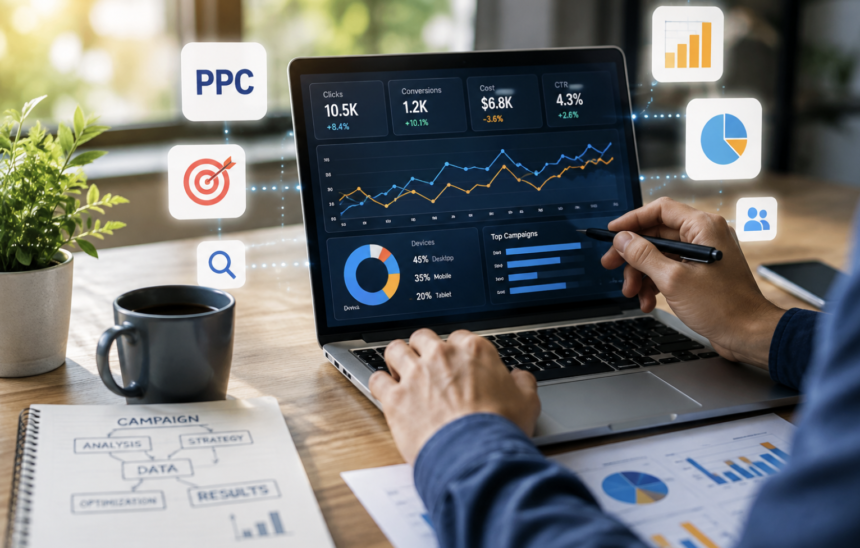
Paid advertising has become a game of precision rather than simple visibility. Every click matters when competition keeps pushing advertising costs higher. Therefore, businesses can no longer depend on intuition alone to manage PPC campaigns.
Modern PPC marketing combines data analytics, automation, artificial intelligence, customer insights, and real-time reporting. Together, these technologies help advertisers understand audiences and make faster decisions. More importantly, they reveal what happens before and after someone clicks an advertisement. That insight helps marketers build campaigns around actual customer behavior instead of assumptions.
As advertising platforms become smarter, businesses must also become smarter with their data. Otherwise, valuable information can remain trapped inside disconnected tools.
From predictive analytics to automated bidding, technology now influences nearly every part of paid advertising. It helps brands reduce wasted spending while discovering opportunities that manual analysis can easily miss. This shift makes data analytics and technology essential for anyone seeking sustainable PPC growth in 2026.
Why Data Has Become the Foundation of PPC Marketing
Successful PPC campaigns begin with reliable information. Marketers need to understand who clicks, what they search, and what encourages conversions. However, modern data analysis goes much deeper than basic click and impression counts. Advertisers can examine customer demographics, devices, locations, browsing patterns, purchase behavior, and conversion paths. Consequently, marketers can identify valuable audience segments with greater accuracy. They can also separate high-intent visitors from users who rarely convert.
Historical data provides another major advantage. Previous campaign results can reveal seasonal patterns and profitable keywords.
For example, a business may discover that mobile users generate more leads during evenings. Marketers can then adjust their strategies around that behavior. Therefore, data transforms PPC planning from guesswork into evidence-based decision-making.
Predictive Analytics Helps Marketers Plan Ahead
Traditional PPC analysis usually focuses on what already happened. Predictive analytics adds another dimension by helping marketers anticipate future outcomes. Advanced models can examine historical performance and identify patterns linked with conversions. They can then estimate which audiences, keywords, or campaigns may deliver stronger results. This approach helps businesses prepare budgets more intelligently. Instead of reacting after spending increases, marketers can identify warning signs earlier.
Predictive analytics can also support demand forecasting. Businesses can estimate potential changes in search interest during promotions or seasonal periods.
As a result, advertisers can prepare campaigns before demand reaches its peak. This proactive approach can create an important advantage in competitive markets.
Automation Makes PPC Campaign Management More Efficient
Managing multiple PPC campaigns manually can consume enormous amounts of time. Fortunately, automation now handles many repetitive advertising tasks. Automated systems can adjust bids, manage budgets, pause weak advertisements, and respond to changing performance signals. They can also help control spending throughout the day. This prevents campaigns from exhausting their budgets too quickly.
However, automation does not remove the need for human strategy. Instead, it allows marketers to spend more time on creative and strategic decisions.
For instance, marketers can define conversion goals and audience priorities. Automated systems can then optimize campaign delivery around those objectives. This combination creates a stronger workflow. Humans provide direction, while technology handles repetitive execution.
Artificial Intelligence Is Reshaping PPC Optimization
Artificial intelligence has become one of the biggest forces influencing digital advertising. Modern PPC platforms use AI to process enormous amounts of information. These systems can evaluate user signals, search behavior, device information, location, and historical conversion patterns. They can then use those signals to influence ad delivery and bidding decisions.
AI can also support creative development. Advertisers can generate different headlines, descriptions, images, and messaging concepts for testing.
However, human oversight remains important. Automatically generated content still requires brand review and quality control. Therefore, the strongest PPC strategies combine artificial intelligence with human judgment.
Real-Time Analytics Enables Faster Campaign Decisions
PPC performance can change within minutes. A keyword that performs well in the morning may become expensive later. Real-time analytics helps marketers notice these changes quickly. Dashboards can display clicks, conversions, spending, conversion rates, and acquisition costs. This immediate visibility supports faster optimization. Marketers can identify unusual spending patterns before they become major problems.
They can also detect creative fatigue. If engagement begins declining, advertisers can introduce fresh messaging before performance falls further.
Furthermore, real-time data makes budget management more responsive. Teams can shift spending toward campaigns producing stronger results. This creates a continuous feedback loop between campaign performance and strategic decisions.
Customer Data Connects PPC With the Entire Buying Journey
One major PPC challenge involves understanding what happens after the click. Website analytics alone may not reveal the complete customer journey. Customer relationship management systems can provide additional information. They may show lead quality, sales activity, customer value, and repeat purchases. When these systems connect with advertising platforms, marketers gain a broader perspective.
A campaign might generate fewer leads but produce higher-value customers. Another campaign could generate many leads with very little revenue. Without customer data, marketers may incorrectly favor the second campaign. Therefore, integrating PPC data with customer information can improve budget allocation and performance evaluation.
Conversion Tracking Has Become More Important Than Clicks
Clicks can look impressive, but they do not automatically generate revenue. PPC campaigns should ultimately focus on meaningful business outcomes. Depending on the business, those outcomes may include purchases, qualified leads, bookings, subscriptions, or phone calls. Accurate conversion tracking helps marketers understand which campaigns create those outcomes.
Moreover, improved tracking can reveal differences between traffic sources. A keyword may generate many clicks but few valuable actions.
Another keyword might receive fewer clicks while producing significantly better customers. Consequently, advertisers should evaluate campaign quality beyond surface-level traffic metrics.
Attribution Technology Reveals Hidden Conversion Paths
Customers rarely convert after interacting with one advertisement. They may see a search ad, visit a website, return through another channel, and finally purchase. Last-click attribution can overlook these supporting interactions. Modern attribution approaches attempt to distribute conversion value across multiple touchpoints. This provides a broader understanding of customer journeys. Data-driven attribution can use available interaction signals to estimate how different touchpoints contribute to conversions.
This information can influence budget decisions. Marketers may discover that some campaigns assist conversions even when they rarely receive final-click credit. As a result, attribution technology can prevent businesses from cutting valuable campaigns prematurely.
A/B Testing Turns PPC Into a Continuous Experiment
Successful PPC campaigns rarely remain unchanged for long. Markets shift, audiences evolve, and competitors introduce new messages. A/B testing provides a structured way to respond. Advertisers can test headlines, descriptions, calls to action, landing pages, offers, and creative concepts.
For example, one advertisement may emphasize affordability. Another may focus on convenience. The resulting data can show which message creates stronger engagement or conversion rates.
However, marketers should test meaningful variables rather than changing everything simultaneously. Clear testing creates useful insights. Random changes make performance harder to understand. Therefore, consistent experimentation can create a reliable path toward gradual PPC improvement.
Landing Page Analytics Strengthens PPC Performance
Advertising performance does not end when someone clicks. The landing page plays a major role in determining whether that visitor converts. A strong advertisement can still fail when the landing page loads slowly or provides confusing information. Technology helps marketers analyze landing page behavior. They can examine bounce rates, session duration, form interactions, and conversion behavior.
Heatmaps can also show where visitors interact with a page. Session recordings may reveal confusing navigation patterns. These insights help businesses improve the experience after the advertisement. Consequently, PPC optimization should include both advertising campaigns and destination pages.
Cross-Platform Data Creates a Unified Advertising Strategy
Businesses increasingly advertise across several platforms. These may include search engines, social networks, video platforms, and professional advertising networks. Managing these channels separately can create fragmented information. Integrated analytics brings campaign data into a more centralized view. Marketers can compare performance across platforms using consistent business objectives.
This approach can also improve audience sequencing. For example, someone who interacts with a search advertisement could later receive a relevant remarketing message. The customer journey becomes more connected instead of feeling like separate advertisements from unrelated campaigns.
Privacy Changes Are Transforming PPC Data Strategies
Privacy has become another important consideration for modern advertisers. Businesses cannot assume that unlimited user-level information will always be available. Consequently, marketers increasingly need stronger first-party data strategies. First-party data comes directly from customer interactions with a business. Examples include website registrations, purchases, subscriptions, and customer preferences. Organizations should collect this information responsibly and communicate clearly about its use.
Better first-party data can also improve audience understanding. It gives businesses valuable insights without relying entirely on external tracking signals. Therefore, privacy-conscious data strategies are becoming an important part of long-term PPC planning.
Data Quality Determines the Value of PPC Technology
Advanced technology cannot fix inaccurate information. Poor tracking can produce misleading reports and incorrect optimization decisions. For example, duplicated conversions may make a campaign appear more successful than it really is. Similarly, missing conversion events can cause advertising platforms to optimize toward the wrong goals.
Businesses should regularly audit tracking systems and analytics configurations. They should also check whether conversion definitions match actual business objectives.
Clean data creates stronger foundations for automation and artificial intelligence. In contrast, poor data can cause sophisticated systems to make poor decisions faster.
How Businesses Can Build a Smarter PPC Technology Stack
A modern PPC technology stack should support the entire advertising journey. It can include advertising platforms, analytics software, CRM systems, reporting dashboards, conversion tracking tools, and automation solutions. However, businesses should avoid adding tools simply because they appear advanced.
Every technology should solve a specific business problem. First, companies should establish clear conversion goals. Next, they should ensure accurate tracking across important customer touchpoints. Afterward, marketers can connect relevant data sources and create centralized reporting.
Finally, automation and AI can be introduced where they provide measurable efficiency. This gradual approach reduces complexity while creating a stronger foundation for growth.
The Human Role Still Matters in Technology-Driven PPC
Technology may process data faster than humans, but strategy still requires human thinking. Machines can identify patterns, adjust bids, and predict likely outcomes. However, humans understand brand identity, customer emotions, market positioning, and business priorities. Creative decisions also require judgment. A technically strong advertisement may still feel disconnected from its audience.
Therefore, businesses should not treat technology as a replacement for marketing expertise. Instead, technology should expand what skilled marketers can accomplish. The best PPC teams combine analytical thinking, creative strategy, technological tools, and continuous experimentation.
The Future of PPC Marketing Will Be More Predictive
PPC marketing is moving beyond simple reporting and manual optimization. Increasingly, advertising technology is becoming predictive, automated and highly adaptive. Future campaigns will likely rely more heavily on integrated customer data and intelligent decision-making systems.
Marketers will spend less time collecting information manually. Instead, they will focus on interpreting insights and making strategic choices.
At the same time, privacy requirements will continue influencing how advertisers collect and use information. Businesses that adapt early can build stronger and more resilient advertising systems. Ultimately, PPC success will depend on connecting accurate data with meaningful strategy.
Conclusion: Data and Technology Are the New PPC Advantage
PPC marketing has entered an era where data quality and technology can determine competitive advantage. Analytics helps marketers understand performance. Automation improves execution. Artificial intelligence identifies patterns and supports optimization. Meanwhile, attribution, conversion tracking, customer data, and testing provide deeper insights into campaign effectiveness. However, technology alone cannot guarantee success. Businesses need clear objectives, accurate tracking, strong creative ideas, and thoughtful strategy.
When these elements work together, PPC becomes more than a traffic-generation channel. It becomes a measurable growth engine that can adapt to changing customer behavior.
Therefore, businesses should treat data analytics and technology as core components of their PPC strategy rather than optional additions.
Frequently Asked Questions
1. What is the role of data analytics in PPC marketing?
Data analytics helps marketers understand campaign performance and make better targeting, bidding, and budget decisions.
2. How does automation improve PPC campaigns?
Automation handles repetitive tasks quickly while helping marketers manage bids, budgets, targeting, and campaign adjustments.
3. Can artificial intelligence improve PPC advertising?
Yes, AI can analyze signals, identify patterns, optimize delivery, and support creative testing.
4. Why is conversion tracking important for PPC?
Conversion tracking shows which advertisements generate meaningful business actions instead of simply producing clicks.
5. What is predictive analytics in PPC marketing?
Predictive analytics uses historical and current data to estimate future campaign performance and customer behavior.
6. How does attribution help PPC marketers?
Attribution helps marketers understand how multiple advertising touchpoints contribute to conversions.
7. Why should PPC campaigns use A/B testing?
A/B testing helps marketers compare different campaign elements and identify approaches that produce stronger results.
8. What is first-party data in PPC marketing?
First-party data is customer information collected directly through a business’s own digital interactions.
9. Does automation replace PPC marketers?
No, automation handles repetitive work while marketers remain responsible for strategy, creativity, and business decisions.
10. How can businesses improve PPC performance with technology?
Businesses can improve PPC performance by combining accurate tracking, analytics, automation, AI, testing, and customer data.