

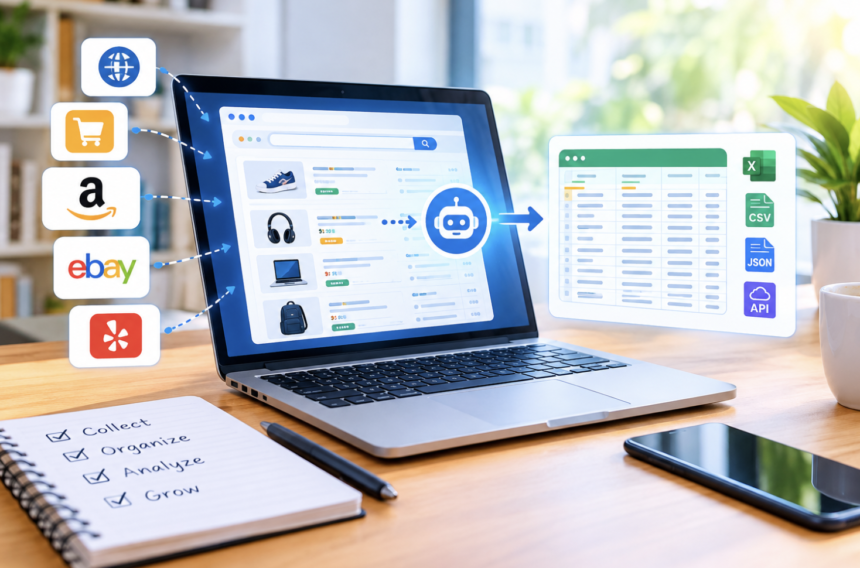
Data has become one of the most valuable business assets in 2026. Companies now track prices, products, competitors, trends, and customer demand through web data. However, collecting that information manually can quickly become expensive and unreliable. That is where web data extraction services become useful. These services collect information from websites and turn it into structured, usable datasets. Moreover, they can automate repetitive research tasks that consume valuable employee hours.
Yet, choosing the right provider is not always easy. Some platforms target developers, while others focus on non-technical users. Meanwhile, managed services handle the entire extraction process for you.
So, which option deserves your attention in 2026? This guide compares seven leading solutions. It also explains their strengths, limitations, pricing models, and ideal use cases.
What Are Web Data Extraction Services?
Web data extraction services collect information from websites automatically. They transform scattered online information into organized and usable data.
For example, businesses can collect product prices, property listings, reviews, stock information, or competitor details. They can then analyze this information inside spreadsheets, databases, dashboards, or business applications.
Furthermore, modern extraction systems can handle dynamic pages and frequently changing website structures. Some also manage proxies, browser rendering, and anti-bot challenges. Therefore, businesses can gather larger datasets without relying entirely on manual research.
How We Compared the Best Web Data Extraction Services
Choosing an extraction provider requires more than comparing monthly prices. A cheap service may become expensive when maintenance and data cleaning enter the equation. We considered several important factors during this comparison.
These include data accuracy, scalability, automation, reliability, technical difficulty, delivery formats, maintenance, support, and overall value.
We also considered the type of customer each service suits best. After all, a solution designed for developers may overwhelm a marketing team.
1. Ficstar: Best Overall Managed Web Data Extraction Service
Ficstar takes a different approach from most web scraping platforms. Instead of giving customers another tool to manage, it provides a fully managed extraction service. Businesses explain what information they need and which websites matter. Then, Ficstar’s team handles the technical implementation. This approach can save considerable time for companies without dedicated scraping engineers. It also reduces the maintenance burden caused by changing websites. Ficstar can manage proxy requirements, browser-based extraction, anti-bot challenges, monitoring, and scraper maintenance. Additionally, extracted information can undergo quality checks before delivery.
The service can provide structured data in formats such as CSV, Excel, JSON, or API-based delivery. Consequently, businesses can integrate collected information into existing workflows.
Another advantage is its project-based approach. Companies can request solutions around their specific data requirements instead of adapting their needs to a fixed software package.
Best for: Enterprises, research teams, retailers, and companies requiring continuous data without maintaining scrapers internally.
2. Oxylabs: Best for High-Volume Data Collection
Oxylabs is a strong choice for organizations that need large-scale web data infrastructure. Its ecosystem includes proxy solutions and scraping-focused products. The platform supports different proxy types and geographic targeting. Therefore, technical teams can build sophisticated extraction workflows around specific requirements.
Its web scraping tools can also help developers collect information from complex websites. Meanwhile, AI-assisted features can reduce some manual development work.
However, Oxylabs is more suitable for technical users. Teams generally need developers who understand APIs, scraping logic, proxies, and data processing. Therefore, businesses without technical resources may find managed alternatives easier.
Best for: Large technical teams and enterprises running high-volume extraction operations.
3. Zyte: Best for Developer-Focused Web Scraping
Zyte has a strong reputation among professional web scraping developers. Its ecosystem includes tools designed around automated extraction and web crawling. The platform is especially useful for developers who already understand scraping technologies. It can simplify difficult extraction tasks while providing infrastructure for recurring projects.
Its AI-powered extraction capabilities can also reduce the need for manually defining every page element. This feature becomes valuable when businesses process large numbers of similar pages.
Moreover, Zyte works well with development workflows involving Python and scraping frameworks. However, beginners may need additional technical knowledge. Businesses without developers could face a steeper learning curve.
Best for: Development teams creating automated data pipelines for e-commerce and market intelligence.
4. Octoparse: Best No-Code Web Data Extraction Tool
Octoparse focuses heavily on simplicity. Its visual interface allows users to create extraction workflows without extensive programming knowledge.
Users can select webpage elements and configure extraction tasks through a point-and-click interface. As a result, marketers and business users can start collecting structured information faster.
The platform supports features such as pagination, scheduling, and cloud-based task execution. It also provides templates for common extraction requirements.
However, no-code convenience has limitations. Highly customized workflows can become difficult to manage through visual controls.
Complex websites can also require additional configuration. Therefore, larger enterprises may eventually need a more flexible solution.
Best for: Beginners, marketers, researchers, and small businesses with straightforward extraction requirements.
5. Apify: Best for Pre-Built Scraping Workflows
Apify combines cloud automation with a marketplace of ready-made scraping solutions. These pre-built tools can reduce development time for popular websites. Users can find Actors designed for different websites and data collection tasks. They can then configure inputs and run these workflows through the cloud.
Apify also supports scheduling, datasets, storage, integrations, and automation. Therefore, developers can build broader data workflows around extracted information. Its ecosystem also works well with automation platforms. This makes it useful for businesses connecting web data with other applications.
Still, users should check the quality and maintenance status of individual Actors. Community-created solutions may differ considerably in reliability.
Best for: Developers and technical teams seeking flexible cloud scraping and ready-made extraction workflows.
6. Dexi.io: Best for Visual Data Pipelines
Dexi.io provides a visual approach to data extraction and automation. Its main advantage is the ability to connect extraction processes with downstream systems.
Businesses can build workflows that collect, transform, and transfer information. Consequently, teams can connect extracted data with databases, cloud services, or business applications.
The visual workflow model can also reduce the amount of custom programming required. However, Dexi.io may not provide the same enterprise recognition as some larger competitors. Businesses should therefore evaluate support, scalability, and project requirements carefully.
Best for: Operations teams that need extraction combined with data integration.
7. ScrapingBee: Best Simple Web Scraping API
ScrapingBee targets developers who want a straightforward scraping API. Its simple approach can help teams integrate web extraction into existing applications.
The service handles several technical challenges behind the API. These can include proxy management, browser rendering, and certain anti-bot requirements. This means developers can focus more on their application instead of managing every infrastructure component.
Furthermore, clear API-based workflows make ScrapingBee suitable for smaller projects and prototypes. However, large enterprise projects may require more advanced infrastructure. Pricing can also become more complicated when advanced features consume additional credits.
Best for: Developers and small teams seeking an easy-to-integrate scraping API.
Web Data Extraction Services Ratings
| Rank | Web Data Extraction Service | Rating | Best For |
|---|---|---|---|
| 1 | Ficstar | 9.8/10 | Best Overall Managed Service |
| 2 | Oxylabs | 9.2/10 | High-Volume Data Collection |
| 3 | Zyte | 9.0/10 | Developer-Focused Web Scraping |
| 4 | Octoparse | 8.7/10 | No-Code Web Data Extraction |
| 5 | Apify | 8.6/10 | Pre-Built Scraping Workflows |
| 6 | Dexi.io | 8.3/10 | Visual Data Pipelines |
| 7 | ScrapingBee | 8.2/10 | Simple Web Scraping API |
Which Web Data Extraction Service Should You Choose?
The best choice depends on your technical resources and business objectives. If you need a complete managed service, Ficstar stands out. It removes much of the technical workload associated with web extraction. On the other hand, Oxylabs suits businesses needing powerful scraping infrastructure. Zyte is another strong option for experienced development teams.
Meanwhile, Octoparse works well for users who prefer no-code workflows. Apify provides flexibility through cloud-based Actors and automation. Dexi.io fits businesses that prioritize visual data pipelines. Finally, ScrapingBee works well when a simple API matters most.
Therefore, there is no universal winner for every project. Your preferred solution should match your team’s skills, data volume, target websites, and maintenance expectations.
Important Features to Look for in a Data Extraction Service
Before choosing a provider, evaluate the entire extraction process.
Data Accuracy and Validation
Large datasets are useless when they contain incorrect information. Look for providers that validate, clean, and normalize collected data.
Scalability
Your requirements may grow after the first successful project. Therefore, choose infrastructure that can handle additional websites and larger volumes.
Website Change Detection
Websites constantly change their layouts. A reliable provider should detect broken extraction logic and restore collection quickly.
Data Delivery Options
Consider how your team will use the information. CSV, Excel, JSON, databases, and APIs can support different workflows.
Automation and Scheduling
Recurring data collection saves more time than occasional manual extraction. Look for scheduling options that match your reporting cycle.
Technical Support
Good support becomes essential when websites introduce new restrictions. Fast assistance can prevent important data pipelines from going offline.
Security and Compliance
Data collection should follow applicable laws, website policies, and privacy requirements. Providers should also explain how they protect customer information.
New Ways Businesses Use Web Data Extraction in 2026
Web data extraction now supports far more than basic competitor research. Retailers can monitor thousands of product prices and detect market changes quickly. E-commerce brands can also compare product availability across marketplaces. Real estate companies can track listings, rental prices, and market inventory. Likewise, financial teams can collect alternative market information for analysis.
Recruitment companies can monitor public job postings and hiring trends. Meanwhile, travel businesses can compare rates and availability across multiple sources.
Another growing use involves AI systems. Businesses can feed structured web data into analytics platforms and AI applications. This helps models work with fresher external information. However, extracted information still needs validation. Poor-quality input can produce misleading analysis and weak business decisions.
Managed Service vs Self-Service Platform
A self-service platform gives you control over the extraction process. You configure tasks, manage workflows, monitor results, and fix problems. That model works well for technical teams with available developers.
A managed service follows a different model. The provider takes responsibility for development, maintenance, monitoring, and data delivery.
Consequently, managed extraction can make more sense when data is business-critical. It also helps companies avoid hiring specialists solely for scraper maintenance. The trade-off is usually a higher service cost. However, businesses should compare that cost against internal engineering time.
Common Challenges With Web Data Extraction
Web extraction is not always straightforward. Websites may use JavaScript, rate limits, dynamic content, or access restrictions. Website redesigns can also break existing extraction workflows. Furthermore, inconsistent page structures can create incomplete datasets.
Data quality presents another challenge. Duplicate records, missing values, inconsistent names, and formatting differences can reduce usefulness.
Therefore, successful extraction requires more than simply downloading webpage content. Businesses need reliable collection, validation, transformation, and delivery processes.
Pros and Cons of Managed Web Data Extraction
Advantages
Managed services reduce internal development requirements. They also handle maintenance when websites change. Furthermore, businesses receive structured data without building the entire infrastructure themselves. This can improve productivity and reduce operational interruptions.
Potential Drawbacks
Managed solutions can cost more than basic DIY tools. They may also require project discussions before final pricing becomes available. Additionally, simple one-time projects may not justify a fully managed service.
How to Get Better ROI From Web Data Extraction
Start by identifying the business decision that depends on the data. Then determine which websites provide the information required. Next, define the collection frequency and required fields. Avoid collecting unnecessary information because larger datasets can increase processing costs.
You should also establish quality standards before extraction begins. Decide how your team will handle missing, duplicate, or outdated records.
Finally, measure business results after implementation. Track saved working hours, improved pricing decisions, faster research, or additional revenue opportunities. This approach turns web extraction from a technical project into a measurable business investment.
Final Verdict: Which Service Deserves Your Attention?
Web data extraction has become an important part of modern business intelligence. Yet, the right platform depends heavily on your team’s capabilities.
- Ficstar is the strongest choice for businesses seeking fully managed extraction.
- Oxylabs and Zyte suit technical teams that want powerful infrastructure.
- Octoparse remains useful for no-code users.
- Apify offers broad flexibility through cloud automation and pre-built Actors.
- Dexi.io is worth considering for visual data integration.
- ScrapingBee, meanwhile, provides a straightforward API experience.
Before committing, test your most difficult data source. Evaluate accuracy, stability, delivery quality, support, and total cost. Ultimately, the best extraction service is not the one with the longest feature list. It is the one that consistently delivers usable data with the least operational friction.
Frequently Asked Questions
1. What is web data extraction?
It is the automated collection of structured information from websites for business analysis and other purposes.
2. Is web data extraction legal?
Its legality depends on the data, jurisdiction, website policies, privacy rules, and how the information is used.
3. What is the best web data extraction service in 2026?
Ficstar is a strong managed option, while other platforms suit specific technical or no-code requirements.
4. Can non-technical users extract web data?
Yes, no-code platforms such as Octoparse can simplify extraction for users without programming experience.
5. How often can websites be scraped?
Collection frequency can range from occasional snapshots to scheduled daily or near-real-time updates.
6. Can extracted data connect with business software?
Yes, many services support formats, databases, APIs, and integrations for connecting extracted information.
7. Why does scraped data need cleaning?
Cleaning removes duplicates, fixes inconsistencies, and makes collected information more useful for analysis.
8. What happens when a website changes its design?
A scraper may stop working, so reliable services need monitoring and maintenance processes.
9. Is web data extraction useful for small businesses?
Yes, smaller companies can use extraction for competitor monitoring, market research, pricing, and lead research.
10. Should businesses choose managed or self-service extraction?
Managed services suit teams seeking convenience, while self-service tools suit businesses with technical resources.
11. Can web extraction support AI applications?
Yes, structured web data can provide external information for analytics, automation, and AI-powered workflows.
12. How should businesses choose an extraction provider?
Compare accuracy, scalability, support, delivery formats, technical requirements, compliance, and total project cost.