
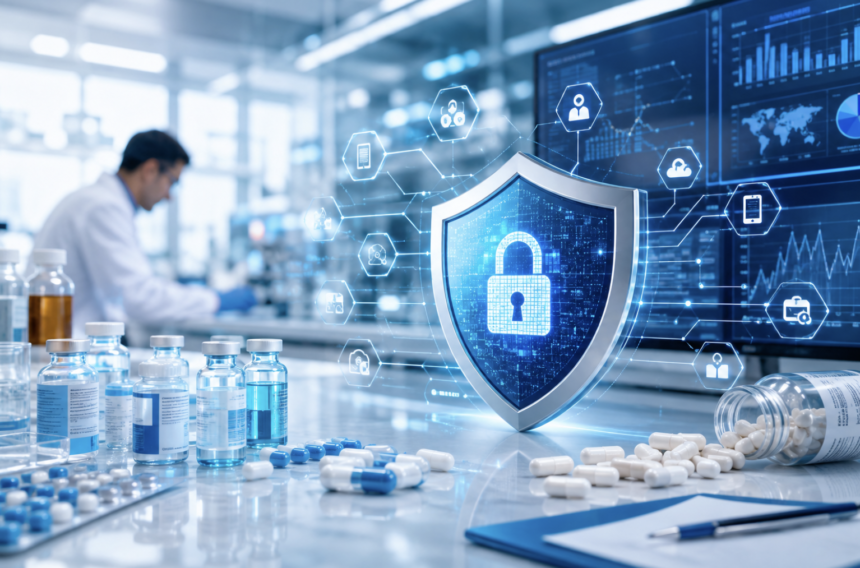
The pharmaceutical industry runs on information that cannot afford to fall into the wrong hands. A single clinical file can contain years of research, patient information, trial results, and commercial secrets. Meanwhile, cybercriminals continue searching for weaknesses across increasingly connected healthcare systems. That makes pharmaceutical data security more than an IT responsibility. It has become a critical part of research, compliance, business continuity, and patient safety. At the same time, pharmaceutical companies are generating more data than ever. Clinical trials produce enormous datasets. Genomic research creates highly detailed biological information. Laboratories generate reports, images, and experimental records every day.
Therefore, traditional security approaches are struggling to keep up. Advanced AI platforms are changing that situation. Instead of simply reacting to suspicious activity, modern systems can identify unusual patterns, analyse complex information, and support faster investigations.
More importantly, specialised platforms can help organisations manage sensitive data while maintaining stronger control over compliance and governance.
Why Pharmaceutical Data Has Become a Prime Cybersecurity Target
Pharmaceutical companies hold some of the world’s most valuable digital assets. These assets include drug formulas, clinical research, intellectual property, patient information, and regulatory documentation. Naturally, attackers see enormous financial opportunities in this information. Ransomware remains a major concern. However, modern attacks can involve much more than encrypted files. Criminal groups may steal research before demanding payment. They can also target employees, vendors, cloud accounts, and connected applications.
Furthermore, pharmaceutical organisations often work with universities, contract research organisations, laboratories, hospitals, and technology providers.
Consequently, every external connection can introduce another potential security weakness. An effective cybersecurity strategy must therefore look beyond the company’s internal network. It must also understand data movement across the wider research ecosystem.
The Hidden Problem: Pharmaceutical Data Is Extremely Complex
Security becomes harder when information does not follow a predictable structure. Pharmaceutical organisations handle structured databases alongside enormous volumes of unstructured content. These files may include laboratory notes, emails, scanned documents, clinical reports, contracts, images, spreadsheets, and research records. Traditional tools often struggle to understand the meaning hidden inside these formats.
For example, a document might contain sensitive trial information without using obvious security labels. A basic system may treat it like an ordinary file. Advanced AI platforms can approach the problem differently.
Machine learning and natural language processing can help identify relationships, patterns, and important information across different data types. As a result, security teams can gain a clearer view of what information exists and where it resides.
How Advanced AI Platforms Improve Pharmaceutical Data Security
Advanced AI platforms can strengthen pharmaceutical security across several important areas. First, they can help organisations discover sensitive information across large environments. Instead of reviewing thousands of documents manually, security teams can use intelligent classification capabilities to identify important records.
Second, AI can support anomaly detection. Systems can learn normal activity patterns and highlight unusual behaviour for investigation.
For instance, an account suddenly accessing thousands of clinical documents could trigger an alert. Similarly, unexpected data movement between systems may deserve immediate attention. Therefore, AI can help security teams focus their time on the events that matter most.
AI-Powered Threat Detection Can Reduce Response Time
Speed matters during a cyberattack. The longer attackers remain inside an environment, the more information they may access. They can also establish additional access points and disrupt critical operations. Advanced AI systems can continuously examine activity across large datasets. They can identify suspicious patterns that might otherwise remain unnoticed.
Moreover, automated analysis can help security teams investigate incidents faster. Instead of starting with thousands of unrelated records, investigators can receive prioritised information about potentially relevant activity. This does not eliminate the need for human experts. Instead, it gives those experts better information at the right moment.
AI Can Protect Intellectual Property Beyond Traditional Firewalls
Firewalls and endpoint protection remain important. However, they cannot solve every modern data security problem. Pharmaceutical intellectual property often exists inside documents and communication systems. Therefore, protecting the surrounding data requires deeper visibility. AI-powered platforms can analyse documents and identify sensitive content based on context.
For example, an organisation may need to locate files containing experimental results, proprietary formulas, or confidential agreements.
Intelligent classification can help identify these materials even when employees use inconsistent file names. As a result, companies can apply stronger controls to their most valuable information.
The Role of Natural Language Processing in Clinical Data Security
Natural language processing has become increasingly useful for pharmaceutical organisations. Clinical and research environments contain enormous amounts of written information. Much of it cannot be analysed effectively using simple keyword searches. NLP can examine language and identify relevant concepts across large document collections.
This capability can help organisations locate sensitive information more efficiently. It can also support investigations involving emails, reports, contracts, and research documentation.
Additionally, NLP can help investigators understand connections between people, documents, events, and communication. That makes it particularly valuable during regulatory investigations and digital forensics.
Advanced AI Helps Strengthen Regulatory Compliance
Pharmaceutical organisations operate under strict regulatory expectations. Data must remain accurate, traceable, and trustworthy throughout its lifecycle. Furthermore, organisations must demonstrate appropriate controls when regulators request evidence. This is where AI-supported governance can provide significant value.
Advanced platforms can help organisations locate relevant records quickly. They can also support classification, auditing, investigation, and information governance.
Consequently, compliance teams can spend less time searching through disconnected systems. Instead, they can focus on reviewing evidence and addressing genuine risks.
Protecting Data Throughout Its Entire Lifecycle
Data security should not begin when information reaches a database. It should begin when data is created. Pharmaceutical information passes through multiple stages. It may move from laboratories to clinical research teams. Later, it may reach regulatory departments, external partners, and manufacturing organisations. Each stage creates security considerations. Advanced AI platforms can support visibility across this lifecycle.
They can help identify where sensitive information exists, who accesses it, and how it moves through the organisation. This broader visibility can help security teams identify risks before they become major incidents.
AI Can Strengthen Third-Party Risk Management
Third-party relationships create another major challenge for pharmaceutical companies. Research organisations often depend on external laboratories, software providers, consultants, cloud services, and clinical partners.
Unfortunately, attackers can exploit weaker security controls within these connected environments. Therefore, third-party risk management should become part of the overall security strategy.
AI can help organisations analyse activity associated with external users and systems. It can also help identify unusual access patterns and potential data exposure. As a result, companies can monitor vendor-related risks more consistently.
Advanced Analytics Can Improve Digital Forensics
When an incident occurs, investigators need answers quickly. They must determine what happened, which systems were affected, what information was accessed, and who was involved. However, large organisations may have millions of records to examine. Advanced AI platforms can accelerate this process by analysing huge volumes of information. They can help investigators discover relationships between seemingly unrelated records.
For example, an investigation could connect an unusual login with a document download and subsequent external communication.
These connections may provide valuable clues about the attack. Therefore, AI-supported digital forensics can reduce investigation time while improving visibility.
AI Governance Is Just as Important as AI Security
Using AI for security does not remove the need for governance. Pharmaceutical organisations must understand how AI systems process information. They should also establish appropriate access controls, audit mechanisms, and human oversight. Furthermore, AI models can produce inaccurate results.
A security team should never assume that an automated recommendation is always correct. Human review remains essential for high-impact decisions.
Companies should therefore establish clear policies covering model validation, data access, monitoring, and accountability. This approach can make AI deployment safer and more reliable.
The Importance of Data Classification
Data classification provides another important security layer. Not every pharmaceutical document carries the same level of risk. A public research announcement differs significantly from confidential clinical trial data. Likewise, an internal project plan may require different controls from personally identifiable patient information.
AI can help classify information based on its content and context. This process allows organisations to apply appropriate protection measures.
For example, highly sensitive research documents may receive stricter access controls and monitoring. Meanwhile, less sensitive information can remain easier for authorised employees to access. This balance can improve both security and productivity.
How AI Supports Zero Trust Security
Zero Trust has become an important security approach for modern organisations. Its central principle is simple: access should never be trusted automatically. Every user, device, application, and connection should receive appropriate verification. Advanced AI can support this model by analysing behavioural signals.
A user might normally access a small group of research files. Suddenly, that same account begins accessing unrelated datasets at unusual times.
AI can identify the difference between normal and suspicious behaviour. Consequently, security teams can investigate potentially compromised accounts sooner.
Cloud Security Needs Intelligent Monitoring
Pharmaceutical companies increasingly rely on cloud environments for collaboration and data processing. Cloud platforms offer flexibility and scalability. However, they can also introduce new configuration and access risks.
Sensitive information may move between cloud applications, internal systems, and external services. AI-powered monitoring can help organisations understand these movements.
It can identify unusual access, suspicious downloads, and unexpected changes in activity. Therefore, intelligent cloud monitoring can become an important part of a broader pharmaceutical cybersecurity strategy.
Reducing Security Costs Through Intelligent Automation
Cybersecurity requires significant resources. Security teams must monitor systems, investigate alerts, manage compliance requirements, and respond to incidents. Manual processes can consume substantial time. AI can automate repetitive analytical tasks and help prioritise investigations.
As a result, skilled security professionals can concentrate on complex decisions rather than routine data review. Over time, this can improve operational efficiency while supporting stronger security.
What Pharmaceutical Companies Should Look for in an AI Security Platform
Not every AI platform is suitable for pharmaceutical environments. Companies should evaluate several capabilities before making a decision. First, the platform should support large and diverse datasets. It should also provide strong search and discovery capabilities. Next, organisations should examine its security controls and audit features. Data privacy also deserves careful attention. Sensitive information should receive appropriate protection throughout processing and storage.
Additionally, companies should evaluate integration capabilities. A useful platform should work effectively with existing security, compliance, cloud, and data management environments.
Finally, organisations should consider explainability and human oversight. Security teams need to understand why a system identified something as suspicious.
Building a Future-Ready Pharmaceutical Security Strategy
The future of pharmaceutical cybersecurity will involve more than deploying another security product. Organisations need a connected strategy that combines people, processes, governance, and intelligent technology. Advanced AI platforms can become an important part of that strategy. However, successful implementation requires careful planning.
Companies should first identify their most sensitive information. Next, they should map where that information exists and how it moves. Afterward, they can identify gaps in monitoring, classification, compliance, and incident response.
AI can then be introduced where it provides the greatest practical benefit. This approach reduces unnecessary complexity and creates a stronger foundation for long-term security.
The Future of AI-Driven Pharmaceutical Data Protection
Pharmaceutical research will continue generating larger and more complicated datasets. At the same time, cyber threats will become more sophisticated. Therefore, organisations need security systems that can keep pace with both challenges. Advanced AI platforms offer a promising path forward. They can analyse complex information, identify unusual activity, support investigations, strengthen compliance, and improve data visibility.
More importantly, they can help pharmaceutical companies protect the information behind tomorrow’s medical breakthroughs. The goal is not simply to stop attacks. It is to create an environment where researchers can innovate confidently while sensitive information remains protected.
As pharmaceutical organisations continue their digital transformation, intelligent data security will become increasingly important. Companies that combine advanced AI with strong governance and human expertise will be better positioned to protect their research, meet regulatory expectations, and maintain trust.
Conclusion
Pharmaceutical data has become one of the most valuable digital assets in the world. Unfortunately, its value also makes it an attractive target for cybercriminals. Traditional security tools remain essential, but they cannot always provide the visibility needed across complex research environments. Advanced AI platforms can fill important gaps.
They can discover sensitive information, detect unusual behaviour, accelerate investigations, support compliance, and improve third-party monitoring. Furthermore, AI can help security teams manage massive volumes of structured and unstructured information. Still, technology alone cannot guarantee complete protection.
Pharmaceutical companies need strong governance, skilled professionals, sensible access controls, and continuous monitoring. When these elements work together, advanced AI becomes more than a cybersecurity tool. It becomes a strategic layer for protecting research, intellectual property, patient information, and the future of pharmaceutical innovation.
Frequently Asked Questions
1. What are advanced AI platforms in pharmaceutical cybersecurity?
Advanced AI platforms use machine learning and intelligent analytics to detect threats and protect sensitive pharmaceutical information.
2. Why is pharmaceutical data a major cybersecurity target?
Pharmaceutical companies hold valuable patient information, clinical research, intellectual property, and proprietary drug development data.
3. Can AI detect suspicious activity in pharmaceutical systems?
Yes, AI can analyse behavioural patterns and identify unusual activity that may indicate security risks.
4. How does AI protect clinical trial information?
AI can classify sensitive records, monitor access, identify anomalies, and support investigations involving clinical trial data.
5. Can AI help pharmaceutical companies meet compliance requirements?
Yes, AI can improve data discovery, auditing, classification, monitoring, and evidence collection for compliance activities.
6. Does AI replace human cybersecurity professionals?
No, AI supports security professionals by automating analysis while humans remain responsible for important decisions.
7. How can AI protect pharmaceutical intellectual property?
AI can identify sensitive research documents and monitor unusual access or movement involving proprietary information.
8. Why is unstructured data difficult to secure?
Unstructured information appears across documents, emails, reports, and images, making traditional classification and monitoring more difficult.
9. Can AI improve pharmaceutical digital forensics?
Yes, AI can analyse large datasets quickly and help investigators discover connections between users, files, systems, and events.
10. Is AI useful for third-party pharmaceutical security?
Yes, AI can monitor vendor activity and identify unusual access patterns across connected external environments.
11. What is the role of AI in Zero Trust security?
AI can analyse behaviour and risk signals to help organisations make more informed access and monitoring decisions.
12. What should companies consider before adopting AI security platforms?
Companies should evaluate data protection, integrations, scalability, governance, explainability, compliance, and human oversight.