

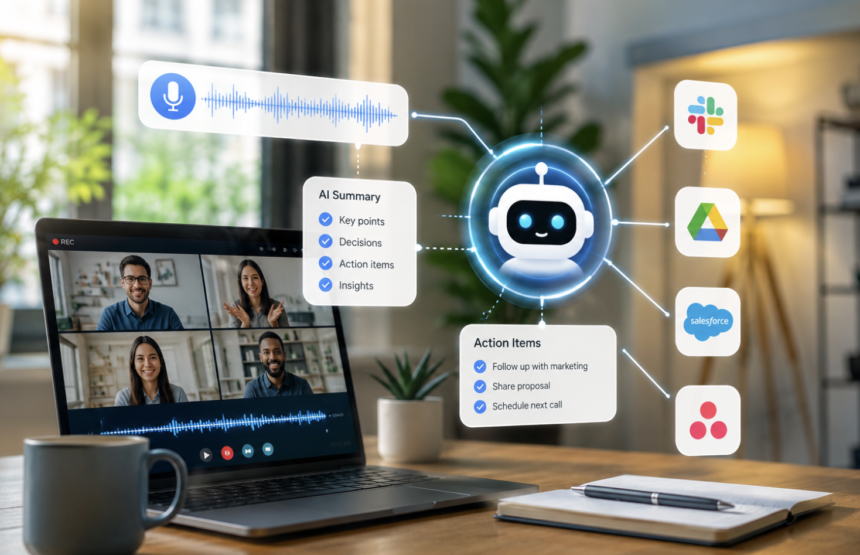
A meeting can end in thirty minutes, yet its most valuable information can shape decisions for months. Customers reveal priorities, teams make commitments, and managers approve important changes. However, much of that knowledge disappears into recordings and transcripts after the call ends.
Now, AI agents are changing what happens next. Instead of treating meeting recordings as passive archives, businesses can connect them directly to intelligent agents. This connection allows AI systems to find conversations, understand context, identify decisions, and support follow-up work. The key technology behind this shift is the Model Context Protocol (MCP). It creates a standardized way for AI applications to interact with external tools and information sources.
Consequently, meeting data can become part of an agent’s working environment. That means an AI agent can move beyond simply summarizing meetings. It can use conversation history to support workflows, answer questions, update systems, and improve business decisions.
This creates a powerful opportunity for companies that already depend on recorded meetings but struggle to turn conversations into useful action.
Why Meeting Recordings Have Become Valuable AI Data
Every business conversation contains information that rarely appears in formal documents. A sales call might reveal a customer’s biggest concern. A product meeting might settle an important feature decision. Meanwhile, an internal discussion might assign responsibilities that nobody records elsewhere. Traditionally, employees had to remember these details or manually transfer them into another system. That process creates several problems. First, important context can be forgotten. Second, employees may interpret conversations differently. Finally, manual data entry consumes time that teams could spend on higher-value activities. Meeting recordings solve only part of the problem.
They preserve conversations, but storing information does not automatically make it useful. Someone still needs to locate the right recording, review it, extract relevant details, and apply those findings.
AI agents can change that workflow. When agents can access meeting information, conversations become searchable sources of business context rather than forgotten files.
What Is MCP and Why Does It Matter?
The Model Context Protocol provides a standardized framework for connecting AI systems with external applications and data. Before standardized protocols became available, developers often needed separate integrations for individual AI tools and applications. Each connection could require different authentication methods, data formats, and development work. MCP introduces a more consistent approach.
A compatible application can expose selected information or functions through an MCP server. An AI agent can then interact with those capabilities through the protocol. For meeting recordings, this could create a structured bridge between the recording platform and an AI agent.
The agent does not necessarily need direct access to every stored file. Instead, the meeting platform can determine which information the agent can request. This distinction matters because meeting data often contains confidential business information.
How MCP Connects Meeting Recordings to AI Agents
The basic workflow can be surprisingly straightforward. A meeting platform stores a recording, transcript, summary, or related information. Its MCP implementation exposes approved capabilities. An AI agent then connects to that MCP interface. When the agent receives a relevant task, it can request information from the meeting system. For example, imagine a sales representative asking an AI agent to prepare a customer follow-up. The agent could retrieve the relevant meeting transcript. It could then identify the customer’s concerns, requested features, agreed deadlines, and unanswered questions.
Afterward, the agent could use that information to prepare a personalized follow-up. The employee still reviews the result. However, they no longer need to manually replay an hour-long meeting.
This is where the real value appears. The technology does not simply make meetings easier to search. It connects conversation intelligence with the rest of the business workflow.
From Passive Recordings to Actionable Conversation Data
A recording by itself is passive. An AI-accessible recording becomes actionable. That difference can influence several business processes. Sales teams can connect customer conversations with CRM activities. Support teams can identify recurring customer complaints. Product teams can discover feature requests across multiple calls. Furthermore, managers can investigate decisions without asking employees to reconstruct old conversations.
Instead of asking, “What did the customer say last month?” an employee could ask an AI agent to locate relevant discussions. The agent could potentially identify patterns across numerous meetings.
For example, it might discover that several customers mentioned the same competitor. Similarly, it could identify repeated objections during sales demonstrations. That information can support better planning without requiring employees to manually review every recording.
Practical Tasks AI Agents Can Perform With Meeting Data
Connecting meeting recordings to AI agents can support many workflows.
1. Automated Follow-Up Preparation
After a customer meeting, an agent can extract important discussion points. It can identify commitments, questions, deadlines, and next steps. Then, it can use those details when preparing a follow-up message. Therefore, follow-ups become more relevant and less dependent on human memory.
2. CRM Context Enrichment
Sales conversations often contain information that never reaches the CRM. An AI agent could identify relevant details from approved meeting data. It could then prepare suggested CRM updates for human review. This approach can reduce repetitive administrative work while preserving important customer context.
3. Cross-Meeting Search
Searching one recording is useful. Searching hundreds of conversations is far more powerful. An AI agent could help users locate discussions involving specific customers, products, competitors, problems, or decisions. Consequently, historical conversations become easier to analyze.
4. Decision Tracking
Meetings frequently produce decisions that later become unclear. An AI agent can help locate the conversation where a decision was discussed. It can also surface supporting context when employees need to understand why something changed. This capability can reduce unnecessary meetings and repeated discussions.
5. Task Identification
People often leave meetings with several responsibilities. However, those responsibilities can remain buried inside transcripts. An AI agent can identify potential action items and organize them for review. Those tasks can then move into project management or workflow systems.
How MCP Can Improve AI Agent Context
AI agents perform better when they have relevant context. Without meeting information, an agent may understand a customer’s CRM record but miss the conversation behind it. Consider a customer whose CRM record says, “Interested in enterprise plan.” That statement provides limited context. A meeting transcript could reveal why the customer wants the plan, which features matter most, and what objections remain. The agent can combine those details with information from other business systems.
As a result, its responses can become more grounded in actual conversations. This is especially useful when employees interact with multiple systems throughout the day.
Instead of switching between recording platforms, CRMs, calendars, task managers, and email tools, they can increasingly rely on AI to connect the information.
Security and Permission Controls Are Essential
Meeting recordings can contain sensitive information. They may include customer data, financial discussions, employee conversations, product plans, or confidential business strategies. Therefore, connecting recordings to AI agents requires careful permission management. Access should follow existing authorization rules wherever possible. An employee who cannot access a particular meeting should not suddenly gain access through an AI agent.
Organizations should also examine authentication, data retention, encryption, audit logs, and administrative controls. Additionally, companies should understand exactly what information an MCP server exposes.
A secure implementation should minimize unnecessary access. The goal is not to give an AI agent unrestricted visibility. Instead, the goal is to provide the right information for the right task.
Data Quality Determines AI Quality
AI cannot create reliable information from poor meeting data. If recordings are missing, transcripts contain major errors, or speakers are incorrectly identified, agents may produce incomplete results. Therefore, organizations should improve their meeting-data foundation before expanding AI automation. Consistent recording policies can help.
Clear audio can also improve transcription accuracy. Likewise, accurate speaker identification can make conversations easier for AI systems to interpret. Human review remains valuable as well.
AI-generated action items and decisions should be verified before they trigger important business processes. This creates a balanced workflow where AI handles repetitive analysis while people maintain final control.
MCP and the Future of Meeting Intelligence
The broader opportunity goes beyond individual meeting summaries. As AI agents become more capable, meeting data could become part of continuous business intelligence. Imagine an agent monitoring approved customer conversations over several months. It could identify recurring requests and emerging concerns. Similarly, a product agent could analyze discussions across sales, support, and research teams. A leadership agent could help identify unresolved decisions across departments.
These possibilities become more practical when AI systems can access business information through standardized connections. MCP can therefore serve as an important bridge between conversational data and agent-based automation.
The technology itself is only one part of the equation. Businesses also need clear governance, reliable data, appropriate permissions, and well-defined workflows.
What Businesses Should Consider Before Connecting Meeting Data
Companies should begin with a specific use case rather than connecting everything immediately. For example, a sales team might start with automated follow-up preparation. A customer-support department could begin with recurring issue discovery. Next, organizations should determine which meeting data the agent actually needs. They should also establish permission rules before enabling access. Testing is equally important.
Teams should compare AI-generated outputs against original recordings. This process can reveal transcription problems, missing context, or incorrect interpretations.
Finally, organizations should measure the results. Useful metrics might include time saved, follow-up speed, CRM accuracy, task completion, and employee adoption. A successful implementation should produce measurable improvements rather than simply adding another AI feature.
Why This Connection Could Change Everyday Work
The biggest opportunity is not faster transcription. It is the ability to connect conversations with action. Meetings represent a significant portion of organizational knowledge. Yet historically, much of that knowledge remained trapped inside recordings. MCP can help open a standardized pathway between meeting platforms and AI agents. Once that pathway exists, agents can potentially use conversations alongside calendars, CRMs, project systems, documents, and other business tools.
That creates a more connected working environment. Employees spend less time searching for information. Managers gain better visibility into decisions. Sales teams can maintain stronger customer context.
Meanwhile, AI agents gain access to information that previously remained outside their reach. The result is a shift from recording meetings to using meetings as operational intelligence.
Conclusion
Meeting recordings have long preserved valuable business conversations, but preservation alone is not enough. The real advantage comes when that information can support decisions and workflows. By connecting meeting platforms with AI agents through MCP, organizations can make conversation data more accessible and useful. Agents can potentially find relevant discussions, identify decisions, prepare follow-ups, support CRM workflows, and uncover patterns across historical conversations.
However, businesses must approach the process responsibly. Strong permissions, reliable transcripts, clear governance, and human oversight remain essential. Ultimately, MCP could help transform meetings from forgotten archives into active sources of business intelligence.
As AI agents become more deeply integrated into everyday work, that transformation could become one of the most practical ways to turn conversations into measurable action.
Frequently Asked Questions
1. What is MCP for AI agents?
MCP is a standardized protocol that helps AI agents interact with external tools, data, and services.
2. Can AI agents access meeting recordings through MCP?
Yes, compatible meeting platforms can expose approved recording data through MCP connections.
3. What meeting information can AI agents use?
Depending on the integration, agents may access transcripts, summaries, action items, metadata, or other approved information.
4. Can MCP automatically update a CRM from meetings?
It can support that workflow when the connected systems and agent provide the necessary capabilities.
5. Are meeting recordings safe to connect to AI agents?
They can be, provided organizations implement strong authentication, permissions, privacy controls, and monitoring.
6. Does MCP give an AI agent access to every meeting?
Not necessarily, because properly configured permissions can restrict which meetings and information an agent can access.
7. Can AI agents search multiple meeting recordings?
Yes, supported integrations can allow agents to retrieve relevant information across multiple approved conversations.
8. Why are meeting transcripts useful for AI agents?
Transcripts provide searchable conversational context that agents can analyze for decisions, questions, commitments, and customer needs.
9. Can AI agents create meeting summaries automatically?
Yes, AI agents can generate summaries when they have access to suitable recording or transcript data.
10. Will AI completely replace human meeting follow-ups?
No, human review remains important for accuracy, judgment, privacy, and sensitive business decisions.
11. What is the biggest benefit of connecting meetings to AI?
The biggest benefit is turning previously passive conversation data into information that can support real business workflows.
12. What should companies do before implementing MCP?
Companies should define a clear use case, review permissions, assess data quality, and test the workflow before scaling it.
13. Can MCP connect AI agents with other business tools?
Yes, MCP is designed to provide standardized connections between AI systems and compatible external tools or services.
14. Does better meeting data improve AI results?
Yes, accurate recordings, transcripts, speaker identification, and consistent capture can improve the quality of AI-generated results.
15. Is MCP useful for small businesses?
Yes, small businesses can benefit when meeting data represents an important source of customer or operational information.