

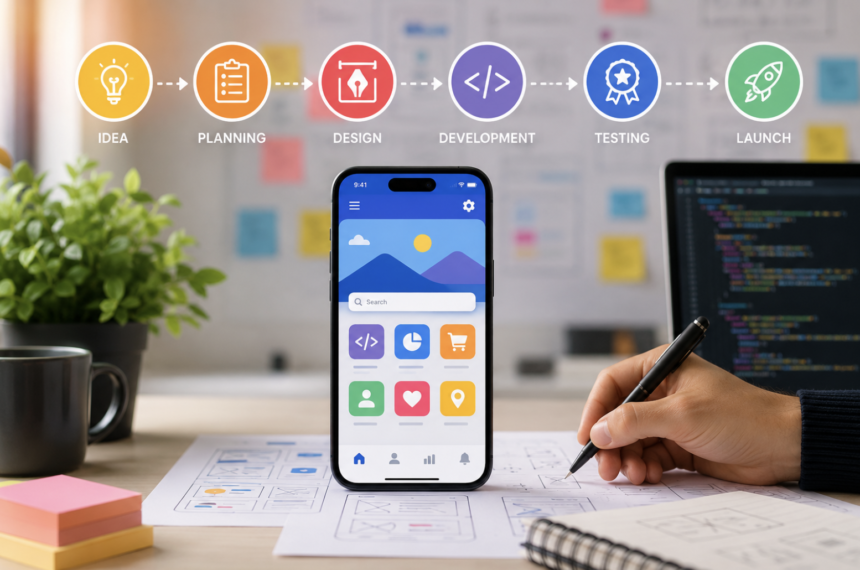
Every successful mobile application begins with a single idea. However, only a small percentage of those ideas become profitable digital products. The difference rarely depends on creativity alone. Instead, it comes from following a structured mobile app development lifecycle that transforms concepts into scalable, user-friendly applications.
Modern businesses rely on mobile apps to connect with customers, increase revenue, and build lasting relationships. Consequently, founders who understand every development stage make better business decisions while avoiding expensive mistakes. Moreover, they communicate more effectively with designers, developers, and investors throughout the project.
Whether you plan to build a startup, launch a marketplace, create a healthcare solution, or develop a fintech platform, understanding the mobile app development lifecycle is essential. This comprehensive guide explains every phase while introducing additional strategies that help founders reduce risks, improve product quality, and accelerate long-term growth.
Why the Mobile App Development Lifecycle Matters
Launching an application without a proper development process often leads to delays, budget overruns, poor user experiences, and disappointing downloads. Therefore, following a structured lifecycle creates consistency from planning through maintenance. A well-defined development lifecycle helps businesses:
- Reduce unnecessary development costs.
- Build products users genuinely need.
- Improve collaboration between departments.
- Launch faster with fewer bugs.
- Scale efficiently after release.
- Increase customer satisfaction.
- Improve long-term return on investment.
Most importantly, every stage prepares the foundation for the next. As a result, skipping one phase usually creates problems later.
Phase 1: Validate the Business Idea Before Writing Code
Many founders become excited about their app idea. Nevertheless, successful entrepreneurs validate the opportunity before investing significant money.
Identify a Real Market Problem
Every great application solves an actual customer challenge. Therefore, begin by identifying problems people experience daily. Instead of asking whether your idea sounds interesting, ask:
- What pain point does this solve?
- Why would customers switch?
- How frequently will users need this solution?
- Is the problem valuable enough to justify downloading another app?
Answering these questions helps determine whether your product has genuine market demand.
Conduct Detailed Market Research
Competitive research reveals opportunities that competitors overlook. Study existing applications carefully by examining:
- User ratings
- Negative reviews
- Missing features
- Pricing strategies
- Customer complaints
- User experience quality
Furthermore, analyze successful competitors to understand industry expectations without copying their products.
Define Your Target Audience
Understanding users influences every business decision. Create detailed customer personas including:
- Age groups
- Occupation
- Geographic location
- Technical knowledge
- Buying behavior
- Daily challenges
- Preferred devices
Consequently, your application becomes easier to design and market.
Build an MVP Instead of a Full Product
Many startups fail because they attempt to launch every feature immediately. Instead, create a Minimum Viable Product (MVP) containing only essential functionality. An MVP helps you:
- Launch earlier.
- Reduce development costs.
- Test assumptions.
- Collect real customer feedback.
- Improve future updates.
Phase 2: Strategic Product Planning
Before development begins, successful teams create detailed project documentation. This planning stage includes:
- Product requirements
- Feature prioritization
- User stories
- Technical specifications
- Budget estimation
- Timeline planning
- Risk assessment
Additionally, founders should define measurable business goals before coding starts. Examples include:
- Monthly active users
- Customer retention
- Revenue targets
- App downloads
- Subscription growth
These metrics guide future decisions.
Phase 3: Create an Outstanding UI and UX Design
Outstanding technology cannot compensate for poor design. Users decide whether they like an app within seconds. Therefore, user experience becomes one of the strongest competitive advantages.
Information Architecture
Information architecture organizes content logically. Designers determine:
- Navigation structure
- Screen hierarchy
- User pathways
- Menu organization
Every action should require minimal effort.
Wireframing
Wireframes provide simple blueprints for each screen. At this stage, teams focus entirely on functionality instead of visual appearance. Consequently, structural problems become easier to fix before expensive development begins.
Interactive Prototypes
Interactive prototypes simulate the real application. Founders can test navigation, user flows, and interactions without writing production code. This process saves considerable time and money.
Visual Design
Once functionality is approved, designers create attractive interfaces using:
- Brand colors
- Typography
- Icons
- Illustrations
- Animations
- Visual consistency
Strong branding increases recognition while improving user confidence.
Phase 4: Choosing the Right Development Approach
Technology decisions directly affect project cost, maintenance, and scalability.
Native Development
Native applications use:
- Swift for iOS
- Kotlin for Android
Native apps deliver:
- Better performance
- Faster execution
- Superior hardware integration
- Improved responsiveness
However, development costs increase because separate applications require separate codebases.
Cross-Platform Development
Frameworks like Flutter and React Native allow developers to build one application for multiple platforms. Benefits include:
- Faster development
- Lower costs
- Easier maintenance
- Consistent experiences
Many startups prefer this option during early growth.
Phase 5: Backend Development and Infrastructure
The backend powers everything users cannot see. It manages:
- Authentication
- Databases
- Payment processing
- Notifications
- Cloud storage
- Security
- APIs
A scalable backend ensures future growth without major rebuilding. Cloud providers such as AWS, Microsoft Azure, and Google Cloud simplify infrastructure while supporting millions of users.
Phase 6: Frontend Development
Frontend developers transform approved designs into working applications. Their responsibilities include:
- Screen implementation
- Navigation
- Animations
- User interactions
- Offline functionality
- Accessibility improvements
Performance optimization remains essential because slow applications quickly lose users.
Phase 7: API Integration
Modern applications depend on external services. Developers integrate APIs for:
- Payment gateways
- Maps
- Social login
- Messaging
- Email verification
- Artificial intelligence
- Analytics
Reliable API architecture improves flexibility and future expansion.
Phase 8: Security and Data Protection
Cybersecurity should never become an afterthought. Instead, security begins during development. Essential practices include:
- Data encryption
- Secure authentication
- Multi-factor authentication
- SSL certificates
- Regular vulnerability testing
- Secure coding practices
- GDPR and privacy compliance
Strong security builds customer trust while protecting sensitive information.
Phase 9: Agile Development Methodology
Most successful software teams use Agile development. Instead of building everything simultaneously, developers work in short sprints. Each sprint delivers working functionality that founders can review immediately. Agile provides several advantages:
- Faster feedback
- Better flexibility
- Continuous improvement
- Lower project risks
- Easier prioritization
Consequently, businesses adapt quickly to changing market demands.
Phase 10: Comprehensive Testing and Quality Assurance
Testing ensures the application performs reliably under real-world conditions. Quality assurance includes multiple testing types.
Functional Testing
Every feature should operate exactly as expected.
Performance Testing
Applications must remain responsive during heavy traffic.
Compatibility Testing
Apps require testing across multiple devices, operating systems, and screen sizes.
Security Testing
Ethical hackers identify vulnerabilities before attackers discover them.
Usability Testing
Real users reveal navigation issues developers often overlook. Continuous testing dramatically reduces launch-day surprises.
Phase 11: App Store Launch Strategy
Publishing an application requires more than pressing a button. Apple and Google review every submission carefully. Prepare:
- Privacy policies
- App descriptions
- Keywords
- Screenshots
- Promotional videos
- Age ratings
- Support information
Additionally, optimize every listing using App Store Optimization (ASO). Higher rankings generate more organic downloads.
Phase 12: Marketing Before Launch
Marketing should begin months before release. Build anticipation through:
- Landing pages
- Email newsletters
- Social media campaigns
- Product teasers
- Beta communities
- Influencer collaborations
- Press outreach
Early visibility creates momentum during launch week.
Phase 13: Monitor Performance After Launch
Launch day marks the beginning rather than the finish. Track important metrics including:
- Daily active users
- Session duration
- Customer retention
- Crash reports
- Conversion rates
- Subscription renewals
- Feature adoption
Analytics platforms reveal opportunities for continuous improvement.
Phase 14: Continuous Updates and Feature Expansion
Successful applications evolve constantly. Listen carefully to customer feedback. Release improvements regularly by:
- Fixing bugs
- Improving performance
- Adding requested features
- Updating security
- Enhancing accessibility
- Supporting new operating systems
Frequent updates encourage long-term customer loyalty.
How Artificial Intelligence Is Transforming Mobile App Development
Artificial intelligence has become a major advantage during modern app development. AI helps teams:
- Personalize recommendations.
- Automate customer support.
- Predict user behavior.
- Detect fraud.
- Improve search functionality.
- Generate smarter analytics.
- Increase customer engagement.
Consequently, AI-driven applications often achieve higher retention rates.
Common Mistakes Founders Should Avoid
Many promising projects fail because of preventable mistakes. Avoid these common problems:
- Skipping market validation.
- Ignoring user feedback.
- Adding unnecessary features.
- Underestimating testing.
- Choosing technology solely by cost.
- Neglecting cybersecurity.
- Launching without marketing.
- Failing to monitor analytics.
Preventing these issues significantly improves long-term success.
Choosing the Right Mobile App Development Partner
Selecting an experienced development company often determines project success. Look for partners with:
- Strong technical expertise.
- Transparent communication.
- Proven portfolios.
- Agile development experience.
- Dedicated QA teams.
- Post-launch support.
- Scalable infrastructure knowledge.
An experienced development partner contributes strategic guidance beyond programming.
Future Trends in Mobile App Development
Technology continues evolving rapidly. Founders should monitor emerging innovations including:
- Artificial intelligence integration.
- Machine learning automation.
- Augmented reality experiences.
- Internet of Things connectivity.
- Voice-enabled applications.
- Wearable device compatibility.
- Blockchain-based security.
- Edge computing.
- 5G optimization.
Adopting these technologies strategically creates stronger competitive advantages.
Conclusion
Understanding the mobile app development lifecycle gives founders a significant competitive advantage. Every stage contributes to creating a reliable, scalable, and customer-focused application. Careful planning reduces unnecessary expenses, while thoughtful design improves user satisfaction. Strong development practices increase stability, and comprehensive testing minimizes launch risks. After release, continuous monitoring and regular updates keep the application relevant in an increasingly competitive marketplace. Founders who embrace every phase, invest in quality, and prioritize user feedback position their products for sustainable long-term growth and lasting success.
Frequently Asked Questions
1. What is the mobile app development lifecycle?
It is the complete process of planning, designing, developing, testing, launching, and maintaining a mobile application.
2. Why is an MVP important?
An MVP helps validate ideas quickly while reducing development costs and risks.
3. How long does mobile app development take?
Most applications require three to twelve months, depending on complexity.
4. Should startups choose native or cross-platform development?
The choice depends on budget, performance requirements, and long-term business goals.
5. Why is UI/UX design important?
Excellent design improves usability, customer satisfaction, and user retention.
6. What is Agile development?
Agile delivers software through short development cycles with continuous improvements.
7. Why is quality assurance necessary?
QA identifies bugs before release and ensures a stable user experience.
8. What is App Store Optimization (ASO)?
ASO improves app visibility and increases organic downloads in app stores.
9. How important is cybersecurity in mobile apps?
Strong security protects user data, builds trust, and prevents costly breaches.
10. What should founders monitor after launch?
They should track analytics, user engagement, crash reports, retention, and customer feedback.
11. How often should mobile apps receive updates?
Applications should receive regular updates whenever improvements, fixes, or new features become available.
12. Can artificial intelligence improve mobile applications?
Yes, AI enhances personalization, automation, analytics, customer support, and overall user experience.