

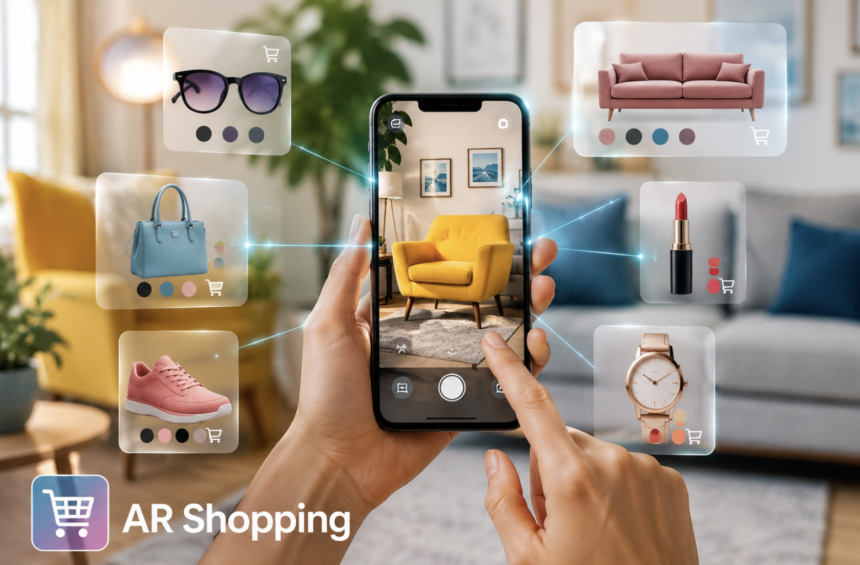
Imagine placing a sofa in your living room before buying it. Picture trying on sunglasses without stepping into a store. Visualize testing makeup shades instantly through your smartphone. This is no longer a futuristic concept. Instead, it has become a powerful reality driven by Augmented Reality shopping experiences.
Modern consumers demand convenience, personalization, and confidence before making purchases. Therefore, retailers are adopting innovative technologies that bridge the gap between physical and digital shopping. Among these innovations, Augmented Reality stands out as one of the most influential tools in e-commerce.
As online competition grows, brands need stronger ways to engage shoppers. Consequently, AR shopping experiences are helping businesses increase customer satisfaction while improving conversion rates. This technology is redefining how people discover, evaluate, and purchase products online.
What Is Augmented Reality Shopping?
Augmented Reality shopping allows consumers to visualize products within their real-world environment using smartphones, tablets, or AR-enabled devices. Rather than relying on static images, shoppers can interact with virtual products in real time. This immersive experience creates a stronger connection between consumers and products. As a result, buyers feel more confident during the decision-making process. Many online retailers now offer AR features for furniture, fashion, cosmetics, electronics, and home décor. Furthermore, these interactive tools reduce uncertainty and improve purchasing confidence.
Why AR Shopping Is Becoming Essential for E-Commerce
The modern online marketplace is crowded. Therefore, brands need unique experiences that capture attention immediately. Augmented Reality creates memorable interactions. Moreover, it allows customers to engage with products before spending money.
Several factors contribute to the rapid adoption of AR shopping:
- Enhanced product visualization
- Increased customer engagement
- Improved purchasing confidence
- Reduced return rates
- Higher conversion rates
- Personalized shopping experiences
- Stronger brand loyalty
Consequently, businesses that embrace AR often gain a competitive advantage in their markets.
How AR Improves Consumer Engagement
Consumer engagement remains one of the most valuable metrics in digital commerce. However, traditional product pages often struggle to maintain attention. AR changes this dynamic completely. Instead of simply viewing images, customers actively interact with products. Furthermore, interactive experiences create emotional connections that static content cannot achieve. Shoppers can rotate products, examine details, test colors, and view items from different angles. As a result, they spend more time exploring products.
Longer engagement often translates into higher purchase intent. Therefore, AR becomes a powerful sales-driving tool.
Virtual Try-On Technology Is Changing Fashion Retail
Fashion retailers face significant challenges online. Customers often hesitate because they cannot physically try products. Augmented Reality solves this problem through virtual try-on technology. Consumers can test clothing accessories, eyewear, watches, and cosmetics directly through mobile devices. Moreover, they receive immediate visual feedback. This convenience eliminates much of the uncertainty associated with online purchases.
Consequently, shoppers feel more comfortable completing transactions. Many beauty brands now allow users to experiment with makeup products virtually. As a result, customers can identify suitable shades before purchasing.
Furniture and Home Décor Brands Benefit from AR Visualization
Furniture shopping often involves uncertainty. Consumers frequently wonder whether products will fit their available space. AR visualization addresses this concern effectively. Customers can place virtual furniture inside their homes using smartphone cameras. Furthermore, they can examine size, color, and placement before purchasing. This realistic preview minimizes guesswork. Therefore, consumers make more informed decisions. As confidence increases, purchase hesitation decreases significantly. Consequently, retailers experience stronger conversion rates and fewer product returns.
Reducing Product Returns Through Better Visualization
Product returns represent a major challenge for e-commerce businesses. Many returns occur because products fail to meet customer expectations. Augmented Reality helps solve this issue. When customers visualize products accurately before buying, expectations align more closely with reality. As a result, satisfaction levels increase. Additionally, buyers understand product dimensions, appearance, and compatibility more clearly. Therefore, return requests often decline. Lower return rates reduce operational costs. Consequently, businesses improve profitability while maintaining customer satisfaction.
Personalization Creates More Meaningful Shopping Experiences
Consumers increasingly expect personalized experiences. Therefore, businesses must adapt to evolving expectations. AR shopping supports personalization by allowing customers to customize products in real time. Users can experiment with colors, materials, styles, and configurations instantly. Furthermore, interactive customization creates stronger emotional investment. When customers participate in product creation, engagement naturally increases. As a result, purchasing decisions become easier. Personalized experiences also strengthen brand relationships. Therefore, businesses enjoy higher levels of customer loyalty.
The Role of Mobile Devices in AR Commerce
Smartphones have become the primary gateway to digital shopping. Consequently, AR adoption continues to accelerate across mobile platforms. Modern devices feature advanced cameras and powerful processors. Therefore, they support sophisticated AR experiences without requiring specialized equipment. Consumers appreciate convenience and accessibility. As a result, mobile AR applications continue attracting widespread adoption. Businesses benefit because customers can engage with products anytime and anywhere. Furthermore, seamless mobile experiences encourage spontaneous purchasing behavior.
How AR Supports Omnichannel Retail Strategies
Successful retailers focus on delivering consistent experiences across multiple channels. Therefore, AR plays a vital role in omnichannel strategies. Consumers often move between websites, mobile applications, physical stores, and social platforms. Consequently, businesses need unified experiences. AR creates continuity throughout the customer journey. A shopper might discover a product on social media, test it using AR, and complete the purchase through a website. As a result, the shopping process feels seamless. This integration improves customer satisfaction while strengthening brand consistency.
Social Commerce and AR Are Becoming Powerful Partners
Social media continues influencing purchasing decisions worldwide. Therefore, brands increasingly combine social commerce with AR capabilities. Interactive filters and virtual product experiences allow users to engage with products directly within social platforms. Furthermore, consumers can share these experiences with friends and followers.
As a result, brands gain valuable organic exposure. Social sharing increases visibility while enhancing consumer trust. Consequently, AR-driven social commerce campaigns often generate impressive engagement levels.
The Impact of AR on Customer Confidence
Trust remains critical in online retail. However, uncertainty often prevents customers from completing purchases. Augmented Reality helps eliminate many doubts. Consumers gain realistic previews of products before making commitments. Furthermore, they can verify appearance, scale, and compatibility. This transparency creates confidence. Therefore, customers feel more secure throughout the purchasing process. Higher confidence frequently leads to increased sales and stronger customer satisfaction.
Future Trends Shaping AR Shopping Experiences
The future of AR shopping looks exceptionally promising. As technology advances, experiences will become even more immersive. Artificial intelligence will enhance personalization capabilities. Meanwhile, improved hardware will support more realistic visualizations. Wearable devices may eventually create hands-free shopping experiences.
Furthermore, advanced spatial computing could blur the boundaries between digital and physical retail. Brands that invest early in AR innovation will likely benefit from significant competitive advantages. Consequently, AR is expected to become a standard feature across many e-commerce platforms.
Challenges Businesses Must Overcome
Despite its benefits, AR adoption presents several challenges. Development costs can be substantial. Additionally, businesses require accurate product modeling and technical expertise. Some consumers may also hesitate to use unfamiliar technologies. However, growing smartphone adoption continues reducing this barrier. As AR tools become more accessible, implementation costs will likely decline. Therefore, broader adoption remains highly probable.
Why Businesses Should Invest in AR Today
The retail landscape is evolving rapidly. Therefore, businesses cannot rely solely on traditional online shopping experiences. Augmented Reality delivers engagement, personalization, confidence, and convenience simultaneously. Consumers increasingly expect interactive experiences. Consequently, brands that fail to innovate risk losing market share. AR provides measurable benefits through improved conversion rates, reduced returns, and stronger customer loyalty. For modern retailers, investing in AR is no longer optional. Instead, it is becoming a strategic necessity.
Conclusion
Augmented Reality shopping experiences are reshaping digital commerce in remarkable ways. Consumers now expect more than product images and written descriptions. Instead, they seek immersive experiences that reduce uncertainty and increase confidence. AR bridges the gap between physical and online shopping while delivering highly engaging interactions. Furthermore, it empowers consumers to make smarter purchasing decisions.
As technology continues advancing, AR will play an even greater role in e-commerce success. Businesses that embrace this transformation today will be better positioned for tomorrow’s retail landscape. Consequently, Augmented Reality is not merely enhancing online shopping, it is redefining the entire consumer experience.
Frequently Asked Questions
1. What is Augmented Reality shopping?
AR shopping allows customers to visualize and interact with products in real-world environments before purchasing.
2. How does AR improve online shopping?
AR enhances product visualization, increases confidence, and reduces purchasing uncertainty.
3. Can AR reduce product return rates?
Yes, AR helps customers make informed decisions, which often lowers return requests.
4. Which industries benefit most from AR shopping?
Fashion, beauty, furniture, home décor, and electronics benefit significantly from AR technology.
5. Do customers need special equipment for AR shopping?
Most AR shopping experiences work through standard smartphones and tablets.
6. How does AR increase consumer engagement?
AR encourages interactive product exploration that keeps shoppers engaged longer.
7. Is AR shopping suitable for small businesses?
Yes, affordable AR solutions are becoming increasingly available for smaller retailers.
8. Can AR improve conversion rates?
Yes, better product understanding often leads to higher purchasing confidence and conversions.
9. How does AR support personalized shopping?
Customers can customize products and view changes instantly through interactive features.
10. Will AR become standard in e-commerce?
Industry trends suggest AR will become a common feature across online retail platforms.
11. Does AR help build customer trust?
Yes, realistic product previews improve transparency and purchasing confidence.
12. What is the future of AR shopping?
Future AR experiences will become more immersive through AI, wearable technology, and advanced spatial computing.