

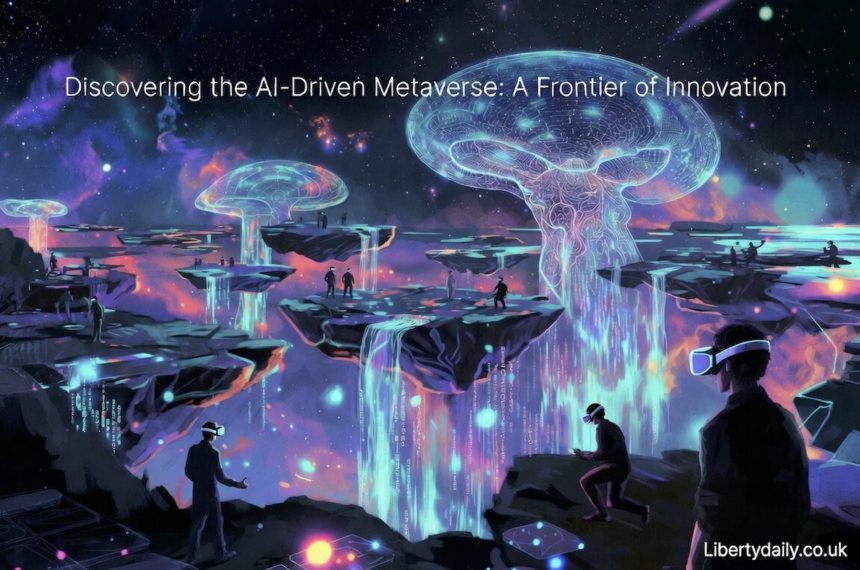
There’s a quiet revolution happening, and most people are too busy scrolling to notice it. The digital landscape surrounding us is constantly evolving. It breathes, learns, and responds. The AI-powered metaverse isn’t some distant sci-fi fantasy anymore. It’s being built right now, layer by layer, algorithm by algorithm, and it’s going to change how humans live, socialize, create, and work in ways we’re only beginning to grasp.
But what exactly is this thing? And why should you care?
More Than Just a Headset
Most people still picture the metaverse as a clunky VR experience, strap on a headset, stumble through a blocky digital world, feel mildly nauseous, take it off. That version of the metaverse is already dead on arrival. The real metaverse, the one being quietly assembled behind the scenes is something else entirely. It’s a living digital environment powered by artificial intelligence at every level. The world doesn’t just exist around you. It knows you’re there, it adapts to you, and in some cases, it anticipates what you want before you’ve asked for it.
Think less “video game” and more “intelligent reality.”
AI is essentially the brain wired into this new environment. Without it, you’d have an empty, shell pretty graphics with nowhere to go. It offers a universe that creates new landscapes, fills itself with characters capable of authentic dialogue, customizes your experience in real time, and adapts continuously based on collective human interactions. Much like the ghost in the machine rewiring reality while you scroll, AI in the metaverse operates invisibly in the background, shaping, nudging, and constructing experience in ways users rarely see but constantly feel.
The Characters Are Actually Listening Now
One of the most jarring shifts in AI-powered virtual environments is what’s happened to NPCs, the non-player characters that populate digital worlds. For decades, these were glorified puppets. You’d talk to them, they’d spit out one of three pre-written lines, and that was that.
Not anymore.
Modern AI-driven characters can hold open-ended conversations. They remember what you said to them last time. They pick up on your tone, frustrated, excited, curious, and adjust their responses accordingly. Some are being built with enough contextual understanding to guide you through complex tasks, act as narrative companions, or serve as personalized virtual assistants that evolve over time.
This matters enormously. The difference between a scripted NPC and a genuinely responsive AI character is the difference between reading a FAQ page and talking to a knowledgeable friend. One feels like a wall. The other feels like a relationship.
Your World, Built Around You
Personalization in today’s apps is already aggressive, the algorithm knows your tastes, your habits, your weak spots. Now imagine that same intelligence extended across an entire virtual reality. An AI-powered metaverse doesn’t just recommend content. It reshapes the environment itself based on who you are. The stores you walk past, the social events that appear on your radar, the aesthetic of the spaces you inhabit, all of it can shift dynamically based on your preferences, your mood, and your behavioral history. This is personalization operating at an architectural level, not just a surface one.
And the world itself doesn’t have to be pre-built. Generative AI can construct landscapes, buildings, interiors, and entire ecosystems on demand, in real time, from a text prompt, tailored to context. The creative ceiling has effectively been removed.
Productivity Gets a Virtual Upgrade
Here’s something that often gets overlooked in metaverse conversations: this isn’t purely entertainment territory. The AI-powered metaverse has serious implications for how we work. Collaborative digital workspaces where remote teams can move through shared 3D environments, interact with real-time data visualizations, and simulate physical processes, that’s not theoretical. Early versions of this already exist. AI layers on top of this by providing instant analysis, flagging anomalies, suggesting optimizations, and essentially acting as an ever-present intelligent co-worker.
For creatives and designers, the possibilities are even more striking. AI tools can generate concept visuals from rough descriptions, optimize spatial layouts, prototype architectural designs in immersive 3D environments, and help iterate faster than any traditional workflow allows.
It’s worth noting that AI productivity tools are already transforming everyday work outside the metaverse, from task automation to smart scheduling. The best free AI productivity tools in 2026 for Android are already giving people a taste of this intelligent augmentation on their phones. The metaverse just takes that same logic and scales it into a fully immersive dimension.
The Problems No One Wants to Talk About
Let’s be honest about the uncomfortable parts. An AI-powered metaverse that knows you intimately, your patterns, your preferences, your emotional responses, is also an AI-powered metaverse that holds an enormous amount of data about you. The personalization that makes these environments feel magical is the exact same mechanism that creates serious privacy risks if mishandled.
Data frameworks built for today’s internet are not equipped for this scale of personal data collection. New legal and ethical infrastructure will be needed, and it needs to be built proactively, not retrofitted after the damage is done. Then there’s the bias problem. AI systems learn from data. If that data carries historical biases, and most of it does, those biases get encoded into the virtual world itself. An AI-powered metaverse that discriminates, excludes, or subtly marginalizes certain groups isn’t a better world. It’s a digital replication of old failures with a fresh coat of paint.
And who governs all of this? The metaverse, especially one that generates itself dynamically, raises governance questions that don’t have clean answers yet. Centralized control risks exploitation. Fully decentralized models risk chaos. The balance will be one of the defining challenges of this decade.
Final Thoughts
The trajectory is clear even if the destination isn’t: AI capabilities are accelerating, generative tools are becoming more powerful, and the line between digital and physical experience is getting thinner. Within the next few years, expect to see metaverse environments that can be created verbally, companions that demonstrate something approaching genuine emotional intelligence, and cross-platform identity systems that let you carry your digital self seamlessly between virtual spaces.
The AI-powered metaverse isn’t just a new product. It’s a new kind of place, one that thinks, remembers, adapts, and grows. How we build it, who it serves, and what values we embed into its foundation will matter enormously. We’re not just designing virtual worlds anymore. We’re designing intelligent realities. And the decisions being made right now, largely out of public view, will shape what it feels like to be human in the decades ahead.
The machine is already thinking. The question is whether we’re thinking carefully enough about it.
FAQ’s
1. What is an AI-powered metaverse, and how is it different from a regular one?
It’s a digital world that can create new content, have real conversations with characters, and personalize your experience on the fly, making it much more dynamic and responsive than a static virtual space.
2. Do I need fancy VR gear to join?
Not at all. Many platforms work on regular screens like your phone, tablet, or computer. VR headsets make it more immersive, but they’re not required.
3. How does AI customize my experience?
AI observes what you do, what you look at, who you chat with, what you buy and then adjusts the environment to suit your preferences, making everything feel more personal.
4. Are the characters in the metaverse truly intelligent?
They’re made with advanced AI that can hold natural conversations and remember past chats, but they’re not truly conscious, just very convincing bots.
5. Is my privacy at risk?
Yes, because these environments can gather a lot of personal data, everything from movements to emotional responses. Protecting this info is crucial, and transparency from platforms is key.