
Imagine an AI system that does more than answer questions. It understands a goal, examines information, makes decisions, and completes tasks. That shift is already changing how modern businesses approach automation. Traditional software waits for instructions and follows predefined rules. AI agents can interpret situations and respond according to changing conditions.
At the same time, cloud platforms are giving businesses the infrastructure needed to deploy these intelligent systems. Microsoft Azure OpenAI combines enterprise cloud capabilities with advanced AI models.
Together, AI agents and Azure can create smarter workflows across customer service, sales, operations, finance, and employee support. More importantly, they can connect intelligence with real business processes. This makes the technology far more valuable than another standalone chatbot.
What Are AI Agents and How Do They Work?
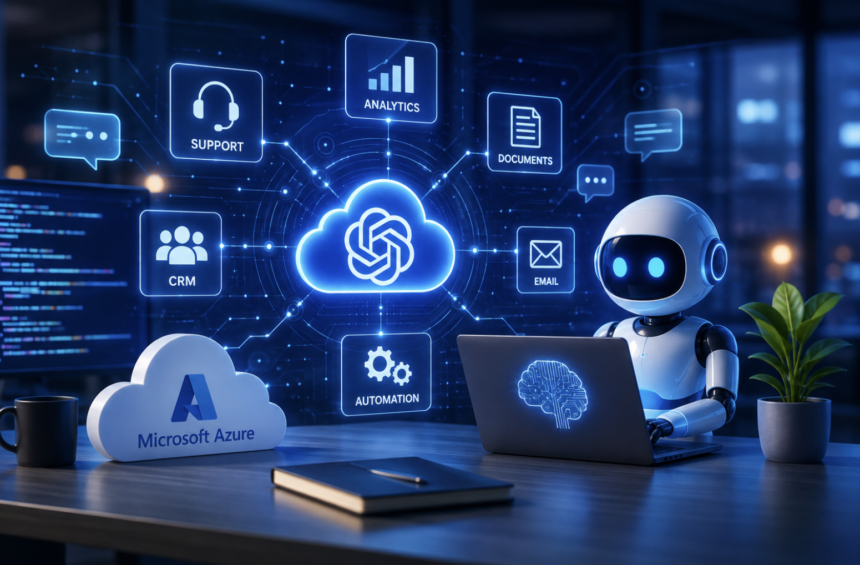
AI agents are software systems designed to pursue specific goals with limited human intervention. They can understand instructions, gather information, reason about possible actions, and complete approved tasks. Unlike conventional automation, agents can handle situations that require more flexibility. For example, a traditional workflow may send the same email after every support ticket. An AI agent can first understand the customer’s problem. Then, it can review relevant information and choose an appropriate response. An agent can also interact with other business applications. These applications may include CRM systems, databases, email platforms, document repositories, and enterprise software.
A typical AI agent workflow involves several important stages. First, the agent receives a request or detects an event. Next, it interprets the available context and identifies the required objective.
Afterward, it retrieves relevant information from approved sources. It then selects suitable actions based on business rules and available tools. Finally, the agent completes the action and reports the result. This approach transforms AI from a question-answering tool into an active digital worker.
Why Businesses Are Moving Beyond Traditional Automation
Traditional automation remains useful for predictable and repetitive processes. However, many business activities involve exceptions, incomplete information, and changing requirements. AI agents can help address these challenges. For instance, an employee might ask an internal assistant to find a policy, summarize it, and prepare an approval request. Completing this task manually could require several applications. An AI agent can potentially coordinate those steps through one interaction.
Furthermore, agents can reduce the need for employees to switch between multiple systems. This can create smoother workflows and reduce unnecessary administrative effort. Businesses can explore AI agents for:
- Customer support and service operations
- Sales lead qualification
- Employee onboarding
- Document classification
- Invoice processing
- Knowledge discovery
- Research assistance
- IT support
- Meeting follow-ups
- Data analysis
- Report preparation
- Workflow coordination
However, successful implementation requires more than connecting an AI model to company data. The agent needs appropriate permissions, reliable information, clear objectives, and carefully designed safeguards.
The Role of Microsoft Azure OpenAI in Enterprise AI
Microsoft Azure provides a broad cloud environment for developing and operating enterprise applications. Azure OpenAI capabilities can support organizations building generative AI solutions within that environment. This creates an important advantage for businesses already using Microsoft’s cloud ecosystem. Organizations can develop AI applications that work alongside existing technologies. Depending on the architecture, these solutions can connect with business data, applications, identity systems, and enterprise workflows.
Azure also provides tools and services that can support areas such as security, monitoring, application development, data management, and scalability.
As a result, businesses can treat generative AI as part of their broader technology environment. That approach is particularly useful for organizations that need stronger governance around enterprise AI.
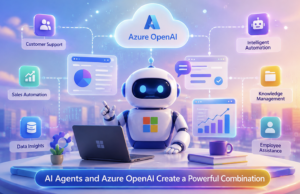
How AI Agents and Azure OpenAI Create a Powerful Combination
The real potential appears when AI agents use cloud-based AI capabilities alongside business systems. Consider an employee asking, “Which customers need follow-up this week?” An intelligent agent could interpret the request and retrieve authorized CRM information. It could then analyze recent interactions and identify customers requiring attention. The agent could summarize the findings and prepare suggested follow-up actions. With appropriate authorization, it could also create tasks for the sales team. This workflow involves several capabilities working together.
The AI model handles language and reasoning. Enterprise data provides business context. APIs connect the agent with applications. Identity controls determine what information the agent can access.
Meanwhile, monitoring and governance help organizations maintain oversight. This architecture can turn isolated AI capabilities into useful business processes.
AI Agent Architecture: The Building Blocks Businesses Need
A reliable AI agent usually depends on several connected components.
- AI Model: Provides language understanding, reasoning, and decision-making capabilities.
- Knowledge Layer: Gives the agent access to company documents, databases, policies, product information, and customer records.
- Tool Layer: Allows the agent to perform actions through APIs, search services, CRM systems, ticketing platforms, and workflow tools.
- Identity Layer: Controls authentication, permissions, and access to confidential business information.
- Orchestration Layer: Coordinates tasks and determines the order in which different steps should happen.
- Monitoring Layer: Tracks agent performance, errors, usage, security events, and unusual activity.
Combining these components creates a more dependable foundation for enterprise AI.
Retrieval-Augmented Generation Makes Enterprise AI More Useful
One major challenge with generative AI involves giving models reliable business information. Retrieval-Augmented Generation, commonly called RAG, can help solve this problem. Instead of relying only on information learned during model training, a RAG system retrieves relevant content from approved sources. The retrieved information then provides context for the AI response.
For example, an employee could ask about a company’s travel reimbursement policy. The system can search the latest internal policy and use that information to produce an answer. This approach can improve relevance and reduce dependence on outdated information.
It also allows businesses to update knowledge sources without retraining the entire AI model. For enterprise applications, this can be particularly valuable because policies and operational information change frequently.
Security and Governance Should Come Before Scale
Enterprise AI introduces new security considerations. An AI agent may have access to sensitive documents, customer records, financial information, or internal communications. Therefore, organizations should carefully control what each agent can access. The principle of least privilege is especially important. Agents should receive only the permissions required for their assigned responsibilities. Businesses should also consider authentication, authorization, encryption, data classification, logging, and monitoring. Human approval can provide another important safeguard.
For high-impact actions, organizations can require an employee to review the agent’s recommendation before execution. This approach creates a balance between automation and human oversight.
Moreover, companies should establish clear policies for acceptable AI usage. These policies can define approved data sources, permitted actions, escalation procedures, and accountability requirements.
Microsoft Azure OpenAI and Data Integration
AI becomes considerably more useful when it can understand business context. However, connecting AI to enterprise data requires careful planning. Businesses may store information across CRM platforms, ERP systems, cloud storage, databases, collaboration tools, and custom applications. An AI agent can potentially connect these systems through APIs and other integration methods.
For example, a service agent could combine customer history with product documentation. It could then create a response based on both sources. Likewise, an operations agent could analyze inventory information and identify potential supply issues. The objective is not simply to connect every system.
Instead, businesses should connect the specific data sources required for each use case. This reduces complexity while improving security and reliability.
AI Agents Can Transform Customer Experience
Customer expectations continue to rise across digital channels. People want fast answers, accurate information, and personalized assistance. AI agents can support these expectations by handling common customer interactions around the clock. An agent can understand a customer’s request and retrieve relevant information from approved systems.
It can then provide a personalized response based on available context. More complex issues can move to human representatives when necessary. This creates a hybrid support model.
AI handles routine interactions while employees focus on sensitive, complex, or high-value conversations. Consequently, businesses can improve response speed without removing human expertise from the customer experience.
AI Agents Can Become Digital Assistants for Employees
Customer-facing applications receive considerable attention, but internal AI agents can deliver major productivity benefits. Employees frequently spend time searching for documents, preparing summaries, checking information, and updating systems. An internal AI assistant can simplify many of these activities.
For example, an employee could request a summary of a lengthy project document. The assistant could retrieve relevant files and create a concise overview. Another agent could help prepare meeting summaries and identify assigned actions.
A finance team might use an agent to organize financial documents. Meanwhile, an HR team could use one to answer routine policy questions. These use cases can reduce administrative workloads across departments.
How to Choose the Right AI Agent Development Partner
Building enterprise AI requires more than model selection. The development partner should understand cloud architecture, data integration, security, automation, and business processes. Industry experience also matters. A capable partner should begin by identifying valuable use cases rather than immediately proposing technology. The team should evaluate existing infrastructure and determine where AI can create measurable improvements. It should also design an architecture that supports future expansion.
Businesses can assess potential partners based on their experience with Microsoft technologies, AI applications, enterprise integrations, security practices, and ongoing support.
The right partner should also explain limitations clearly. A realistic implementation strategy is usually more valuable than unrealistic promises about artificial intelligence.
Common Mistakes to Avoid When Deploying AI Agents
AI projects can struggle when organizations focus heavily on technology and overlook operational requirements. One common mistake is choosing a use case without a clear business objective. Another problem involves poor-quality data. An intelligent agent cannot consistently provide useful results when its information sources contain errors or outdated content. Excessive permissions can create security risks as well. Businesses should avoid giving an agent unrestricted access simply because integration is technically possible.
Testing also deserves significant attention. Organizations should test agents against normal requests, unusual situations, incorrect information, and potentially harmful instructions.
Furthermore, companies should monitor performance after launch. AI systems operate within changing environments. Therefore, businesses should continuously review accuracy, costs, user feedback, and security events.
How to Measure AI Agent Performance
Successful AI deployment requires measurable outcomes. Businesses can track several performance indicators depending on their objectives. Customer service teams might measure response times, resolution rates, and escalation volumes. Sales teams could monitor lead qualification speed and conversion improvements. Operations departments may track processing times and manual workload reductions.
Employee assistants can be evaluated through task completion rates and user satisfaction. Cost also matters. An AI agent should create enough value to justify its infrastructure, development, monitoring, and maintenance expenses.
Therefore, organizations should establish baseline measurements before implementation. This makes it easier to determine whether the solution delivers genuine business value.
The Future of AI Agents and Microsoft Azure
AI agents are moving toward increasingly sophisticated business workflows. Future systems will likely coordinate more tools and complete longer sequences of tasks. However, greater autonomy will also increase the importance of governance. Businesses will need stronger identity controls, monitoring, testing, and approval mechanisms as agents receive broader responsibilities. The most successful organizations will not simply automate everything.
Instead, they will determine where autonomous AI creates meaningful value and where human judgment remains essential. Microsoft Azure can provide an important foundation for this transformation.
Combined with carefully designed AI agents, enterprise data, secure integrations, and human oversight, it can support a new generation of intelligent business applications.
Conclusion
AI agents are changing the meaning of business automation. They can understand objectives, work with information, use digital tools, and complete multi-step processes. Microsoft Azure OpenAI adds enterprise-oriented cloud capabilities that can support these applications at scale. However, technology alone does not guarantee success. Businesses need strong data foundations, secure integrations, thoughtful governance, measurable objectives, and reliable implementation strategies. When these elements work together, AI agents can become more than digital assistants.
They can become intelligent collaborators that help organizations operate faster, serve customers better, and make smarter decisions.
The companies that approach this transformation strategically can build AI capabilities that remain valuable as the technology continues to evolve.
Frequently Asked Questions
1. What are AI agents?
AI agents are intelligent software systems that understand goals, reason through tasks, and perform approved actions.
2. What is Microsoft Azure OpenAI?
Microsoft Azure OpenAI provides access to advanced AI capabilities within Microsoft’s enterprise cloud environment.
3. How do AI agents differ from chatbots?
Chatbots mainly respond to conversations, while AI agents can reason, use tools, and complete multi-step tasks.
4. Can AI agents connect with business applications?
Yes, AI agents can connect with approved applications through APIs, integrations, and enterprise workflow systems.
5. Are AI agents secure for enterprise use?
They can support enterprise security when organizations apply proper permissions, governance, monitoring, and data protection.
6. Can Azure AI agents access company documents?
Yes, agents can retrieve information from authorized enterprise sources when appropriate integrations are configured.
7. What is RAG in enterprise AI?
RAG retrieves relevant information from trusted sources and provides it as context for AI-generated responses.
8. Can AI agents replace employees?
AI agents usually work best as productivity tools that support employees rather than replacing human judgment entirely.
9. How can businesses start an AI agent project?
Businesses should begin with a clearly defined problem, reliable data, measurable goals, and a controlled pilot project.
10. Why is human oversight important for AI agents?
Human oversight helps control high-impact decisions, unusual situations, errors, and actions requiring professional judgment.