

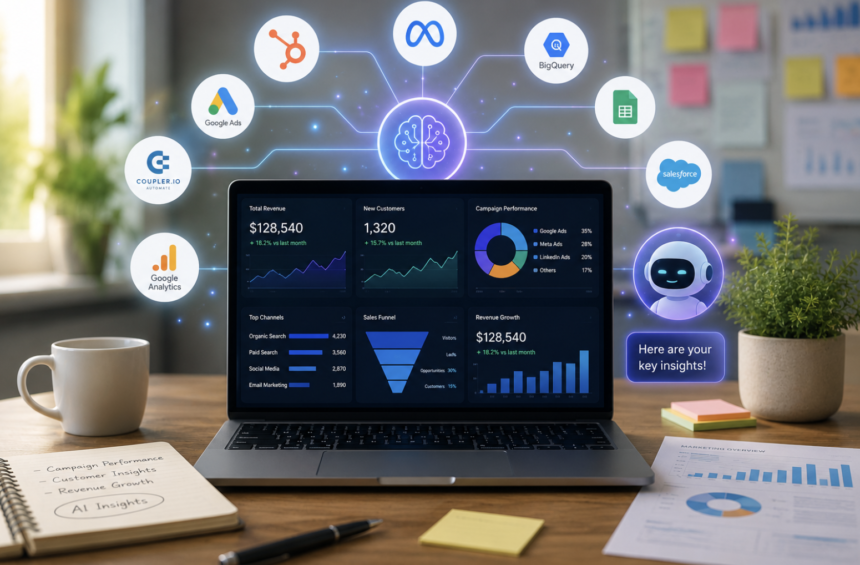
Artificial intelligence has changed how marketers analyze data. However, many professionals still struggle to unlock its full potential. They rely on spreadsheets, screenshots, and outdated reports that no longer reflect current performance. As a result, they make decisions based on yesterday’s numbers instead of today’s opportunities. Claude has become one of the most capable AI assistants for business analysis. Nevertheless, its intelligence depends entirely on the quality of the data it can access. Even the most advanced AI cannot produce meaningful recommendations when it works with incomplete or outdated information.
Modern marketers need more than simple AI conversations. They need an intelligent analytics workflow that connects every important marketing platform in real time. Consequently, Claude can analyze customer behavior, advertising performance, CRM activity, historical trends, and audience insights without waiting for manual exports. The difference between average marketing teams and industry leaders often comes down to automation. While one team spends hours collecting reports, another receives instant insights powered by connected data sources. Therefore, they react faster, optimize campaigns sooner, and improve marketing return on investment more consistently.
A well-designed Claude analytics workflow removes repetitive tasks and allows marketers to focus on strategy instead of reporting. Instead of wasting valuable hours organizing data, professionals can ask detailed business questions and receive actionable recommendations within seconds. This guide explores four essential tools that dramatically improve Claude’s analytical capabilities. In addition, you will discover why combining these platforms creates a powerful marketing intelligence system that helps businesses make faster and smarter decisions.
Why Claude Analytics Is Becoming Essential for Modern Marketing
Marketing generates enormous amounts of information every single day. Paid advertisements, SEO campaigns, email marketing, social media, CRM systems, and website analytics all produce valuable data. Unfortunately, these platforms rarely communicate with one another. Because of this separation, marketers often spend more time collecting reports than analyzing performance. Claude changes this process by interpreting data through natural language. Instead of writing complicated formulas or SQL queries, marketers simply ask questions.
For example, rather than exporting several spreadsheets and calculating customer acquisition costs manually, Claude can compare multiple channels and identify which campaign generated the highest return. However, Claude performs best when connected directly to reliable data sources. Without live connections, every answer becomes limited by stale information.
How a Connected Claude Workflow Improves Marketing Performance
A connected workflow transforms Claude from a chatbot into a complete marketing intelligence assistant. Instead of analyzing isolated reports, Claude evaluates information across multiple platforms simultaneously. This creates several important advantages. First, marketers receive real-time answers instead of outdated reports. Second, campaign optimization becomes significantly faster. Third, customer journey analysis becomes much more accurate.
Finally, marketing and sales teams begin working from identical datasets, reducing confusion during performance reviews. Organizations using connected analytics also reduce reporting errors because automated systems eliminate manual spreadsheet updates.
Why Manual Marketing Reports Are Holding Teams Back
Many businesses still follow an outdated reporting process. Someone logs into advertising platforms. They export campaign data. Another employee downloads CRM reports. Someone else copies website analytics into spreadsheets. Finally, everything gets merged into one presentation. Although this process appears organized, it creates several serious problems. Reports quickly become outdated. Human errors increase. Duplicate information appears frequently. Important metrics become inconsistent across departments. Decision-making slows considerably.
As competition increases, delayed insights often translate directly into lost revenue. Automation solves these issues by continuously updating marketing information. Consequently, Claude always works with fresh and accurate datasets.

The Four Essential Claude Analytics Tools Every Marketer Should Know
Rather than replacing one another, these four platforms perform different responsibilities inside your analytics ecosystem. Each tool strengthens a specific stage of data collection, organization, analysis, or customer research. Together, they create an efficient marketing intelligence workflow.
Coupler.io: The Foundation of Automated Marketing Data Integration
Connect Hundreds of Marketing Platforms Without Manual Work
One of the biggest challenges marketers face involves collecting data from numerous platforms. Advertising campaigns may run on Meta Ads, Google Ads, LinkedIn Ads, TikTok Ads, and other networks simultaneously. Meanwhile, customer information lives inside CRM systems. Website behavior appears inside analytics platforms.
SEO performance comes from search monitoring tools. Coupler.io solves this problem by connecting hundreds of marketing applications into one continuously updated dataset. Instead of downloading reports every week, marketers automate the entire collection process. Claude then receives organized information rather than disconnected spreadsheets.
How Coupler.io Improves Claude’s Analysis
Clean data always produces better AI recommendations. Coupler.io prepares information before Claude begins its analysis. It removes duplicate records. It standardizes naming conventions. It combines multiple campaign sources. It filters unnecessary information. It refreshes reports automatically.
Therefore, Claude spends less time interpreting messy datasets and more time identifying valuable business insights.
Major Benefits for Marketing Teams
Coupler.io significantly improves operational efficiency. Marketing managers monitor campaign performance without switching between platforms. Agency teams prepare client reports faster. Business owners track advertising profitability more accurately. Growth teams identify trends much earlier.
Because data updates automatically, every Claude conversation begins with current information. This dramatically increases confidence in marketing decisions.
Best Use Cases
Coupler.io performs exceptionally well for:
- Multi-channel advertising reports
- Cross-platform campaign comparisons
- Marketing dashboards
- Weekly executive reporting
- Performance monitoring
- ROI analysis
- Lead generation tracking
- Budget optimization
Example Marketing Prompt
“Compare customer acquisition costs across Google Ads, Meta Ads, LinkedIn Ads, and organic traffic. Identify the most profitable channel after including total ad spend and conversion rates.”
HubSpot: Give Claude Complete CRM Intelligence
Transform Customer Data Into Actionable Marketing Insights
Marketing success extends beyond website traffic. Real business growth depends on converting visitors into paying customers. HubSpot gives Claude direct access to CRM records, sales pipelines, email campaigns, customer interactions, and lifecycle stages.
Instead of measuring clicks alone, marketers evaluate complete customer journeys. This creates much deeper business intelligence.
Why CRM Data Matters More Than Traffic Alone
A campaign may generate thousands of visitors. However, only a small percentage may become customers. Without CRM integration, marketers cannot identify which campaigns produce actual revenue. HubSpot closes this information gap. Claude can evaluate:
- Lead quality
- Customer lifetime value
- Sales pipeline movement
- Email engagement
- Conversion rates
- Revenue attribution
- Deal progression
- Customer retention
As a result, marketing teams optimize campaigns based on revenue instead of vanity metrics.
Advanced Marketing Opportunities
HubSpot allows Claude to answer far more sophisticated business questions. For example:
- Which lead source produces the highest customer lifetime value?
- Which email campaign generated the fastest sales cycle?
- Which industries convert most consistently?
- Which customer segments deserve larger advertising budgets?
These insights help businesses allocate resources much more effectively.
Google BigQuery: Unlock Years of Marketing Data with AI
Analyze Massive Datasets Without Writing Complex SQL
As businesses grow, marketing data expands rapidly. Every campaign, customer interaction, website visit, and conversion creates valuable information. Eventually, spreadsheets become too large to manage efficiently. Google BigQuery solves this challenge by storing enormous volumes of structured data in a cloud-based warehouse. When connected to Claude, marketers can explore years of historical information using simple natural language instead of complicated SQL queries.
This capability saves countless hours while making advanced analytics accessible to non-technical teams.
Why Historical Data Matters
Many marketing decisions require long-term analysis rather than weekly reports. For example, seasonal buying patterns often emerge over several years. Likewise, customer retention trends become clearer when marketers compare multiple periods. BigQuery allows Claude to answer questions such as:
- Which acquisition channel generated the highest customer lifetime value over five years?
- How has organic search traffic changed since previous algorithm updates?
- Which marketing campaigns consistently produce repeat customers?
- What seasonal trends affect conversion rates every year?
These insights help businesses build long-term strategies instead of reacting to short-term fluctuations.
Benefits of BigQuery Integration
A connected BigQuery environment gives Claude access to millions of records within seconds. Key advantages include:
- Faster historical reporting
- Enterprise-scale analytics
- Accurate trend forecasting
- Advanced customer segmentation
- Multi-touch attribution analysis
- Improved budget planning
- Better campaign optimization
- Simplified data exploration
Instead of waiting for analysts to prepare reports, marketers receive answers almost instantly.
Example Prompt
“Analyze customer retention from organic search over the last four years. Identify seasonal trends and highlight months with the highest repeat purchase rate.”
Clay: Supercharge Lead Research and Prospect Intelligence
Turn Basic Contact Lists into High-Value Sales Opportunities
Marketing is not only about measuring campaign performance. Finding the right audience is equally important. Clay specializes in enriching customer and company information. Instead of relying on incomplete lead lists, marketers gain detailed insights gathered from numerous trusted data sources. When connected with Claude, enriched data becomes even more valuable.
Claude can evaluate prospects, identify buying signals, prioritize outreach, and recommend personalized marketing strategies.
How Clay Improves Marketing Intelligence
Clay automatically collects valuable business information, including:
- Company size
- Industry
- Technology stack
- Hiring activity
- Website updates
- Social presence
- Contact verification
- Firmographic data
As a result, marketers spend less time researching prospects manually. Instead, they focus on building relationships with the highest-value accounts.
Ideal Marketing Applications
Clay performs exceptionally well for:
- Account-based marketing (ABM)
- Sales prospecting
- B2B lead generation
- Market research
- Customer segmentation
- Outbound campaigns
- Personalized outreach
- CRM enrichment
When combined with Claude, every lead receives intelligent scoring based on your ideal customer profile.
Example Prompt
“Review our enriched account list and rank every company based on buying intent, company growth, industry relevance, and technology compatibility.”
How These Four Tools Work Together
Although each platform serves a different purpose, they become significantly more powerful when connected.Coupler.io continuously gathers marketing data from multiple channels. HubSpot provides live CRM and customer journey information. Google BigQuery stores years of historical business data for deep analysis. Clay enriches customer and company profiles with valuable external intelligence.
Together, they create a complete marketing ecosystem where Claude delivers faster, smarter, and more accurate recommendations. Instead of jumping between platforms, marketers simply ask questions and receive comprehensive answers backed by real-time information.
Additional Ways to Improve Your Claude Analytics Workflow
Connecting data sources is only the beginning. High-performing marketing teams also follow several best practices. Create consistent naming conventions across every campaign. Use standardized conversion goals. Maintain clean CRM records. Remove duplicate contacts regularly. Track custom events inside analytics platforms. Document important business metrics. Schedule automatic data refreshes. Review AI-generated insights before making major business decisions.
These simple improvements increase reporting accuracy while reducing confusion across departments.
Common Mistakes Marketers Should Avoid
Many businesses invest in AI without improving data quality first. Poor data leads to poor recommendations. Some organizations also connect too many platforms without defining clear reporting goals. Others forget to maintain CRM hygiene, causing duplicate records and inaccurate customer journeys. Another common mistake involves relying entirely on AI recommendations.
Although Claude provides outstanding insights, experienced marketers should always verify critical numbers before making financial decisions. Finally, avoid disconnected workflows. Marketing, sales, finance, and customer success should all work from the same trusted datasets.
The Future of AI-Powered Marketing Analytics
Artificial intelligence continues to reshape digital marketing. Instead of spending hours preparing reports, marketers increasingly rely on AI assistants to identify opportunities automatically. Future Claude integrations will likely provide:
- Predictive campaign forecasting
- Automated budget recommendations
- Real-time anomaly detection
- Personalized customer journey optimization
- AI-generated executive dashboards
- Intelligent revenue forecasting
- Advanced audience segmentation
- Automated marketing performance alerts
Businesses that embrace connected AI workflows today will remain more competitive tomorrow.
Why Data Quality Determines Claude’s Success
Claude’s analytical abilities are impressive. However, even the smartest AI depends on reliable information. Clean, organized, and continuously updated data enables Claude to generate recommendations that support real business growth. Disconnected spreadsheets, outdated reports, and inconsistent metrics reduce analytical accuracy.
Investing in strong data infrastructure often produces greater long-term value than purchasing additional marketing software. Therefore, businesses should prioritize data quality alongside AI adoption.
How Marketers Can Get Started Today
Building an intelligent analytics workflow does not require months of planning. Begin by identifying your most important marketing platforms. Next, automate data collection using trusted integration tools. Connect CRM information for complete customer visibility. Store historical data inside a centralized warehouse. Finally, enrich customer profiles before asking Claude complex business questions. This gradual approach minimizes disruption while delivering measurable improvements.
Conclusion
Claude has evolved beyond a conversational AI assistant. When connected to reliable marketing platforms, it becomes an intelligent analytics partner capable of transforming business decisions. Coupler.io simplifies multi-platform reporting through automated data integration. HubSpot connects customer relationships directly to marketing performance. Google BigQuery unlocks years of historical insights for advanced analysis. Clay strengthens prospect research with rich company intelligence. Together, these tools eliminate manual reporting, improve decision-making, and allow marketers to focus on strategy instead of repetitive administrative work.
As AI technology continues advancing, businesses with connected analytics ecosystems will gain a significant competitive advantage. Rather than reacting to outdated reports, they will make faster, smarter, and more profitable marketing decisions based on real-time intelligence.
Building a stronger Claude analytics workflow today prepares your organization for the next generation of AI-powered marketing success.
Frequently Asked Questions
1. What is Claude Analytics?
Claude Analytics refers to using Claude AI to analyze connected business and marketing data for actionable insights.
2. Why should marketers connect Claude to external tools?
Connected tools provide real-time data that improves the accuracy of Claude’s recommendations.
3. Is Coupler.io suitable for beginners?
Yes, it offers user-friendly automation without requiring coding knowledge.
4. Can HubSpot improve marketing attribution?
Yes, HubSpot connects marketing activities directly to customer and sales outcomes.
5. Why is Google BigQuery useful for marketers?
It enables fast analysis of large historical datasets using simple language.
6. What is Clay mainly used for?
Clay enriches lead and company data for better sales and marketing targeting.
7. Does Claude replace marketing analysts?
No, Claude enhances analysts by automating repetitive analysis and surfacing insights faster.
8. How often should marketing data refresh?
Real-time or scheduled daily updates provide the most reliable business insights.
9. Is AI analytics completely error-free?
No, important calculations should always be verified before making strategic decisions.
10. Can Claude analyze multiple marketing channels together?
Yes, when integrated properly, Claude can compare performance across multiple platforms.
11. What is the biggest advantage of connected marketing data?
Unified data enables faster, more accurate, and revenue-focused marketing decisions.
12. Is data security maintained with these integrations?
Yes, most trusted integrations use secure authentication and permission-based access.
13. Can Claude help improve marketing ROI?
Yes, Claude identifies trends and optimization opportunities that support higher marketing returns.
14. What is the first step toward building a better Claude workflow?
Start by connecting your most important marketing data sources and automating data collection.