

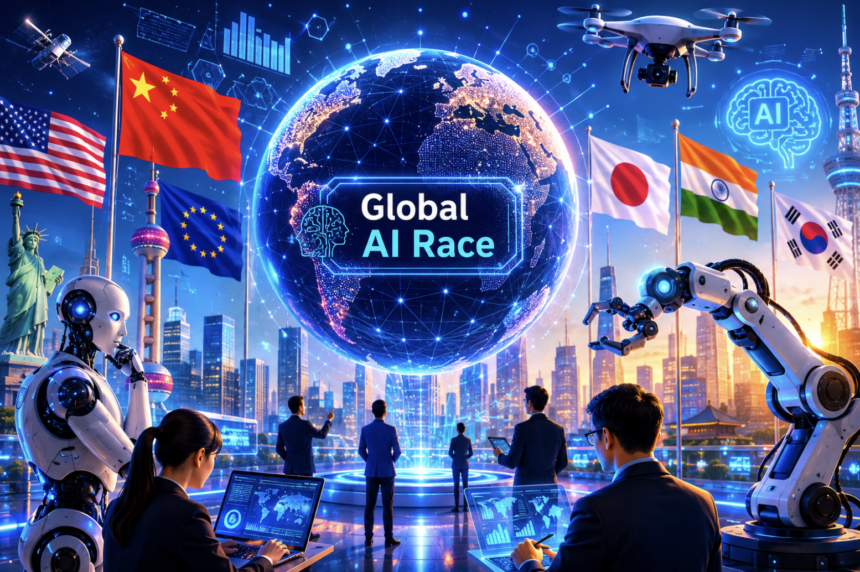
Artificial intelligence is no longer a futuristic concept. Instead, it has become the driving force behind economic growth, innovation, and digital transformation worldwide. Every nation is racing to secure its position in this rapidly evolving landscape. However, each country follows a different path toward AI leadership.
Some nations focus on groundbreaking research. Others prioritize industrial automation and public services. Meanwhile, several emerging economies are using AI to accelerate development at an unprecedented pace. As global competition intensifies, understanding these strategies becomes more important than ever.
From Silicon Valley to Beijing and from Toronto to New Delhi, artificial intelligence is reshaping industries, governments, and daily life. Consequently, countries that successfully adopt AI today will likely define tomorrow’s economic and technological leadership.
The United States: The Innovation Powerhouse Driving AI Advancement
World Class Research Ecosystem Fuels Growth
The United States remains one of the most influential players in artificial intelligence. Its strength comes from a combination of elite universities, private laboratories, and technology giants. Institutions such as MIT, Stanford, and Carnegie Mellon continue producing groundbreaking AI research.
Moreover, leading companies invest billions into AI development. This collaboration between academia and industry accelerates innovation. As a result, the nation consistently produces cutting-edge technologies that shape global AI trends.
The country also attracts highly skilled researchers from around the world. Therefore, talent concentration continues strengthening America’s leadership position in artificial intelligence.
Private Sector Dominance Accelerates AI Adoption
Technology companies play a critical role in expanding AI applications across multiple industries. Businesses integrate artificial intelligence into cloud services, search engines, social media platforms, and productivity tools.

Additionally, startups receive substantial venture capital funding. This financial support enables rapid experimentation and commercialization of AI solutions. Consequently, innovative products enter markets faster than ever before.
Healthcare, finance, retail, and logistics increasingly rely on intelligent systems. Therefore, AI adoption continues spreading throughout the broader economy.
Challenges Facing the American AI Landscape
Despite remarkable progress, several challenges remain. Regulatory frameworks continue evolving, creating uncertainty for organizations deploying AI solutions.
Furthermore, concerns about algorithmic bias and job displacement generate ongoing public debate. These discussions influence policy development and corporate decision-making.
Digital inequality also affects adoption rates. Therefore, ensuring equitable access to AI technologies remains a significant national priority.
China: Building an AI Empire Through Data and State Support
Government Led Strategy Creates Unmatched Momentum
China has embraced a highly coordinated approach to artificial intelligence development. The government views AI as a strategic national priority and supports innovation through large-scale investments.
Moreover, ambitious national plans encourage rapid growth across multiple sectors. This top-down strategy provides clear direction and substantial resources. Consequently, Chinese companies continue expanding their AI capabilities at impressive speeds.
Government initiatives also support infrastructure development, research centers, and talent cultivation programs nationwide.
Massive Data Resources Strengthen AI Development
China benefits from one of the world’s largest digital populations. Millions of citizens interact with online platforms daily, generating enormous amounts of valuable data.
This extensive data ecosystem supports machine learning development and model training. Therefore, Chinese organizations gain advantages in areas such as facial recognition and language processing.
Additionally, smart city initiatives create real-world environments for testing AI technologies. These projects improve transportation, public services, and urban management systems.
Growth Opportunities and Strategic Obstacles
China’s AI expansion continues attracting global attention. However, concerns regarding privacy and surveillance remain prominent internationally.
The nation also faces intense competition for elite AI researchers. Meanwhile, dependence on advanced foreign semiconductor technologies presents ongoing strategic challenges.
Nevertheless, sustained investment ensures China remains a major force in the global AI race.
The European Union: Creating a Human Centered AI Future
Balancing Innovation With Ethical Responsibility
The European Union follows a distinct path toward artificial intelligence leadership. Rather than focusing solely on speed, it prioritizes trust, transparency, and human rights.
The EU believes responsible AI development creates long-term value. Therefore, policymakers emphasize ethical standards alongside technological advancement.
This balanced approach aims to protect citizens while encouraging innovation throughout member states.
The AI Act Shapes Global Regulatory Standards
One of Europe’s most significant contributions is its comprehensive AI regulatory framework. The Artificial Intelligence Act establishes rules based on risk levels.
Consequently, organizations must meet strict requirements when deploying high-risk AI systems. This framework promotes accountability and transparency.
Furthermore, strong privacy regulations influence how businesses collect and process data. As a result, European AI development often prioritizes user protection.
Industrial Strength Supports Adoption
Europe’s powerful manufacturing sector creates valuable opportunities for AI integration. Companies increasingly use intelligent systems to improve efficiency and sustainability.
Automotive industries invest heavily in autonomous technologies and advanced manufacturing solutions. Meanwhile, healthcare organizations explore personalized medicine and predictive diagnostics.
Although investment levels sometimes trail the United States and China, Europe continues building a unique position centered on trustworthy AI.
Canada: Where Responsible Innovation Meets Global Talent
Research Excellence Drives International Recognition
Canada has emerged as a respected leader in artificial intelligence research. Cities such as Toronto and Montreal serve as major hubs for AI innovation.
Researchers have made significant contributions to deep learning and machine learning technologies. Consequently, Canada attracts global attention from academics and technology companies alike.
Government support further strengthens the country’s research ecosystem and talent development efforts.
Collaboration Creates a Strong AI Foundation
Canada encourages collaboration between universities, businesses, and public institutions. This cooperative model accelerates knowledge sharing and practical implementation.
Additionally, favorable immigration policies attract highly skilled professionals. Therefore, organizations gain access to diverse expertise and innovative perspectives.
These partnerships help transform research breakthroughs into real world applications across various industries.
Commitment to Ethical AI Development
Responsible AI remains a central focus of Canada’s national strategy. Organizations actively develop frameworks addressing fairness, accountability, and transparency.
Healthcare, climate initiatives, and sustainability projects increasingly benefit from AI-driven solutions. As a result, technology contributes to broader societal objectives.
However, scaling successful pilot projects into widespread adoption remains an ongoing challenge for many sectors.
India: Accelerating Digital Transformation Through Artificial Intelligence
A Rapidly Expanding Digital Ecosystem
India is becoming one of the world’s most exciting AI markets. The country’s digital transformation efforts create a strong foundation for artificial intelligence adoption.
Government initiatives promote digital access and technological innovation nationwide. Consequently, millions of citizens now engage with digital platforms and services.
This expanding infrastructure supports the development of scalable AI applications across diverse sectors.
AI Powers Innovation Across Key Industries
Financial technology companies increasingly use artificial intelligence for fraud detection, personalized services, and credit assessment.
Healthcare providers leverage AI to improve diagnosis and expand access to medical expertise. Meanwhile, e-commerce businesses optimize logistics and customer experiences through intelligent systems.
India also focuses heavily on language technologies. Therefore, AI solutions continue becoming more accessible across diverse linguistic communities.
Opportunities and Challenges Ahead
India’s technology workforce provides a significant competitive advantage. However, demand for specialized AI expertise continues growing rapidly.
Data privacy concerns also require careful attention as digital adoption expands. Furthermore, infrastructure disparities still affect certain regions.
Despite these obstacles, India’s commitment to innovation positions it as a major future AI leader.
How AI Leadership Is Being Measured Worldwide
Global AI leadership often depends on three important indicators. Research output demonstrates innovation capacity. Startup activity reflects entrepreneurial strength. Patent filings reveal technological advancement.
The United States currently leads in research publications, startup formation, and AI patents. China follows closely while rapidly narrowing the gap.
Meanwhile, countries such as the United Kingdom and Germany maintain strong research communities and growing AI ecosystems. Therefore, competition continues expanding beyond traditional technology powerhouses.
The Future of Global AI Adoption
Artificial intelligence is transforming economies at an extraordinary pace. Nations continue investing heavily in talent, infrastructure, and innovation ecosystems.
The United States remains a leader in private-sector innovation. China advances through government-driven initiatives and massive data resources. Europe prioritizes ethical development and regulation. Canada focuses on responsible innovation, while India leverages digital transformation for large scale adoption.
As AI capabilities evolve, global collaboration will become increasingly important. At the same time, competition will intensify across industries and regions. Ultimately, the countries that balance innovation, ethics, and practical implementation will shape the future of artificial intelligence.
Frequently Asked Questions
1. Which country leads global AI development?
The United States currently leads due to its research institutions, startups, and technology companies.
2. Why is China advancing rapidly in AI?
China benefits from strong government support, extensive data resources, and large-scale implementation projects.
3. What makes the European Union unique in AI adoption?
The EU prioritizes ethical, transparent, and human centered artificial intelligence.
4. Why is Canada important in AI research?
Canada pioneered major deep learning breakthroughs and attracts top global talent.
5. How is India using artificial intelligence?
India applies AI across fintech, healthcare, education, agriculture, and e-commerce sectors.
6. What industries benefit most from AI adoption?
Healthcare, finance, manufacturing, logistics, retail, and transportation gain significant advantages.
7. What are the biggest AI challenges globally?
Data privacy, ethical concerns, talent shortages, and regulatory uncertainty remain major challenges.
8. Can AI improve economic growth?
Yes, AI enhances productivity, efficiency, innovation, and business competitiveness.
9. Why is AI talent important for countries?
Skilled professionals drive research, innovation, and successful AI implementation.
10. Will AI continue growing worldwide?
Yes, AI adoption is expected to expand rapidly across industries and economies.