

Winning government contracts is only the beginning of success in the aerospace and defense industry. Keeping those contracts is an entirely different challenge. Many executives spend years building relationships, developing advanced technologies, and securing valuable federal projects. However, a single weakness in labor accounting can place everything at risk.
Most leaders focus on engineering excellence, project delivery, and customer satisfaction. Meanwhile, labor accounting often receives little executive attention until auditors arrive. Unfortunately, by then, correcting mistakes becomes difficult and expensive. Government agencies expect complete transparency in labor reporting. Every hour worked must be recorded accurately, allocated correctly, and fully documented. Even small errors can trigger extensive audits, financial penalties, contract disputes, and long-term reputational damage.
For contractors working under cost-reimbursable agreements, labor accounting is not simply an accounting function. Instead, it serves as the foundation of regulatory compliance, financial integrity, and future business growth. Companies that invest in strong compliance systems gain a competitive advantage, while those relying on outdated processes expose themselves to enormous financial and legal risks.
Why Labor Accounting Matters More Than Most Executives Realize
Labor expenses often represent the largest cost within aerospace and defense contracts. Because these costs directly affect government reimbursements, agencies closely monitor every labor transaction. Federal auditors evaluate whether employees charge their time correctly, supervisors follow approval procedures, and accounting systems maintain complete audit trails. Without reliable labor records, contractors cannot prove that billed costs accurately reflect the work performed.
As government oversight continues increasing, compliance has become an essential business strategy rather than merely an accounting requirement.
Understanding Federal Compliance Requirements
Government contractors operate under strict regulations that govern labor reporting. These regulations include:
- Federal Acquisition Regulation (FAR)
- Defense Contract Audit Agency (DCAA) requirements
- Cost Accounting Standards (CAS)
- Defense Contract Management Agency (DCMA) oversight
Together, these standards ensure taxpayer money is spent responsibly while preventing fraud, waste, and abuse. Every contractor pursuing cost-type contracts must demonstrate compliance across all labor accounting activities.
How Labor Mischarging Becomes a Serious Legal Problem
Many labor charging mistakes begin as simple administrative errors. Employees may:
- Select incorrect charge codes.
- Forget to update project assignments.
- Estimate previous workdays from memory.
- Misclassify indirect work.
- Follow incorrect management instructions.
Unfortunately, government investigators evaluate outcomes rather than intentions. When inaccurate labor costs appear on invoices submitted for payment, authorities may interpret those errors as false claims. Consequently, organizations may face investigations under the False Claims Act.
The Financial Impact of Non-Compliance Can Be Devastating
Compliance failures extend far beyond accounting corrections. Organizations frequently experience:
- Contract payment delays
- Cost disallowances
- Increased audit frequency
- Legal investigations
- Expensive outside counsel
- Operational disruption
- Customer distrust
- Future bidding restrictions
In severe situations, companies may lose eligibility for government contracting entirely. For organizations depending heavily on federal contracts, that outcome can threaten the entire business.
The False Claims Act: A Risk No Contractor Should Ignore
The False Claims Act remains one of the government’s strongest enforcement tools. If investigators determine that false labor charges were knowingly submitted, companies may face:
- Triple financial damages
- Civil monetary penalties
- Criminal investigations in extreme cases
- Long-term government monitoring
Even when fraud was never intended, poor internal controls can create serious legal exposure. Strong documentation often becomes the organization’s best defense.
Why DCAA Audits Focus So Heavily on Labor Accounting
Labor represents one of the easiest cost categories for auditors to verify. Instead of reviewing thousands of purchase orders, auditors can compare:
- Employee interviews
- Timesheet entries
- Payroll records
- Project assignments
- Supervisor approvals
- Contract budgets
Any inconsistency raises additional questions. As discrepancies increase, audit scope usually expands. What begins as a routine review may eventually involve months of detailed investigation.
What Happens During a DCAA Floor Check
Many organizations misunderstand floor checks. A floor check is designed to verify that employees are charging time accurately while work is actively occurring. Auditors typically ask employees:
- What project are you working on?
- Which charge code are you using?
- When did you begin today’s assignment?
- Who assigned this work?
- Does your timesheet match your current activity?
If employees struggle to answer confidently, auditors may question the reliability of the entire labor system.
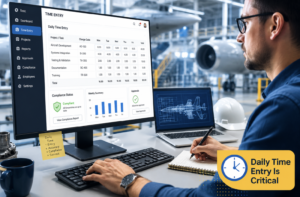
Why Daily Time Entry Is Critical
Memory fades quickly. Employees who complete timesheets only on Fridays often reconstruct an entire week from memory. Even experienced professionals forget:
- Short meetings
- Proposal work
- Internal discussions
- Administrative activities
- Training sessions
- Research assignments
Daily entries dramatically improve accuracy while reducing audit concerns. Many compliant systems automatically remind employees before each workday ends.
The Hidden Dangers of Manual Timesheets
Although spreadsheets appear inexpensive, they introduce significant compliance risks. Manual systems often lack:
- Automatic audit trails
- Timestamp verification
- User authentication
- Change history
- Secure approvals
- Charge code validation
Without these controls, proving compliance becomes extremely difficult. Modern electronic systems provide significantly stronger protection.
Why Audit Trails Are Essential
Every modification should leave permanent evidence. A compliant labor system records:
- Original entry
- Date submitted
- Time submitted
- User identity
- Every correction
- Approval history
- Reason for modification
Nothing should disappear. Instead, every version should remain available for future review. This transparency strengthens credibility during government audits.
The Importance of Segregation of Duties
No single employee should control every step of labor reporting. Instead, responsibilities should remain separated.
For example:
- Employees record their own time.
- Supervisors review project accuracy.
- Payroll verifies compensation.
- Accounting processes labor distribution.
- System administrators maintain software security.
This separation reduces opportunities for fraud while strengthening internal controls.
ERP Integration Improves Compliance
Disconnected software creates unnecessary risks. When payroll, accounting, and timekeeping operate independently, organizations often rely on manual data transfers. Every manual transfer increases the possibility of:
- Human error
- Duplicate entries
- Missing records
- Incorrect allocations
Integrated Enterprise Resource Planning systems automatically synchronize information across departments. This consistency improves reporting accuracy while reducing administrative effort.
Preparing for an SF 1408 Accounting System Review
Contractors seeking cost-reimbursable contracts must often complete an SF 1408 accounting system evaluation. Auditors examine whether the organization can:
- Accumulate contract costs accurately.
- Separate direct and indirect expenses.
- Produce reliable financial reports.
- Maintain compliant labor records.
- Support government reimbursement requests.
Preparation should begin long before the official review. Companies that wait until auditors arrive often discover expensive deficiencies.
Technology Is Transforming Government Compliance
Artificial intelligence now assists many contractors in maintaining labor accuracy. Modern compliance platforms can automatically:
- Detect unusual charging patterns.
- Identify missing entries.
- Validate charge codes.
- Generate compliance reports.
- Monitor approval workflows.
- Flag policy violations.
These intelligent features reduce administrative burdens while strengthening regulatory compliance.
Employee Training Plays a Critical Role
Even the best software cannot replace knowledgeable employees. Regular training ensures workers understand:
- Daily reporting expectations
- Proper charge code selection
- Correction procedures
- Compliance responsibilities
- Audit preparation
- Documentation requirements
Organizations should provide refresher courses throughout the year rather than only during onboarding.
Building a Strong Compliance Culture
Successful contractors view compliance as everyone’s responsibility. Executives establish expectations. Managers reinforce accountability. Employees maintain accurate records. Internal auditors monitor performance. Information technology protects system integrity. When compliance becomes part of company culture, audit readiness improves naturally.
The Real Cost of Audit Defense
Audit response consumes enormous organizational resources. Companies often redirect:
- Accounting personnel
- Project managers
- Human resources
- Executive leadership
- Legal advisors
- External consultants
Meanwhile, daily operations continue. Projects still require attention. Customers still expect delivery. The indirect costs frequently exceed initial compliance investments.
Why Documentation Is Your Strongest Protection
Documentation tells the complete story behind every labor transaction. Organizations should retain:
- Time records
- Approval history
- Change logs
- Supporting emails
- Project assignments
- Training records
- Policy acknowledgments
Complete documentation allows contractors to answer auditor questions confidently. Missing records often create unnecessary uncertainty.
Best Practices for Maintaining DCAA-Compliant Timekeeping
Organizations should adopt several proactive practices.
- Record labor daily.
- Review charge codes regularly.
- Require electronic approvals.
- Document every correction.
- Maintain permanent audit trails.
- Conduct periodic internal audits.
- Train employees consistently.
- Integrate accounting systems.
- Monitor unusual charging patterns.
- Update compliance policies annually.
These practices significantly reduce audit risk.
Compliance Should Be Viewed as a Business Investment
Many executives mistakenly consider compliance an administrative expense. In reality, strong labor accounting creates business opportunities. Organizations with mature compliance systems often:
- Win larger contracts.
- Pass audits faster.
- Build stronger customer trust.
- Reduce financial uncertainty.
- Improve operational efficiency.
- Strengthen corporate reputation.
Compliance therefore supports long-term revenue growth rather than limiting profitability.
Future Trends in Government Contract Compliance
Federal oversight continues evolving. Future compliance programs will increasingly emphasize:
- Artificial intelligence monitoring.
- Continuous auditing.
- Cybersecurity integration.
- Real-time labor verification.
- Automated risk scoring.
- Digital compliance dashboards.
Organizations investing early in modern compliance technologies will remain better positioned for future regulatory expectations.
Conclusion
Labor accounting represents far more than administrative paperwork. It protects revenue, preserves government relationships, and strengthens organizational credibility. Aerospace and defense contractors operating under federal regulations must recognize that every recorded hour carries financial and legal significance.
Investing in compliant systems, employee education, automated controls, and strong documentation creates lasting competitive advantages. Moreover, these investments improve operational efficiency while reducing audit exposure. Companies that prioritize compliance today position themselves for sustainable growth, larger contract opportunities, and long-term success within the government contracting marketplace.
Frequently Asked Questions
1. What is DCAA-compliant timekeeping?
It is a labor tracking system that meets Defense Contract Audit Agency requirements.
2. Why is labor accounting important for government contractors?
It ensures accurate billing and regulatory compliance for federal contracts.
3. What is a DCAA floor check?
It is an unannounced audit verifying employees’ current work against their recorded timesheets.
4. Can manual spreadsheets satisfy DCAA requirements?
Generally, they lack many controls required for full compliance.
5. What is the False Claims Act?
It allows the government to pursue penalties for fraudulent payment claims.
6. Why are daily timesheet entries required?
Daily recording improves accuracy and reduces memory-related mistakes.
7. What is an audit trail?
It is a permanent record showing every timesheet entry, change, and approval.
8. What does segregation of duties mean?
Different individuals handle recording, approving, and processing labor information.
9. Why is ERP integration beneficial?
It improves data accuracy by eliminating manual transfers between systems.
10. What is the SF 1408 review?
It evaluates whether a contractor’s accounting system supports cost-type government contracts.
11. Can AI improve labor accounting compliance?
Yes, AI detects risks, validates entries, and automates compliance monitoring.
12. How often should compliance training occur?
Organizations should provide regular training throughout the year.
13. What happens if labor costs are mischarged?
Contractors may face audits, financial penalties, and possible legal action.
14. Why are reason codes important for timesheet corrections?
They document why changes occurred and support audit transparency.
15. How does strong compliance support business growth?
It increases audit readiness and improves eligibility for valuable government contracts.