

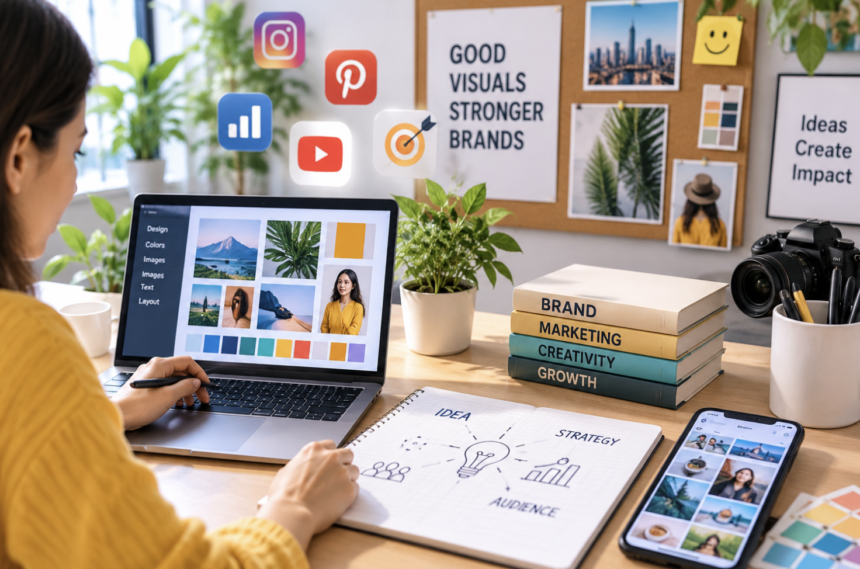
A customer may forget your slogan, but they can remember how your brand looked and felt. That is the power of visual marketing. In a crowded digital world, strong visuals can stop scrolling, communicate value, and build recognition within seconds.
However, successful visual marketing requires more than attractive images. Every color, photograph, video, icon, layout, and printed design should support the same brand story. When digital and physical experiences work together, your business can create a memorable presence across multiple customer touchpoints.
Therefore, a thoughtful visual marketing strategy can turn ordinary campaigns into recognizable brand experiences. It can also improve communication, strengthen trust, and encourage customers to take action. This guide explains how to build a powerful visual marketing strategy across digital and physical channels.
1. Define Your Brand’s Visual Identity First
Before creating marketing graphics, establish a clear visual identity. Your visual identity should reflect your brand personality and audience expectations. Start with essential elements such as your logo, colors, fonts, photography style, illustrations, icons, and graphic patterns. Then, decide how these elements should appear across different marketing channels.
For example, a professional financial company may prefer clean layouts and restrained colors. Conversely, a youth-focused brand may use energetic colors and playful graphics.
Consistency matters because customers often recognize brands through repeated visual signals. Therefore, your visual identity should remain recognizable even when the content format changes.
Create brand guidelines that explain correct logo usage, typography, spacing, colors, imagery, and design principles. Also, include examples of designs that match your brand. This system gives designers and marketing teams a reliable creative foundation.
2. Build a Strategy Around Your Target Audience
Effective visual marketing begins with understanding the people you want to reach. Different audiences respond to different visual styles, messages, and formats. First, consider your customers’ interests, habits, expectations, and purchasing behavior. Then, identify where they usually interact with your brand.
Younger audiences may spend more time with short-form videos and social content. Meanwhile, business customers may respond better to presentations, reports, webinars, or professional websites.
Audience research can also reveal important cultural and visual preferences. Consequently, your designs can feel more relevant and natural. Avoid creating visuals simply because they look fashionable. Instead, connect every creative decision with your audience and marketing objective.
3. Give Every Visual a Specific Marketing Purpose
Beautiful design alone does not guarantee effective marketing. Each visual should communicate a clear idea or encourage a specific action.
For example, an awareness campaign may focus on brand recognition. A product campaign might highlight features and benefits. Meanwhile, a promotional graphic may encourage immediate purchases. Before designing an asset, identify its primary goal. Ask what customers should understand, feel, or do after seeing it.
This approach prevents unnecessary decoration and confusing messages. Moreover, it makes campaign performance easier to evaluate. A strong visual should support the message rather than compete with it.
4. Adapt Visual Content to Every Marketing Channel
One design rarely works perfectly everywhere. Each platform has different dimensions, viewing environments, audience behaviors, and technical requirements. A social media graphic needs immediate visual impact. A website banner can provide more context. Meanwhile, an outdoor billboard must remain readable from a considerable distance.
Printed brochures can contain detailed information because readers control the viewing time. In contrast, mobile advertisements need to communicate quickly.
Therefore, adapt the creative concept instead of simply resizing one file repeatedly. Maintain the same brand identity while adjusting layouts, image sizes, text placement, and calls to action. This strategy creates consistency without making every channel look identical.
5. Create a Strong Visual Content System
Businesses often waste valuable time designing similar assets repeatedly. A visual content system can solve this problem. Develop reusable templates for social media posts, advertisements, email headers, presentations, brochures, promotional materials, and landing pages.
However, templates should remain flexible. Include different layouts for announcements, educational content, product promotions, testimonials, and seasonal campaigns.
A structured system allows teams to produce content faster. At the same time, it reduces inconsistent branding. Furthermore, organized design files make collaboration easier when several people work on the same campaign.
6. Use Photography and Video to Build Emotional Connection
Images can communicate emotions faster than lengthy explanations. Therefore, photography deserves an important place in your visual marketing strategy. Whenever possible, use authentic photography that reflects your actual customers, products, employees, or environments. Stock imagery can help, but excessive use may make a brand feel generic.
Video can add another powerful dimension. Short product demonstrations, behind-the-scenes clips, customer stories, tutorials, and educational videos can increase engagement.
Additionally, motion graphics can explain complicated ideas without overwhelming viewers. Keep your visual storytelling aligned with your brand personality. A consistent photography and video style can make different campaigns feel connected.
7. Design for Mobile-First Experiences
Many customers encounter marketing content on smartphones. Therefore, mobile viewing should influence your design decisions from the beginning. Use readable typography and strong contrast. Keep important information away from crowded areas. Also, avoid placing critical details in tiny text.
Images should load efficiently without sacrificing necessary quality. Similarly, videos should remain understandable even when viewers watch without sound.
Mobile-first design also means reducing unnecessary visual clutter. A simple composition can communicate faster on a small screen. Consequently, designing for mobile can improve both usability and marketing performance.
8. Connect Digital and Physical Marketing
Digital and physical marketing should not operate as separate worlds. Instead, connect them through consistent visuals and interactive elements. Imagine a retail campaign featuring social advertisements, email promotions, window displays, printed posters, product packaging, and event materials. Each asset can share the same campaign concept.
QR codes can connect physical materials with digital destinations. Customers could scan a poster to access a product page, discount, booking form, tutorial, or promotional video.
Likewise, memorable URLs and campaign-specific landing pages can extend offline experiences online. This connection creates a smoother customer journey. Someone can discover your brand offline and continue the experience through a smartphone.

9. Make Packaging Part of Your Marketing Strategy
Packaging often receives less attention than websites and advertisements. Yet, it can become a valuable visual marketing channel. Customers interact directly with packaging after purchasing a product. Attractive packaging can encourage sharing, photography, recommendations, and repeat recognition.
Use consistent colors, typography, imagery, and messaging across your packaging. However, also consider functionality and readability. Special editions can introduce limited visual themes without abandoning core brand recognition.
Additionally, packaging can include QR codes that lead customers toward tutorials, loyalty programs, reviews, or social communities.
10. Pay Attention to In-Store and Event Experiences
Physical environments can reinforce digital branding. Retail displays, banners, signs, booths, wall graphics, and promotional materials can create immersive experiences.
For events, consider the entire visual journey. This includes entrance signage, presentation screens, printed materials, booth graphics, staff clothing, product displays, and promotional items.
Consistent design can make your organization easier to recognize in busy environments. Moreover, branded physical spaces can create opportunities for customers to photograph and share their experiences online. This creates a natural connection between physical marketing and social media visibility.
11. Prioritize Accessibility and Inclusive Design
Modern visual marketing should be attractive and accessible. Consider customers who may have visual, cognitive, or other accessibility needs.
Use sufficient color contrast and readable font sizes. Avoid communicating important information through color alone. Add alternative text where appropriate for digital images. Also, ensure video content can support viewers who cannot rely on audio.
Inclusive design expands your potential audience while improving usability for everyone. Furthermore, accessible content often provides a clearer and more organized experience.
12. Protect Brand Consistency Without Killing Creativity
Consistency does not mean every advertisement should look identical. Repetition should establish recognition, while creativity keeps the audience interested. Create a visual framework instead of rigid rules for every design. Then, allow designers to experiment within that framework.
For example, your brand may maintain consistent typography and colors while changing photography, composition, animation, or illustration styles.
Seasonal campaigns can introduce temporary creative elements. However, they should still contain recognizable brand signals. As a result, customers can experience variety without losing connection with the brand.
13. Choose Quality Production for Physical Marketing
Digital designs can look excellent on a screen but disappoint when printed. Therefore, physical marketing requires careful production planning. Consider image resolution, file formats, color profiles, paper types, materials, dimensions, finishing, and viewing distance.
Outdoor signs require durable materials that can withstand environmental conditions. Meanwhile, premium brochures may benefit from high-quality paper and professional finishing.
Large displays also require appropriate production equipment. Poor printing can reduce perceived brand quality, even when the original design was excellent. Always request proofs when necessary. Then, check colors, spacing, text, and image quality before approving large production runs.
14. Use Visual Storytelling Across Campaigns
A campaign becomes more memorable when its visuals tell a connected story. Instead of creating unrelated posts, develop a central creative concept. Then, adapt that concept across advertisements, videos, emails, websites, social media, packaging, and physical materials.
For example, a product launch might begin with curiosity-focused visuals. Later content could introduce product benefits and customer experiences.
Finally, promotional visuals could encourage purchase or registration. This sequence creates continuity while giving customers different reasons to engage.
15. Measure Visual Marketing Performance
Visual marketing should support measurable business objectives. Therefore, track how your creative assets perform. Digital channels can provide data about impressions, clicks, engagement, conversions, video views, and landing-page activity. Physical campaigns can use QR codes, promotional codes, dedicated URLs, surveys, and event registrations.
Compare different visual approaches to identify patterns. One design may generate more clicks, while another may produce stronger conversions. Do not judge performance only by likes or views. Connect visual results with meaningful business outcomes.
16. Test Different Creative Approaches
A strong visual strategy improves through experimentation. Test different headlines, images, layouts, colors, calls to action, and formats.
For digital advertising, controlled testing can reveal which creative version performs better. Social platforms can also provide useful engagement insights.
However, avoid changing too many elements at once. Otherwise, you may struggle to identify what caused the performance difference. Over time, these experiments can build a valuable creative knowledge base.
17. Refresh Your Visual Strategy Regularly
Customer preferences change quickly. Platforms also introduce new formats and technologies. Therefore, review your visual marketing strategy regularly. Identify outdated templates, weak-performing designs, inconsistent assets, and emerging opportunities.
A refresh does not always require a complete rebrand. Small improvements can modernize your appearance while protecting recognition.
Update imagery, layouts, animation styles, templates, and campaign concepts when necessary. Most importantly, keep your visual identity connected to your current business goals.
Conclusion
A successful visual marketing strategy goes far beyond attractive graphics. It creates a connected brand experience that customers can recognize across screens, stores, events, packaging, and advertisements. Start with a clear visual identity and understand your audience. Then, assign a purpose to every creative asset and adapt designs for individual channels.
Additionally, connect digital campaigns with physical experiences. Use reusable systems, authentic storytelling, accessible design, and high-quality production. Finally, measure performance and continuously refine your approach.
When every visual works toward the same brand story, marketing becomes more recognizable and memorable. More importantly, customers begin to associate your visual language with your business. That recognition can become one of your brand’s strongest long-term marketing assets.
Frequently Asked Questions
1. What is a visual marketing strategy?
A visual marketing strategy is a planned approach for using images, videos, graphics, colors, and designs to promote a brand.
2. Why is visual marketing important for businesses?
Visual marketing helps businesses communicate quickly, strengthen recognition, and create memorable customer experiences.
3. What are the main elements of visual marketing?
Key elements include branding, photography, video, typography, color, graphic design, illustrations, packaging, and physical displays.
4. How can businesses maintain visual brand consistency?
Businesses can maintain consistency by creating brand guidelines, reusable templates, and clear design standards.
5. Should visual content differ across marketing channels?
Yes, businesses should adapt visual content to each platform while maintaining recognizable brand elements.
6. How does visual marketing support digital marketing?
Visual marketing improves digital campaigns by making websites, advertisements, social posts, emails, and videos more engaging.
7. Can visual marketing work with physical advertising?
Yes, consistent visuals can connect posters, packaging, signs, events, displays, and printed materials with digital campaigns.
8. What role does video play in visual marketing?
Video adds movement and storytelling while helping businesses demonstrate products, explain ideas, and create emotional connections.
9. How can QR codes support visual marketing?
QR codes connect physical marketing materials with digital destinations such as websites, offers, videos, and booking pages.
10. How do you measure visual marketing success?
Businesses can measure success through engagement, clicks, conversions, QR scans, promotional codes, leads, sales, and customer feedback.
11. What is mobile-first visual marketing?
Mobile-first visual marketing creates content specifically for smartphone viewing before adapting it to larger screens.
12. How often should a business update its visual strategy?
Businesses should review their visual strategy regularly and make updates whenever customer behavior, platforms, or business objectives change.