
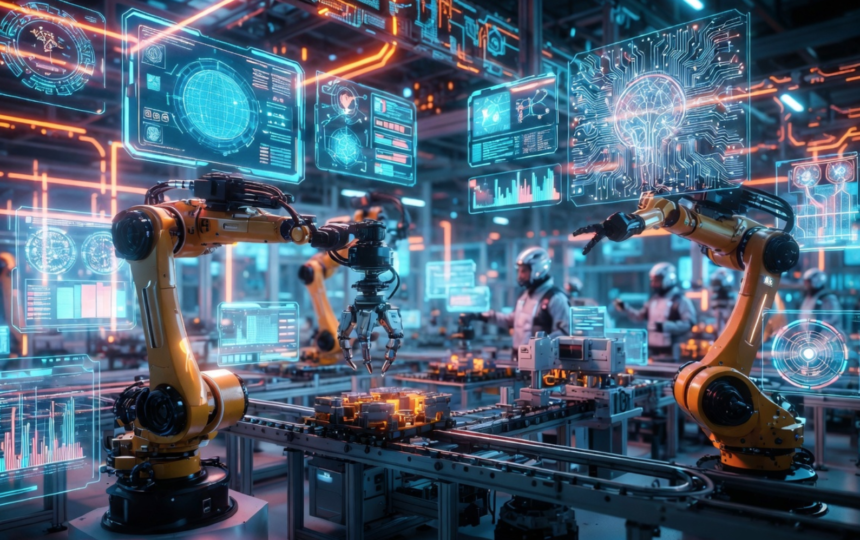
Walk onto a modern factory floor and you might not immediately notice anything extraordinary. Machines hum, workers move, parts travel down lines. But look closer, at the data streaming from sensors, the cameras scanning for microscopic flaws, the algorithms quietly rerouting supply chains in real time, and you start to see it. Manufacturing has been rewired from the inside out, and artificial intelligence is the wire.
This isn’t the robot-takeover narrative that makes for dramatic headlines. The reality is quieter, more pervasive, and in many ways more interesting. AI in manufacturing is less about replacing humans and more about making everything, the machines, the processes, the people, smarter, faster, and more resilient.
Designing Better Products Before a Single Bolt Is Tightened
The transformation starts long before anything physical gets made. AI has fundamentally changed how products are conceived and tested, collapsing what used to be months of iterative design work into days.
Why Generative Design Is Changing Engineering Forever
Generative design is perhaps the most striking example. Engineers no longer have to imagine every possible configuration of a component and test each one manually. Instead, they feed an AI system the constraints, weight limits, material properties, stress tolerances, manufacturing boundaries, and the algorithm explores thousands of structural possibilities simultaneously, surfacing options that no human designer would have thought to try. The results are often strange-looking, almost organic structures that happen to be extraordinarily strong and efficient. Form follows function in a way that intuition alone never quite achieves.
Virtual prototyping has undergone a similar leap. Physical prototypes are expensive to build and slow to test. AI-enhanced simulation software now allows engineers to put a digital product through its paces, pressure tests, thermal analysis, fatigue modeling, before anything enters production. Failure points get identified before they become costly problems. Development cycles shrink. Better products reach the market faster.
The Factory Floor Gets Smarter
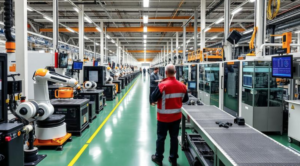
Once a design graduates to production, AI follows it onto the manufacturing floor, and this is where the operational impact becomes most visible.
Predictive Maintenance: Fixing Problems Before They Happen
Industrial machines are now blanketed in sensors measuring temperature, vibration, pressure, and electrical load. AI systems process this continuous data stream, learning what normal looks like for each machine and detecting the subtle deviations that signal trouble ahead, a bearing beginning to wear, a motor running fractionally hotter than it should. The result is maintenance that happens at exactly the right moment, not too early and not too late. Unplanned downtime, which can cost manufacturers thousands of dollars per minute, drops sharply.
Quality control has been similarly transformed. AI-powered vision systems can inspect every single unit passing through a production line, not a sample, every unit at speeds no human inspector could match, flagging defects in real time and feeding that information back upstream so root causes get corrected, not just symptoms.
Supply Chains That Think for Themselves
Manufacturing doesn’t end when the product leaves the line. Getting goods to the right place, at the right time, in the right quantities is a logistical puzzle of staggering complexity and AI has become indispensable in solving it.
From Demand Forecasting to Last-Mile Delivery
AI demand forecasting draws on a far wider pool of signals than traditional methods, economic indicators, weather patterns, social media sentiment, competitor activity, and real-time market shifts. Forecasts update continuously, businesses hold less excess inventory, and stockouts become far less common. Route optimization platforms process live traffic, weather, and delivery windows simultaneously, adapting automatically when conditions change.
Much like the ghost in the machine quietly rewiring reality while you scroll, these AI systems operate invisibly in the background of modern commerce, making thousands of micro-decisions every hour that collectively determine whether supply chains hold together or fall apart.
Empowering the People on the Floor
One of the most persistent misconceptions about AI in manufacturing is that it’s hostile to the human workforce. The more accurate picture is the opposite.
Smarter Workers, Safer Workplaces
Augmented reality guidance systems, headsets that overlay instructions and real-time data directly onto a worker’s field of vision are already active in some of the world’s most advanced facilities. Complex assembly steps that once demanded extensive training can now be completed accurately with real-time AI guidance. Safety monitoring systems watch factory floors continuously, flagging unsafe behaviors before accidents happen. AI-driven ergonomic analysis identifies repetitive movements likely to cause long-term injury, enabling early intervention.
It’s worth noting that as these systems grow more sophisticated, so do the risks attached to them. Deep learning cyberattacks represent the next evolution of AI-driven threats and manufacturing infrastructure, with its dense networks of connected sensors and automated systems, is a high-value target. Security must be built in from the ground up, not added as an afterthought.
The Smart Factory Vision
The logical endpoint of all these applications is the fully integrated smart factory, a manufacturing environment where every machine, process, and data stream is interconnected, and AI serves as the central nervous system making sense of it all.
Cobots, Autonomy, and the Self-Optimizing Factory
In a smart factory, production lines adjust dynamically to shifts in demand. Machines communicate with each other, sharing performance data that allows the whole system to self-optimize. Collaborative robots, cobots, work alongside human colleagues, trained by machine learning to anticipate movement and adapt to new tasks without constant reprogramming. The numbers reflect real impact: manufacturers deploying AI-driven systems are reporting defect reductions of around 30%, productivity improvements of 25%, and annual cost savings running into seven figures.
A Smarter Industry, Built by Smarter Decisions
What’s unfolding in manufacturing is a genuine transformation, not a future promise, but a present reality being built factory by factory, algorithm by algorithm. The companies moving fastest aren’t doing so blindly. They’re pairing AI capability with careful human oversight, treating the technology as a partner rather than a replacement.
The intelligence being embedded into modern manufacturing isn’t just making goods better and cheaper. It’s building an industry more capable of adapting to uncertainty, responding to disruption, and sustaining the kind of efficiency that keeps economies competitive.
The quiet revolution is already underway. The factory floor will never look quite the same again.
Final Thought
AI in manufacturing isn’t a single dramatic invention, it’s a thousand small improvements compounding quietly across every stage of production. From the first sketch of a component to the final mile of delivery, intelligent systems are reshaping what’s possible. The factories that embrace this shift thoughtfully, with equal attention to capability and responsibility, are the ones that will define industrial standards for the next generation.
FAQ’s
1. How is AI being used in manufacturing right now?
AI is active across design, quality inspection, predictive maintenance, supply chain management, and worker safety, not as experiments, but as operational systems running in facilities worldwide every single day.
2. Will AI take jobs away from factory workers?
In most cases, no. AI handles the repetitive, high-risk, and high-volume tasks, while human workers shift toward roles requiring judgment and adaptability. Tools like AR guidance systems are specifically built to make workers more capable, not redundant.
3. What is generative design?
It’s an AI process that explores thousands of structural configurations for a product based on set constraints, weight, strength, materials, often producing designs that outperform anything a human engineer would have conceived manually, in a fraction of the time.
4. How does predictive maintenance work?
Sensors on industrial machines continuously feed data to AI systems that learn each machine’s normal operating patterns. When subtle deviations appear, the system flags potential failures early, allowing scheduled maintenance before a costly breakdown occurs.
5. How does AI improve quality control on production lines?
AI vision systems inspect every unit passing through the line at high speed, catching surface defects, dimensional errors, and assembly faults with consistent accuracy. Real-time feedback means problems get fixed at the source, not discovered after thousands of faulty units have already been produced.
6. Can AI genuinely improve supply chain management?
Yes, significantly. AI forecasting draws on a broader and more dynamic range of data than traditional methods, producing more accurate predictions. Paired with intelligent route optimization, it reduces delivery costs, cuts inventory waste, and improves reliability across the entire chain.
7. What cybersecurity risks come with AI-powered manufacturing?
Connected manufacturing systems are attractive targets. Deep learning cyberattacks can mimic normal system behavior to avoid detection while probing for vulnerabilities. Cybersecurity must be treated as a core design requirement, not an optional layer added after deployment.
8. What makes a factory “smart”?
A smart factory integrates machines, sensors, software, and workers through a shared data infrastructure. AI processes the combined data to optimize the whole facility, scheduling, maintenance, logistics, often allowing production lines to adjust autonomously without waiting for human instruction.
9. What are cobots and why do they matter?
Cobots are collaborative robots designed to work safely alongside humans rather than in separated enclosures. AI gives them the perception to detect human movement and adapt their behavior in real time, making genuine human-robot teamwork on shared tasks both practical and safe.
10. What holds manufacturers back from adopting AI?
The main barriers are data quality, legacy system integration, and workforce readiness. AI needs good data to function well, and older facilities often lack the sensor infrastructure to provide it. Bridging that gap, technically and culturally, is the real work before the benefits kick in.