
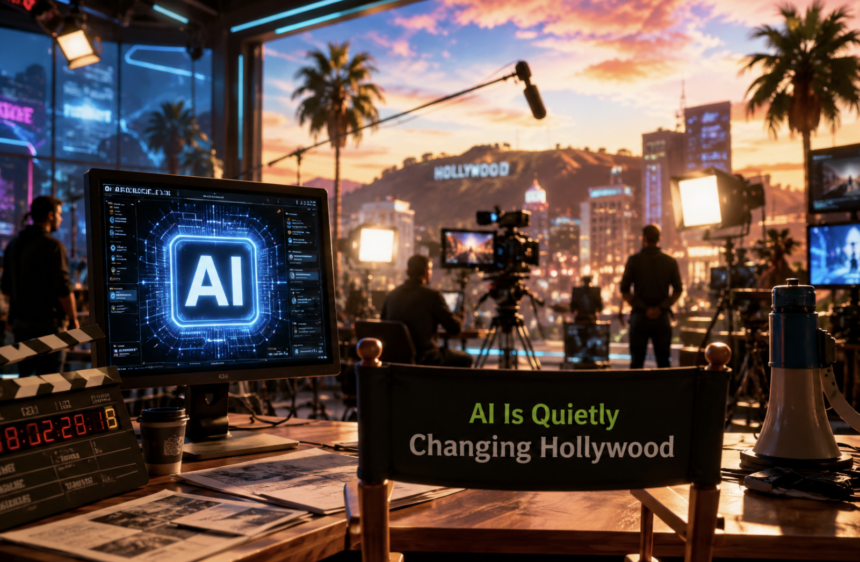
Have you ever watched a movie and wondered how filmmakers created breathtaking visual effects, realistic digital characters, or flawless action scenes? The answer is becoming increasingly clear. Artificial Intelligence is transforming the film industry faster than ever before. What once existed only in futuristic movies has become a powerful technology working behind the scenes of modern filmmaking.
Today, AI does much more than generate visual effects. It helps writers brainstorm stories, assists directors in planning scenes, supports editors during post-production, and even improves audience accessibility with automatic subtitles and dubbing.
As technology continues to evolve, AI is becoming an essential creative partner rather than simply another software tool. However, this transformation goes beyond technical improvements. It is changing how movies are imagined, produced, distributed, and experienced across the world. While AI offers remarkable efficiency, it also raises important discussions about creativity, ethics, and the future of human storytelling.
Let’s explore how AI is revolutionizing Hollywood and why its influence will only continue growing in the coming years.
The Evolution of Artificial Intelligence in the Film Industry
Artificial Intelligence did not appear overnight. Instead, it gradually became part of filmmaking through decades of technological innovation. Initially, filmmakers relied on traditional computer software to perform repetitive calculations required for animation and digital effects. Although these systems were advanced for their time, they lacked the ability to learn or improve independently.
As machine learning developed, filmmakers gained access to tools capable of recognizing patterns, automating repetitive tasks, and producing increasingly realistic results. Today, AI contributes to nearly every production stage, making filmmaking faster, more affordable, and significantly more creative.
How Early Digital Technology Prepared the Way for AI
Before AI entered the spotlight, filmmakers already depended heavily on computer technology. Large production studios invested in powerful render farms capable of processing enormous amounts of visual data. These computer networks dramatically reduced rendering times for complex CGI scenes. At the same time, motion capture technology evolved rapidly. Actors performed wearing specialized suits that recorded body movements. Software then translated those movements into animated characters with increasing precision.
Although these systems were not true Artificial Intelligence, they established the technological foundation that modern AI now expands upon.
Machine Learning Changed Post-Production Forever
Post-production experienced one of the earliest AI revolutions. Editors previously spent countless hours removing backgrounds, isolating objects, and adjusting color consistency frame by frame. AI now performs many of these tasks automatically while maintaining impressive accuracy. Modern editing software identifies subjects, tracks movement, and generates clean masks within seconds.
Consequently, visual effects artists spend less time on repetitive work and more time refining creative details. AI also assists colorists by recommending balanced color grading across entire scenes. Instead of manually correcting every shot, professionals can fine-tune AI-generated suggestions for a polished cinematic appearance. This combination dramatically accelerates production without sacrificing artistic quality.
AI Is Becoming a Creative Partner for Screenwriters
Many people believe storytelling belongs exclusively to human creativity. While that remains true, AI has become a valuable assistant during script development. Artificial Intelligence analyzes thousands of successful screenplays to identify narrative structures, pacing patterns, emotional arcs, and character development techniques. Writers use these insights to strengthen stories while maintaining complete creative control. AI can also generate:
- Alternative dialogue options
- Scene variations
- Character background ideas
- Plot suggestions
- Story outlines
Rather than replacing writers, AI provides fresh inspiration whenever creative blocks appear.
Predicting Audience Preferences with Artificial Intelligence
Studios invest millions in movie production, making audience prediction extremely valuable. AI examines historical box office data, streaming behavior, social media discussions, and viewer preferences to estimate audience reactions before production even begins. Although these predictions remain imperfect, they help studios understand:
- Popular genres
- Preferred story structures
- Audience demographics
- Marketing opportunities
- Potential commercial performance
As a result, filmmakers make more informed production decisions.
AI Is Revolutionizing Pre-Production Planning
Pre-production determines how efficiently filming proceeds. Artificial Intelligence now helps directors visualize scenes before cameras begin rolling. Virtual production platforms generate realistic digital environments where directors experiment with lighting, camera angles, and actor placement. This technology reduces expensive on-set adjustments while improving creative flexibility.
AI also recommends camera positions based on scene composition, movement, and emotional tone, allowing cinematographers to refine their vision long before filming starts.
Smarter Casting Decisions Through Data Analysis
Casting remains a human decision, yet AI provides valuable research. Instead of reviewing thousands of actor profiles manually, casting teams use AI to analyze:
- Previous performances
- Vocal characteristics
- Facial expressions
- Audience reception
- Genre experience
These recommendations often introduce talented performers who might otherwise remain overlooked. Human judgment still determines final selections, but AI expands creative possibilities.
AI Is Making Film Production Faster and More Efficient
Movie production involves hundreds of moving parts. Scheduling actors, organizing equipment, securing locations, and coordinating crew members require careful planning. Artificial Intelligence simplifies these complex logistics by analyzing countless variables simultaneously. Production managers use AI to optimize:
- Shooting schedules
- Budget allocation
- Equipment usage
- Crew availability
- Location planning
Consequently, productions experience fewer delays while reducing unnecessary expenses.
Creating Hyper-Realistic Digital Characters
Modern audiences expect believable visual effects. Artificial Intelligence helps artists produce astonishingly realistic digital humans by replicating facial expressions, skin textures, muscle movement, and even subtle eye behavior. Digital doubles now perform dangerous stunts without risking actor safety.
Meanwhile, AI enhances facial animation by matching emotional expressions with extraordinary precision. These improvements blur the line between reality and computer-generated imagery.
Building Massive Digital Worlds with AI
Creating enormous fictional environments once demanded years of manual design. Today, AI generates detailed cities, forests, mountains, futuristic landscapes, and alien planets in significantly less time. Artists remain responsible for creative direction, while AI rapidly produces environmental variations that save countless development hours. This technology allows filmmakers to imagine larger cinematic universes without dramatically increasing production costs.
The Rise of AI-Powered De-Aging and Age Progression
Several blockbuster films already demonstrate AI-driven age transformation. Artificial Intelligence studies thousands of facial images to recreate younger or older versions of actors with remarkable realism. Unlike traditional makeup, AI preserves natural facial movement while maintaining consistent lighting and skin detail. This technology allows performers to portray characters across multiple decades without changing actors.
How AI Is Transforming Film Editing
Editing shapes every movie’s emotional rhythm. Artificial Intelligence now assists editors by reviewing raw footage and identifying useful takes based on script structure, facial expressions, camera stability, and pacing. Editors remain fully responsible for creative decisions. However, AI provides organized starting points that dramatically reduce review time. Instead of replacing editors, AI removes repetitive technical tasks so professionals focus on storytelling.
AI Improves Sound Design and Audio Quality
Audio quality often determines whether audiences feel fully immersed. Artificial Intelligence automatically removes background noise, balances dialogue levels, enhances speech clarity, and repairs damaged recordings. Additionally, AI generates realistic ambient sounds and supports composers by creating musical ideas that match scene emotions. Human musicians continue shaping final compositions, while AI accelerates the creative workflow.
Restoring Classic Films with Artificial Intelligence
Many historic films suffer from scratches, fading, and low resolution. AI restoration software analyzes damaged footage frame by frame. It reconstructs missing details, sharpens images, reduces visual noise, and improves overall clarity. As a result, classic movies become accessible to modern audiences without losing their original artistic identity. Film preservation has never been more effective.
Making Movies More Accessible Worldwide
Artificial Intelligence also improves global accessibility. Automatic speech recognition generates highly accurate subtitles within minutes. AI-powered voice synthesis produces natural-sounding dubbing across multiple languages, allowing international audiences to enjoy films more comfortably. These advancements reduce translation costs while expanding worldwide distribution. Consequently, filmmakers reach broader audiences than ever before.
Fighting Deepfakes with AI Detection
While AI creates convincing digital media, it also helps identify manipulated content. Specialized detection systems analyze facial inconsistencies, lighting patterns, and image artifacts to identify deepfake videos. Studios increasingly rely on these tools to protect actors, preserve authenticity, and maintain audience trust. As synthetic media becomes more sophisticated, AI-based verification grows increasingly important.
The Ethical Challenges of AI in Hollywood
Despite its advantages, Artificial Intelligence introduces serious ethical questions. One major concern involves creative ownership. If AI contributes to scripts, music, or visual effects, determining authorship becomes increasingly complicated. Copyright laws continue evolving as governments and creative industries address these new challenges. Another concern involves employment. Although AI streamlines production, some repetitive jobs may gradually disappear.
However, entirely new careers focused on AI supervision, prompt engineering, digital production, and machine learning continue emerging alongside technological progress. Finding the right balance between automation and human creativity remains essential.
Can AI Replace Human Creativity?
Many filmmakers believe AI will never replace genuine human imagination. Technology excels at analyzing patterns and generating possibilities. Nevertheless, emotional storytelling depends on lived experiences, empathy, culture, intuition, and artistic vision. Great films connect audiences because humans understand emotion in ways machines cannot truly replicate.
Therefore, AI works best as a creative assistant rather than a creative replacement. The most successful productions will likely combine technological efficiency with authentic human storytelling.
The Future of AI in Movies Looks More Exciting Than Ever
Artificial Intelligence continues advancing at an extraordinary pace. Future innovations may include:
- Interactive movies with personalized storylines
- AI-assisted virtual actors
- Fully immersive virtual production environments
- Real-time language translation during streaming
- Personalized viewing experiences
- Advanced cinematic world generation
Although these possibilities sound futuristic, many already exist in early development. The coming decade will likely redefine filmmaking in ways audiences have never experienced before.
Conclusion
Artificial Intelligence has evolved from a futuristic concept into one of Hollywood’s most influential technologies. It supports filmmakers from the earliest script ideas to the final moments of post-production.
Whether generating breathtaking visual effects, streamlining production schedules, restoring classic films, or expanding accessibility worldwide, AI continues reshaping every aspect of cinema. Still, technology alone cannot create unforgettable stories. Human creativity remains the heart of filmmaking, while AI serves as an incredibly powerful collaborator.
As both continue evolving together, audiences can expect richer stories, more immersive visuals, and cinematic experiences that push creative boundaries even further. The future of movies is not about humans versus AI. Instead, it is about humans and AI creating extraordinary entertainment together.
Frequently Asked Questions
1. Is AI replacing filmmakers?
No, AI assists filmmakers by improving efficiency while human creativity remains essential.
2. How does AI help movie production?
AI automates editing, scheduling, visual effects, sound enhancement, and production planning.
3. Can AI write movie scripts?
AI can generate ideas and drafts, but human writers create the final screenplay.
4. Does AI improve visual effects?
Yes, AI creates more realistic digital characters, environments, and cinematic effects.
5. How does AI help film editors?
AI organizes footage, suggests rough cuts, and automates repetitive editing tasks.
6. Can AI restore old movies?
Yes, AI enhances image quality, repairs damage, and increases video resolution.
7. Does AI help with movie subtitles?
Yes, AI generates accurate subtitles and supports multilingual dubbing.
8. What are digital doubles in movies?
Digital doubles are AI-enhanced virtual versions of actors used for visual effects and stunts.
9. Can AI predict movie success?
AI analyzes audience data to estimate market trends, but predictions are never guaranteed.
10. Will AI completely replace actors?
No, human performances remain irreplaceable despite advances in digital character technology.
11. What are the biggest concerns about AI in filmmaking?
Creative ownership, ethical use, bias, and job changes remain the industry’s primary concerns.
12. What is the future of AI in movies?
AI will continue enhancing storytelling, production quality, accessibility, and personalized cinematic experiences.