

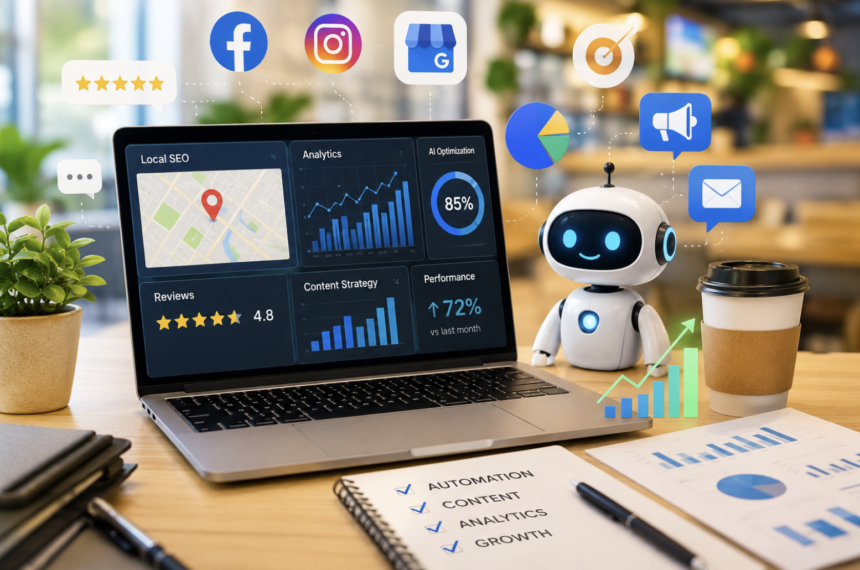
Local businesses once depended heavily on referrals, flyers, and traditional advertising. Today, customer journeys begin with a search, message, review, or social post. However, competition has also become tougher. Customers expect faster replies, relevant offers, helpful content, and seamless online experiences. That is where AI and marketing automation create a major advantage. These technologies help local businesses understand customers, reduce repetitive work, improve campaigns, and generate better leads.
More importantly, they allow small teams to compete with much larger brands. From intelligent local SEO to automated customer journeys, AI is changing how businesses attract and retain customers. Therefore, companies that adopt these tools strategically can build stronger digital relationships.
How AI Is Changing Local Digital Marketing
Artificial intelligence can process enormous amounts of information within seconds. Consequently, businesses can discover patterns that would take humans much longer to identify. AI can study search behavior, customer interactions, campaign performance, website activity, and purchasing patterns. It can then transform those signals into practical marketing decisions. Meanwhile, automation handles repetitive activities without requiring constant manual attention.
For example, automation can send appointment reminders, organize leads, schedule social posts, and trigger follow-up emails. As a result, business owners gain more time for customers and daily operations. The real advantage appears when businesses combine AI insights with automated workflows.
AI-Powered Local SEO Is Changing Search Visibility
Local SEO remains essential for businesses that depend on nearby customers. However, search behavior has become more conversational and personalized. Customers now ask complete questions instead of typing short keywords.
Additionally, voice assistants and mobile searches have changed how people discover local services. AI can help businesses identify these changing search patterns.
Smarter Keyword and Search Intent Analysis
Modern AI tools can identify topics, questions, and phrases connected to customer intent. Therefore, businesses can create content that answers real customer needs. A local dental practice, for instance, can target questions about emergency appointments, dental costs, and preventive care.
Similarly, restaurants can create content around nearby attractions, dining occasions, and popular local searches.
Improved Google Business Profile Strategies
AI can also support local listing management by identifying missing information and content opportunities. Businesses can analyze customer questions, review patterns, and listing performance. Consequently, they can improve profiles with more useful information. This approach can strengthen local visibility while making listings more helpful to potential customers.
Personalized Marketing Without Expanding Your Team
Customers increasingly expect businesses to understand their preferences. However, manually personalizing every interaction requires considerable time. AI makes personalization possible at a much larger scale. For instance, an online retailer can recommend products based on browsing behavior. A fitness studio can promote suitable classes based on previous bookings.
Likewise, a healthcare business can automate relevant appointment reminders. AI can divide audiences according to behavior, interests, location, and engagement. Then, automation can deliver appropriate messages to each segment. As a result, customers receive more relevant communication without overwhelming marketing teams.
AI Chatbots Are Reshaping Customer Communication
Customers often want immediate answers. Unfortunately, small businesses cannot always respond instantly to every question. AI-powered chatbots help solve this problem. A chatbot can answer common questions about opening hours, services, pricing, availability, and appointment procedures. F
urthermore, advanced systems can collect customer information before transferring complex conversations to employees. This creates a faster customer experience while reducing repetitive support requests. However, businesses should maintain human oversight. Customers should have an easy path to reach a real person when necessary.
Marketing Automation Creates Better Customer Journeys
Marketing automation does more than send scheduled emails. It can create entire customer journeys based on specific actions. For example, someone may download a guide from a business website. That action can trigger a welcome email.
Next, the system can send educational content based on engagement. Then, it can provide a relevant offer when the customer shows stronger buying intent. Therefore, businesses can nurture prospects without manually tracking every interaction. Automation can also reconnect with inactive customers. A personalized reminder may encourage a previous customer to return.
Predictive Analytics Helps Businesses Make Smarter Decisions
Traditional marketing often relies on assumptions. Predictive analytics provides a more data-driven alternative. AI can examine historical information to identify patterns around customer behavior, demand, and engagement. For example, a restaurant may discover higher demand during specific weekends. A salon might identify seasonal increases in certain services. Meanwhile, a service company could identify which leads usually become paying customers.
These insights help businesses allocate budgets more effectively. They can also prepare inventory, staffing, promotions, and campaigns around expected demand.
AI Is Making Content Marketing Faster and More Strategic
Creating useful content consistently can challenge small businesses. AI can simplify several stages of the content process. It can generate topic ideas, identify frequently asked questions, organize outlines, and suggest content improvements.
Additionally, businesses can use AI to repurpose existing content. A detailed blog post can become social media posts, email content, short video scripts, and customer FAQs. However, businesses should never publish generic AI content without human review. Local knowledge creates differentiation.
Real customer experiences, local examples, expert opinions, and original insights make content more trustworthy. Therefore, AI should support human creativity rather than replace it.
Automated Social Media Marketing Saves Valuable Time
Social media requires consistency. Yet, many local business owners struggle to publish regularly while managing daily operations. Automation can schedule posts across multiple platforms. AI can also suggest content ideas based on customer interests and seasonal trends. Businesses can prepare promotional posts, educational updates, customer stories, and event announcements in advance.
Furthermore, analytics can identify which content generates stronger engagement. Businesses can then adjust their strategy instead of publishing content blindly.
AI Can Improve Online Reputation Management
Online reviews strongly influence local purchasing decisions. However, monitoring every review manually can become difficult. AI-powered reputation tools can monitor multiple platforms and identify new customer feedback. Sentiment analysis can categorize reviews according to their overall tone.
Additionally, recurring complaints can reveal operational problems. For example, repeated complaints about waiting times may indicate a scheduling issue. Businesses can then address the underlying problem instead of simply responding to reviews. Automated alerts also help businesses respond faster. Nevertheless, sensitive complaints should receive personal responses from trained staff.
AI Advertising Can Reduce Unnecessary Marketing Waste
Paid advertising becomes expensive when campaigns target the wrong audiences. AI can analyze campaign performance and identify patterns among high-value customers. Automated bidding systems can adjust spending according to performance signals. Similarly, audience models can help identify users with stronger conversion potential. Businesses can also test different headlines, images, offers, and landing pages.
Instead of relying on one advertisement, AI-supported testing can compare multiple variations. Consequently, marketers can learn what works and reduce ineffective spending. However, businesses still need clear goals and accurate tracking. Technology cannot compensate for poor campaign strategy.
Customer Retention Is Becoming More Intelligent
Acquiring a new customer often requires significant marketing effort. Therefore, retaining existing customers deserves equal attention. AI can identify customers whose engagement is declining. For example, a fitness center could detect members who stopped attending regularly.
An online store might identify customers who have not purchased recently. Automation can then trigger personalized messages. A helpful reminder, exclusive offer, or educational message may encourage customers to return. This approach turns retention into a proactive process instead of a last-minute effort.
AI Can Connect Marketing With Sales
Marketing and sales teams often work with separate information. That disconnect can create missed opportunities. AI and automation can connect customer interactions across different stages. A lead can enter a marketing system after submitting a form. The system can then score the lead based on engagement. Highly interested prospects can move toward sales teams faster.
Meanwhile, less engaged prospects can receive additional educational content. This process helps employees focus on leads with stronger potential. As a result, businesses can improve efficiency without increasing headcount.
First-Party Data Is Becoming More Important
Privacy changes are reshaping digital marketing. Businesses can no longer depend entirely on external tracking systems. First-party data provides a valuable alternative. This information comes directly from customers through websites, purchases, bookings, forms, surveys, and loyalty programs. AI can analyze this information to identify useful patterns while businesses maintain greater control.
However, companies must collect and use customer information responsibly. Clear consent, secure storage, and transparent communication remain essential. Trust should always come before personalization.
AI Helps Local Businesses Compete With Larger Brands
Large corporations traditionally had access to larger marketing teams and bigger budgets. AI is narrowing part of that gap. A small business can now automate workflows that once required several employees. It can analyze customer behavior, create marketing drafts, monitor reviews, personalize communication, and evaluate campaigns. Consequently, smaller businesses can operate with greater marketing efficiency.
However, technology alone does not guarantee success. Local businesses still need strong products, excellent service, authentic branding, and meaningful customer relationships. AI simply gives those businesses better tools.
How Businesses Can Adopt AI Without Losing Authenticity
Successful AI adoption requires balance. First, identify repetitive tasks that consume valuable time. Next, determine which activities require human judgment. Then, automate predictable processes while keeping important customer interactions personal. Businesses should also review AI-generated content before publishing it.
Furthermore, teams should regularly evaluate automation results. If a workflow creates poor customer experiences, businesses should modify or remove it. The objective is not to automate everything. Instead, the goal is to automate the right things.
The Future of AI and Automation in Local Marketing
The next stage of local marketing will become increasingly intelligent. AI will continue improving personalization, predictive analytics, conversational search, content optimization, and customer service. Meanwhile, automation will connect more marketing activities into unified customer journeys. Local businesses will increasingly compete through speed, relevance, convenience, and experience. Those that adapt early can build stronger digital foundations. However, the most successful businesses will combine technology with genuine human connection.
Customers still value trust, empathy, expertise, and personal attention. Therefore, the future belongs to businesses that use AI without losing their human identity.
Conclusion: AI Is Becoming the New Engine of Local Growth
AI and automation are no longer optional concepts for forward-thinking local businesses. They are becoming practical tools for improving visibility, communication, advertising, retention, and customer experience. From smarter local SEO to predictive customer insights, these technologies can transform everyday marketing activities. Furthermore, automation allows small teams to accomplish more without creating unnecessary workloads.
Yet, successful implementation requires strategy. Businesses should focus on useful automation rather than adopting technology simply because it is popular.
They should also protect customer privacy and maintain authentic communication. Ultimately, AI works best when it strengthens human marketing rather than replacing it. Local businesses that combine intelligent technology with genuine service can create stronger and longer-lasting customer relationships.
Frequently Asked Questions
1. How does AI improve local digital marketing?
AI improves local marketing by analyzing customer data, predicting behavior, and optimizing campaigns more efficiently.
2. Can small businesses afford AI marketing tools?
Yes, many affordable AI platforms offer scalable features designed for small businesses and limited marketing budgets.
3. Can AI improve local SEO rankings?
AI can support keyword research, search-intent analysis, content optimization, and local SEO strategy development.
4. Are AI chatbots useful for local businesses?
Yes, chatbots can answer common questions, capture leads, schedule appointments, and provide faster customer support.
5. Can AI replace human marketers?
AI can automate repetitive tasks, but human creativity, judgment, empathy, and strategy remain essential.
6. How does automation help customer retention?
Automation can identify engagement changes and send timely reminders, offers, and follow-up messages.
7. Does AI make digital advertising more effective?
AI can optimize targeting, bidding, testing, and budget allocation based on campaign performance data.
8. Why is first-party data important for AI marketing?
First-party data gives businesses direct customer insights while supporting stronger privacy and data-control practices.
9. Can AI create SEO-friendly content?
AI can assist with research and optimization, but human editing ensures accuracy, originality, expertise, and brand authenticity.
10. What should businesses automate first?
Businesses should initially automate repetitive tasks such as appointment reminders, lead follow-ups, reporting, and content scheduling.
11. Is AI marketing suitable for every local business?
Yes, nearly every local business can find useful AI applications when technology matches its specific goals.
12. What is the biggest benefit of marketing automation?
The biggest benefit is consistent customer engagement while reducing repetitive manual marketing work.
13. How can businesses use AI responsibly?
Businesses should protect customer information, disclose automation where appropriate, review AI outputs, and maintain human oversight.
14. Will AI change local customer expectations?
Yes, faster responses, personalized recommendations, and convenient digital experiences are increasingly becoming customer expectations.
15. What is the future of AI in local marketing?
The future will focus on predictive personalization, conversational search, intelligent automation, and increasingly connected customer experiences.