

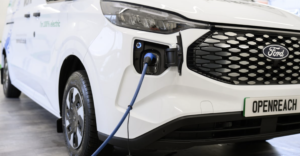
Openreach, the company that maintains much of the UK’s broadband network, says it is working with a fuel card provider to make charging its electric vans easier. That matters beyond one employer, because the same problem faces any business that asks staff to drive electric vehicles but cannot assume everyone has a driveway.
In this article, we will explore what was reported, how fuel card charging works, why home charging is hard, and what fleet drivers can ask their own employers.
The Announcement in Plain Terms
According to ISPreview, which reported the story on 12 November 2026, Openreach (the BT group business that builds and repairs the UK’s telephone and broadband lines) is working to adopt the fuel card network run by Allstar. The aim is to support its move away from diesel vans and cars towards electric ones. The wording matters. The report says Openreach is working to adopt the network, which is not the same as saying a finished deal is live, and we return to that point later.
Several pieces are described. Allstar Homecharge would let engineers who have a charger at home charge work mileage directly to their energy supplier, rather than paying the bill out of their own pocket and then claiming the money back. The Allstar Co-Pilot app would direct engineers to the nearest suitable charging location. The partnership would also develop access to commercial and shared depot charging, which means chargers at business sites that are not owned by the engineer’s own employer.
The report adds that spare capacity at depots could be offered through platforms such as First Charge and Voltempo, according to an EV Infrastructure News report cited by ISPreview. The phrase “such as” is important. It signals examples of the kind of platform involved, so readers should not treat those two names as confirmed partners.
This is a UK story, and the details of fleet charging differ by country. Other nations have different tax treatment of company vehicles, different electricity markets and different public charging networks. Everything below is written with UK readers in mind, and where we draw on general knowledge rather than the reporting, we say so.
Who Is Affected
The most direct group is Openreach engineers, who spend their working days driving between homes, street cabinets and exchanges. Their employer, their energy suppliers and the charging companies involved are also affected. Beyond that, anyone who drives a company electric vehicle and charges it at home will recognise the reimbursement problem the scheme is meant to solve.
Ordinary broadband customers are affected only indirectly. A smoother electric fleet might reduce running costs and emissions for a large employer, but the reporting does not say what it means for prices, repair visits or service levels, so we make no claim about them.
Scale also matters here. A business with a fleet this large cannot rely on individual workarounds, because small frustrations are multiplied across thousands of drivers every working day. A payment problem that costs one driver ten minutes becomes a large operational cost across a workforce, which is the practical reason employers pay attention to details such as who fronts the money for electricity.
Why It Is News Now
Electric vans have moved from trials to everyday work in many fleets, and the difficult part is no longer buying the vehicle. It is keeping the vehicle charged where the driver lives and works. A deal that tackles payment, location and depot access together is therefore a useful case study, even if it is still being developed.
How Fuel Card Charging Works
A fuel card is a payment card or account that an employer issues so staff can buy fuel for work vehicles without using personal money. The employer receives a consolidated bill, and the card provider typically records each transaction by vehicle or driver. This is general knowledge about how fuel cards have long worked for petrol and diesel, and the details vary by provider, so check the specific terms.
Applying the same idea to electricity is harder, because electricity can be bought in several different places. A driver might charge at a depot, at a public rapid charger on a motorway, at a supermarket or at home. Each place has its own operator, its own price and its own way of taking payment. A network that links many of them under one account is attractive to a fleet manager because it replaces a pile of separate receipts with a single record.
The Home Charging Piece
The Homecharge feature described in the report addresses the most awkward case. When an engineer plugs a work van into a home charger, the electricity is drawn from the household supply and appears on the household bill. Without a scheme in place, the engineer pays and then claims reimbursement.
According to the report, Homecharge would let the work costs be charged directly to the energy supplier instead. How that would be arranged, whether it needs a particular tariff, a particular supplier or a smart charger, is not described in the reporting we reviewed. We would treat any claim about the mechanics as unconfirmed until Openreach or Allstar publish more.
The Navigation Piece
The Co-Pilot app is described as pointing engineers to the nearest charging location. For anyone who has hunted for a working public charger on a tight schedule, that is a practical benefit. An engineer who is running late with a half-empty battery does not need a map of every charger in the country. They need the closest one that works with their payment account.
The Depot Piece
Depots are sites where vehicles are parked and loaded, often overnight. Chargers there can be cheap and predictable to use because the vehicle is stationary for hours. The report says the partnership would develop access to commercial and shared depot charging, which could help when an engineer is working far from their own base.
Home Charging Is Harder than It Sounds
Home charging is often described as the easiest and cheapest way to run an electric vehicle, and for people with a driveway that is usually fair. A vehicle that charges overnight starts each morning full, and the driver never visits a forecourt. The difficulty is that this convenience depends on housing, which an employer cannot change.
The reporting says around one in three Openreach engineers cannot install a home charger. That single figure explains why a fuel card network is part of the plan. If a third of a workforce cannot charge at home, the employer needs another route for them, and that route has to be both convenient and affordable.
Why Some Homes Cannot Have a Charger
General knowledge points to several common reasons. Many British homes have no off-street parking, so the car or van is left on the road, and running a cable across a pavement is impractical and often unsafe. Flats and rented homes usually need permission from a freeholder, landlord or management company before any wiring is changed. Some properties also have electrical supplies that would need an upgrade to support a charger, which can be costly. These reasons are general and not drawn from the report, which gives only the one-in-three figure.
What Engineers Do Instead
Without a home charger, the options are public chargers, workplace or depot chargers, or a mix. Public charging has its own difficulties, including queues, broken units and different payment apps. This is where a single account and a navigation tool could matter. They do not create chargers, but they could make the existing ones simpler to use.
It is worth noting that a van parked on a street overnight cannot take advantage of cheap night-time electricity unless a charger is nearby. Engineers who rely on public charging may therefore pay different prices from colleagues who charge at home. The reporting does not say how Openreach would handle such differences.
Depot Charging and Shared Capacity
A depot charger is shared by many vehicles, so its limiting factor is often the electricity supply to the site rather than the number of charger units. If a depot has spare power overnight, because its own vehicles are not all plugged in at once, that capacity could in principle be offered to other businesses. That is the idea behind the platforms named in the report.
According to the EV Infrastructure News report cited by ISPreview, excess depot capacity would be offered through platforms such as First Charge and Voltempo. We have not seen either company confirm a role. Readers should therefore treat these names as illustrations of how shared depot access might work.
Why Sharing Could Help
Think of it as a car park that is full in the day and empty at night. The same logic applies to electrical capacity, which is paid for whether or not it is used.
The advantage of sharing is that expensive electrical connections are used more of the day. A site that sits idle at night is wasted infrastructure. A neighbouring business with a few electric vans could use it, and the owner could earn money from it. This describes the general economic logic, and it is not a statement about any named company.
The Obstacles to Sharing
Sharing is not simple. Sites need secure access, accurate metering so each user pays for what they take, and clear rules on who gets priority when demand rises. Insurance, safety and planning matters also arise. None of these obstacles are discussed in the reporting, and we raise them only as general considerations that would need to be resolved in any shared arrangement.
Fleet Numbers and a Simple Illustration
The numbers in the report give a sense of scale. They come from the same single trade report, so they are attributed to it rather than checked against Openreach figures.
The table below sets out the reported figures. The final row is not a reported number. It is a simple arithmetic illustration of what the first two rows imply, shown step by step so you can check it.
| Item | Reported or Calculated | Detail |
| Total vehicles | Reported | 22,000 |
| Electric vehicles | Reported | Over 7,000 |
| Charging points installed | Reported | More than 4,000 at operational sites and engineers’ homes |
| Engineers unable to fit a home charger | Reported | Around one in three |
| Diesel conversion target | Reported | Vast majority by the end of March 2031 |
| Electric share (illustration) | Calculated | 7,000 divided by 22,000 is about 0.32, or roughly 32 percent |
Because the report says “over 7,000”, the true share is a little above 32 percent. The calculation is an illustration of the order of magnitude, not a precise reported percentage. It also shows that the fleet is closer to a third electric than to half, which suggests a large amount of work remains before the 2031 target.
Reading the Target
The report says Openreach aims to convert the vast majority of its diesel vans and cars to electric by the end of March 2031, which matches its Net Zero date. The phrase “vast majority” is not a number, so it leaves room for some vehicles to remain diesel or otherwise fall outside the plan. We cannot say what share that would be.
Charging Points Versus Vehicles
The report counts more than 4,000 charging points at operational sites and engineers’ homes. Comparing that to over 7,000 electric vehicles, you might assume there are too few chargers. That would be a hasty conclusion. Some vehicles charge on public networks, some share a charger, and the report does not say how the 4,000 are split between sites and homes. Without that split, the comparison tells us little.
Steps for Engineers and Other Work EV Drivers
The first thing to say is that the answer to most questions about work charging is “it depends on your employer”. Policies differ widely between firms, and even between teams in the same firm. That is why the checklist focuses on questions to ask and records to keep, not on promises about what will be paid.
Many readers will not work for Openreach but will drive a company electric vehicle, or will soon. The following sequence is our own practical checklist, built on general knowledge. It is not tax or legal advice, and the rules change, so check current guidance from HMRC and your employer.
Step 1
Find out whether your employer has an official charging policy. Ask whether it covers home charging, public charging and depot charging, and get the answer in writing if you can. A policy that exists only in conversation is hard to rely on later.
Step 2
Ask how home charging costs are reimbursed. Some employers pay a set rate per mile, some pay actual electricity costs and some use a direct arrangement with an energy supplier. HMRC publishes rules on how reimbursement of home charging is treated for tax, and those rules can change, so check the current position instead of relying on memory.
Step 3
Check whether you can install a home charger at all. Consider parking, the electrical supply and, if you rent or live in a flat, permission from whoever owns the building. If the answer is no, tell your employer early, because you will need a different route.
Step 4
Learn which public networks and cards your employer supports. A fuel card or charging account only helps if the chargers near you accept it. Download the relevant app and test it before you are in a hurry.
Step 5
Keep records. Save receipts, app statements and the date, time and amount of each charge. Even where a scheme automates reporting, your own record is useful if something is disputed.
Step 6
Raise problems promptly. If a charger is broken, a payment fails or you are repeatedly out of pocket, report it to your manager and the card provider. Fleet schemes improve when drivers describe specific failures.
The table below is a simple decision aid for common situations. It is our own general guide, not a rule from any employer or scheme, so adjust it to your own policy.
| Your Situation | Likely First Move | Why |
| Driveway and a home charger | Ask how home charging is reimbursed | Avoids paying first and chasing money later |
| Home charger possible but not yet fitted | Ask about support, permissions and timing | Installation can take weeks to arrange |
| No home charging possible | Ask for a depot or public charging account | Gives you a reliable route from the start |
| Working far from your usual base | Check the app for nearby supported chargers | Saves time and avoids a flat battery |
| Charger fails or payment is declined | Report it and keep the evidence | Helps you avoid being out of pocket |
Two cautions apply to the table. First, it assumes your employer offers each option, which many do not yet. Second, reimbursement and tax treatment can be complicated, so check current HMRC guidance before assuming anything about what is taxable.
Questions Worth Asking Your Manager
When you raise the subject, specific questions get better answers than general ones. Ask who pays when a public charger is unavailable and you have to use a more expensive one. Ask whether there is a limit on the price per unit that will be reimbursed. Ask how quickly claims or direct payments are settled, and what happens if you charge a personal vehicle from the same home charger. Each of these is a common source of confusion in company vehicle schemes.
It also helps to ask what happens when you change vehicle or leave the firm. A home charger you paid for yourself may stay with you, while one installed under an employer scheme may have conditions attached. These are general points, and the answers will differ from one employer to the next.
Public Charging Payments in General
Not every engineer, and not every reader with a company vehicle, will charge at home or at a depot every time. Public charging is the third leg of most fleet plans, and its payment systems are worth a short tour. This section is general knowledge about how public charging works in the UK, so details may have changed and readers should check the official terms of each network.
Ways to Pay at a Public Charger
Public chargers have traditionally accepted several kinds of payment. Many take contactless bank cards directly at the unit, which needs no account. Others require an app tied to a specific network, with the driver loading a payment method in advance. A third route is a membership card or radio tag that is tapped against the charger, which is common for business accounts because costs are grouped under the employer.
Roaming schemes sit across these. A roaming service lets one account work on several networks, in the same way a mobile phone can use other operators abroad. A fuel card network that links many charge points under one account is, in practical terms, a form of roaming for fleets. Whether Allstar’s network behaves exactly this way is not stated in the reporting, so treat this as a general comparison.
Why One Account Matters to a Fleet
A fleet manager wants three things from a payment system. First, the driver should not need to pay personally. Second, each charge should be tied to a vehicle and a date so that costs can be allocated. Third, the system should work at the chargers drivers are likely to use. A single account helps with all three, which is why such networks appeal to large employers.
For the driver, the benefit is simpler. There are fewer apps to install, fewer receipts to keep and less chance of being left out of pocket after a long week. The trade-off is that the account may not be accepted everywhere, so having a backup way to pay is sensible where your employer allows it.
Final Thoughts
This story rests on a single trade source, ISPreview, and the depot sharing detail comes from an EV Infrastructure News report that ISPreview cited. The wording is that Openreach says it is working to adopt the network, so the language is about intent and progress, not a completed rollout. Readers should keep that in mind.
Several important things are not in the reporting we reviewed. We do not know whether the arrangement has been finalised, or when any part of it would launch. We do not know what it would cost, how many engineers or sites it would cover, or how the van and car split looks within the fleet. Charging rates, meaning the price an engineer would pay per unit of electricity, are also not described.
There is also no stated conflict between sources, because we have only the one report and its cited trade article. That is a limit in itself. When a claim has a single source, a later official announcement from Openreach or Allstar could correct or change it.
What to Ignore
Ignore any suggestion that this scheme will cut your broadband bill, speed up engineer visits or change your tariff. Nothing in the reporting supports those claims. Also ignore social media posts that present the plan as a done deal or give precise savings figures, since the sources we reviewed give none.
What Can Wait
If you are an ordinary broadband customer, you do not need to do anything. If you drive a company EV, you can wait for specifics from your own employer rather than assuming your scheme will match Openreach. The checklist above is a sensible use of the time in the meantime.
Frequently Asked Questions
Is Openreach Really Switching to Electric Vans?
According to the report, over 7,000 of its 22,000 vehicles are already electric, and it aims to convert the vast majority of its diesel vans and cars by the end of March 2031. That target matches its Net Zero date. Our research found no breakdown of how many are vans and how many are cars.
How Would Allstar Homecharge Pay for an Engineer’s Home Charging?
The report says the system would let engineers with home chargers charge work costs directly to their energy supplier, rather than paying first and claiming expenses. How the billing is arranged is not described in the sources we reviewed. Engineers should wait for their employer’s own guidance.
Can You Claim Back the Cost of Charging a Work Van at Home?
In general, employers can reimburse home charging, and HMRC publishes rules on how that is treated. The details depend on the arrangement and can change, so this is general information and not tax advice. Check current HMRC guidance or ask your employer or an adviser.
What if You Cannot Install a Charger at Home?
You have other options, which include public chargers and workplace or depot charging. The report says around one in three Openreach engineers cannot install a home charger, which is why public and depot access are part of the plan. Tell your employer early so a suitable route can be arranged.
When Will the Openreach and Allstar Scheme Start?
The reporting we reviewed gives no launch date and does not say whether the arrangement is final. It describes Openreach as working to adopt the network. Watch for an official announcement from Openreach or Allstar before relying on any date you see elsewhere.