

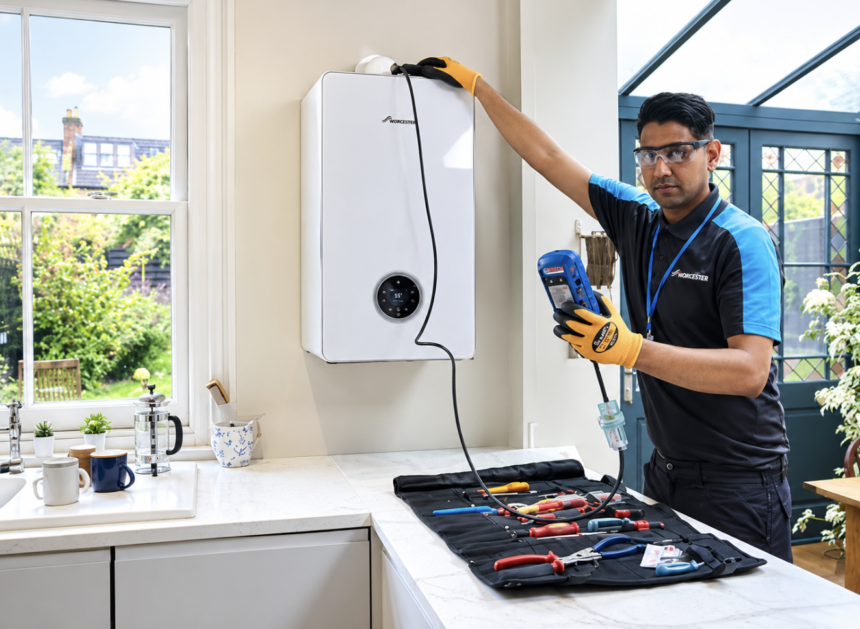
A boiler is the one appliance most UK households cannot do without for long. It heats the radiators, warms the water for showers and washing-up, and usually runs for years without drawing attention to itself. That quiet reliability is exactly why servicing gets postponed. Nothing seems wrong, so the appointment slips for another year, until the first cold snap brings a breakdown at the least convenient moment.
This guide explains what a boiler service involves, who is allowed to carry it out, how an annual service differs from a landlord’s gas safety check, and how the many cover plans on the market compare. It deals with costs without quoting prices that date quickly. Prices vary by region, boiler type and provider, so the aim is to show you what drives them and how to obtain fair quotes. For official detail, the Gas Safe Register, the Health and Safety Executive, GOV.UK and Ofgem are the sources to check.
Checking What a Boiler Service Covers
A boiler service is a planned inspection, clean and safety check carried out by a qualified engineer. It is not a repair visit, although the engineer may find faults along the way and recommend work. The aim is to confirm that the appliance burns fuel safely, runs efficiently and is not showing early signs of wear that could lead to a breakdown.
A typical service for a gas boiler includes the following tasks, though the exact list depends on the manufacturer’s instructions and the engineer’s own checklist:
- Visual inspection: the engineer looks over the boiler casing, pipework, seals and surrounding area for leaks, corrosion, scorch marks or signs of poor installation.
- Flue and ventilation: the flue carries waste gases outside, so the engineer checks that it is secure, unobstructed and correctly terminated, and that the room has adequate ventilation where required.
- Burner and heat exchanger: these components are inspected and cleaned where the manufacturer allows, because dirt and scale reduce efficiency and can lead to unsafe combustion.
- Pressure and controls: the engineer checks system pressure, the expansion vessel, the pump, valves and thermostats to make sure the heating responds correctly.
- Combustion analysis: a flue gas analyser measures what the boiler is producing, which shows whether the fuel is burning cleanly and safely.
Most services take under an hour for a standard domestic boiler, though an older or more awkwardly sited appliance can take longer. A good engineer will explain what they have found, show you any worn parts and complete a service record that notes the boiler’s make, model and serial number. Keep that record. It is useful evidence for a warranty claim, a cover plan application or a future sale of the property.
A service does not normally include repairs, replacement parts or a powerflush of the whole system. Those are separate jobs with separate costs. Equally, a service does not cover the radiators, the hot water cylinder or the wiring unless the engineer has agreed to look at them. If you want something specific checked, say so when you book.
Oil-fired and LPG boilers follow the same principle. Oil boilers are commonly serviced by technicians registered with OFTEC, while LPG appliances fall under the Gas Safe Register like mains gas. Heat pumps and electric boilers have their own servicing needs and different qualified installers, so check the manufacturer’s guidance for those.
Choosing a Gas Safe Registered Engineer
By law, anyone working on a gas appliance in Great Britain must be on the Gas Safe Register. Northern Ireland has its own arrangements, with registration run through a different body, so readers there should check the local requirements. Using an unregistered person is not just a legal risk. Poor gas work can cause fires, explosions and carbon monoxide poisoning, and it can invalidate your home insurance. Verifying an engineer takes a couple of minutes and should be done before any work starts:
- Photo identity card: every registered engineer carries a Gas Safe ID card showing their photograph, licence number and the dates it is valid. Ask to see it, and do not feel awkward about doing so.
- Back of the card: this lists the types of gas work the person is qualified to do, such as boilers, cookers or fires. Make sure boiler work is on the list.
- Online check: the Gas Safe Register website lets you search by engineer or company, and confirms whether the registration is current.
- Business details: registered businesses should be able to give you a company name, a landline or business address, and written terms.
Beyond registration, look at how the engineer or company behaves. A reliable provider will quote clearly, tell you roughly how long the visit will take, explain what happens if a fault is found, and not pressure you into immediate replacement. Be cautious of anyone who condemns a working boiler on the spot without showing you evidence. Engineers do have a duty to turn off an appliance that is unsafe, and that should be taken seriously, but they should explain the reason and give you written details. If you are unsure, ask for a second opinion from another registered engineer.
Before the visit, ask for the price in writing, including any call-out charge, and ask whether parts such as seals or gaskets are charged separately if they need replacing. A clear answer to these simple questions is a good sign. Vague answers, or a price that changes once the engineer is inside your home, are reasons to pause.
Ask also whether the engineer works for the boiler manufacturer, a national company or an independent business. Manufacturer-approved engineers can be useful if your boiler is still under warranty. Independent engineers often offer more flexible times and sometimes lower call-out costs, but you should still check their registration and reviews from local customers.
Comparing Cover Plans and Their Tiers
A boiler cover plan is a paid arrangement, usually monthly or annual, under which a company agrees to repair or sometimes replace your boiler if it breaks down. Many plans include an annual service, which is a major attraction. Cover plans are sold by energy suppliers, specialist heating companies, insurers and some boiler manufacturers, and the products vary widely. Most providers structure their offers in tiers. The names differ, but the pattern is similar:
- Boiler only: covers breakdowns of the boiler itself, often with an annual service, but not the pipes, radiators or controls.
- Boiler and controls: adds the thermostat, timer, programmer and related controls, which are common sources of faults.
- Central heating: extends to the whole heating system, which may include radiators, pipework and valves.
- Home care: bundles heating cover with plumbing, drains, electrics or appliances, sometimes at a higher monthly cost.
- Service only: not really insurance at all, simply an agreed annual service for a fixed fee, with repairs charged separately.
When you compare tiers, look beyond the headline monthly cost. A cheaper plan can leave you paying for parts or labour when a fault arises, while an expensive plan may include protections you will never need. Think about the age of your boiler, how many occupants rely on hot water, and whether you could comfortably pay for an unplanned repair from savings.
Check how the plan handles emergencies. Some include a priority response within a set time, and some include temporary heaters if the boiler cannot be fixed quickly. Others offer no such promise, and appointments are given in the order that requests arrive. If you have young children, an elderly relative or a health condition that makes warmth essential, a faster response may be worth paying for. Ask who will visit your home, too, since some plans use subcontracted engineers, and confirm that they are Gas Safe registered.
Check too whether the plan is an insurance product. Many are, and the provider should be authorised by the Financial Conduct Authority. That matters because it brings consumer protections, including access to the Financial Ombudsman Service if a dispute cannot be resolved with the company.
Reading the Small Print Before You Sign

Cover plans are sold on simple promises, such as “we fix it or we replace it”, yet the real detail sits in the terms and conditions. It is worth setting aside twenty minutes to read them properly. Pay attention to the points where plans commonly differ.
Start with what is excluded. Most plans do not cover faults that existed before the start date, damage caused by a poor installation, deliberate misuse, or issues arising from limescale, sludge or frozen condensate pipes unless these are specifically named. Some exclude boilers over a certain age, or require a successful inspection before the cover begins. Others limit the number of claims or the total value of repairs in a year.
Then look at the conditions you must meet. Many plans require the boiler to be serviced annually, and some will refuse a claim if you cannot show a service record. Others expect you to use only their engineers, or to report faults within a set time. If the plan covers a replacement, check the criteria. It may apply only when the boiler is “beyond economic repair”, which is the provider’s judgement, and the replacement may be a like-for-like model rather than a better one.
Excesses and caps matter too. An excess is the amount you pay towards each claim, and a cap is the most the provider will pay. A plan with a low monthly cost and a large excess can end up costing more than a higher-priced plan with no excess. Ask the provider to explain how the cap applies per claim and per year.
If you ever need to make a claim, act quickly. Report the fault as soon as it appears, note the date and time of each call, and keep reference numbers. Ask for a written summary of what the engineer found and what the plan will pay for, and do not authorise extra work until you know whether it is covered. If a claim is refused, ask for the reason in writing and compare it with the policy wording before you reply.
Finally, check how to cancel. Insurance-type plans usually give a cooling-off period, commonly 14 days, in which you can cancel and receive a refund of unused premium, though terms differ and the provider must state them. After that period, cancellation may carry a fee or may stop refunds altogether. Watch for automatic renewal, which can raise the price at the next anniversary without a prominent warning. Diarise the renewal date and compare with alternatives each year.
Weighing Up the Costs of Servicing, Repair and Cover
Without quoting figures that may be out of date by the time you read this, it helps to grasp what moves the cost of each option. A one-off service is a modest, predictable expense. A repair is unpredictable, since it depends on the fault, the part and the engineer’s time. A cover plan spreads cost across the year, at the price of paying even when nothing goes wrong.
For a standalone service, price is influenced by your region, the type of boiler, how easy it is to reach, and whether the provider bundles it with other checks. Prices in large cities often differ from those in rural areas. Local independent engineers and national firms can differ too, so obtain at least three quotes and ask what each includes.
Repair costs depend on the part and labour. Older boilers can need components that are no longer made, which raises the cost and the wait. Combi boilers have more moving parts than a simple regular boiler, so can have more points of failure, although they are also very common and parts are widely available.
The sensible way to decide is with a worked scenario. Suppose a household has a boiler eight years old, a service each year and no savings set aside for repairs. For them, a plan including servicing and breakdown cover may reduce the risk of a large bill in winter. Now suppose a different household with a two-year-old boiler still under a manufacturer warranty. They might need only a yearly service to keep the warranty valid, and a cover plan would duplicate protection they already have. Consider these questions before committing:
- Is the boiler still under a manufacturer or installer warranty, and does the warranty require an annual service?
- Could you pay for a mid-range repair from savings without hardship?
- How old is the boiler, and how long might it last before replacement is likely?
- Does your home insurance already include any heating cover, such as for emergency repairs?
- Would the speed of response, rather than the price, be the deciding factor for your household?
A rough rule many households use is to compare the cost of repair with the cost of a replacement. If a repair would cost a large share of a new boiler and the appliance is already old, replacement may be wiser, and a cover plan that excludes older boilers may not help. Write down the answers and compare them against two or three plans. The right choice is the one that fits your circumstances, not necessarily the cheapest or the most comprehensive.
Spotting Warning Signs Between Services
A yearly service lowers the risk of faults but does not remove it. Learning to notice early warning signs helps you act before a minor problem becomes an emergency. Some signs are about comfort and cost, while others are about safety and need immediate action.
Safety signs come first. A gas appliance flame should be crisp and blue. A lazy yellow or orange flame, black marks or soot around the boiler, a pilot light that keeps going out, or excess condensation in the room can all suggest poor combustion. Carbon monoxide is colourless and odourless, which is why an audible alarm matters. Headaches, dizziness, nausea, breathlessness and confusion that ease when you leave the house can also point to exposure. These are the main signs to take seriously:
- Smell of gas: turn off the supply at the meter if it is safe to do so, open windows, avoid switches and naked flames, and call the National Gas Emergency Service on 0800 111 999.
- Carbon monoxide alarm sounding: leave the property, get fresh air, and call the gas emergency number. Do not use the appliance until a registered engineer has examined it.
- Unusual noises: banging, whistling or gurgling can point to limescale, trapped air or low water pressure in the system.
- Pressure drops: if the pressure gauge keeps falling, there may be a leak somewhere in the sealed system.
- Radiators cold at the bottom or top: sludge or trapped air can restrict circulation and reduce comfort.
Efficiency signs are less urgent. If your bills climb without a change in how you use heating, or the boiler takes longer to warm the house, it may be worth booking an earlier service. Likewise, if hot water runs lukewarm or the boiler cuts out repeatedly, a diagnostic visit is sensible.
Install a carbon monoxide alarm that meets the relevant British Standard near any gas, oil or solid-fuel appliance, and test it monthly. Replace it according to the manufacturer’s date. If you are vulnerable because of age, health or disability, ask your energy supplier about the Priority Services Register, which can help with support during supply problems.
Booking the Visit and Preparing Your Home
Booking a service is straightforward, but planning ahead avoids disruption. The best time for a service is late spring to early autumn, when demand falls and engineers have more availability. Booking during the first cold weeks of winter often means waiting longer, and emergency callouts are usually dearer. When you contact a company, ask these questions so that the visit goes smoothly:
- Will the engineer carry the parts needed for common repairs, or is a second visit likely if something needs replacing?
- How long should the service take, and will the price change if the boiler is difficult to reach?
- Will you receive a written service record, and will it be emailed or left in paper form?
- If a fault is found, will you be given a written quote before any work starts?
On the day, clear the area around the boiler. Many boilers sit in cupboards, kitchens or lofts that are packed with items, and the engineer needs safe access. Remove stored goods from the cupboard, make sure the loft ladder works if the boiler is up there, and secure pets and small children away from the work area.
Have previous service records, the boiler manual and any warranty paperwork to hand. If the boiler has been behaving oddly, write down what you have noticed and when, because specific details help diagnosis. The engineer may need to turn off the heating and hot water for a short time, so plan accordingly. Make sure someone aged 18 or over is present, as the engineer may need confirmation to continue with certain work or to explain findings.
After the visit, check that the paperwork is complete. It should show the date, the engineer’s name and registration number, what was checked, and any recommendations. If advisory notes say something should be monitored or replaced, ask about timing and cost. Diary the next service date straight away so that it does not slip.
Landlords have a related but distinct duty. In Great Britain, a landlord must arrange a gas safety check of each gas appliance and flue by a registered engineer every twelve months, give tenants a copy of the record, and provide a copy to new tenants before they move in. That check is not the same as a manufacturer-style service, so a landlord may wish to arrange both.
Maintaining Your Boiler for the Long Term
Servicing works best alongside simple habits that protect the system through the year. None of these needs specialist skill, but each makes a difference to reliability and running costs.
- Check the pressure: for a sealed system, the gauge should sit in the range given in the manual, commonly between about one and two bar when the system is cold. Top it up only if you know how, following the manufacturer’s guidance.
- Bleed radiators: release trapped air when radiators feel cold at the top, using a radiator key and a cloth, then recheck the pressure.
- Run the heating occasionally: in summer, turn it on for a short time every few weeks to keep pumps and valves moving freely.
- Protect against freezing: insulate exposed pipework, especially the condensate pipe, which is a frequent cause of winter breakdowns in condensing boilers.
- Consider a magnetic filter: fitted to the return pipe, it catches sludge particles before they reach the boiler, and engineers often recommend one when fitting a new boiler.
Water quality also matters. In hard-water areas, limescale can build up in the heat exchanger and reduce efficiency. Your engineer may suggest a scale reducer or advise on chemical inhibitor levels in the heating system. Do not add chemicals without checking that they suit your boiler.
Think about the end of the boiler’s life as well. Most modern boilers last for around ten to fifteen years if properly maintained, though some run longer and some fail sooner. Signs that replacement is more economical than repair include frequent faults, hard-to-find parts, falling efficiency and rising bills.
Ask for quotes that compare boiler types, controls and warranty terms. Government schemes to support low-carbon heating, such as grants for heat pumps, change from time to time, so check GOV.UK for the current position before committing to a replacement.
Keep the boiler cupboard clear of stored items. Boilers need space around them for airflow and for safe access, and clutter can be a fire risk as well as an obstacle for the engineer. Never block vents or grilles, even if they cause a draught.
Keep a simple folder, paper or digital, containing the boiler manual, installation certificate, service records, cover plan documents and engineer contact details. When something goes wrong, having everything in one place saves time and reduces stress.
Final Thoughts
Boiler servicing and cover plans address the same worry from different angles. A service lowers the risk that something goes wrong, while a plan limits the cost if it does. For many households the best answer is a mix: a Gas Safe registered engineer for a yearly service, a clear view of the warranty, and a plan only if it offers protection you would struggle to fund yourself.
Before buying anything, compare at least three quotes, read the exclusions, check the engineer’s registration and keep your records. If something goes wrong with a provider, start with a written complaint, then consider the Financial Ombudsman Service where the product is regulated, or Citizens Advice for guidance on consumer rights.
This guide is general information and not personal legal or financial advice. For the latest rules, check the Gas Safe Register, the Health and Safety Executive, Ofgem and GOV.UK.
Frequently Asked Questions
Do I have to service my boiler every year?
There is no general law requiring homeowners to service a boiler annually, but manufacturers normally recommend it and many warranties are valid only if you do. Landlords have a legal duty to arrange an annual gas safety check. A yearly service is the simplest way to protect safety, efficiency and your warranty.
How long does a boiler service take?
For a standard domestic gas boiler the visit commonly takes under an hour. An older appliance, a difficult location or a fault found along the way can add time. Ask the engineer for an estimate when booking.
Can I cancel a cover plan if I change my mind?
Many plans, especially those sold as insurance, offer a cooling-off period, often 14 days, during which you can cancel and receive a refund of unused premium. After that, fees or restrictions may apply. Read the cancellation clause before you sign and keep a copy of the terms.
Does a landlord have to service the boiler?
A landlord in Great Britain must arrange an annual gas safety check by a Gas Safe registered engineer and give tenants a copy of the record. They must also keep appliances in safe working order. A full manufacturer-style service is not always required by law, but tenants can ask whether one is arranged.
Is a boiler cover plan the same as home insurance?
No, Home insurance usually covers damage from events such as fire or flood, and may include limited emergency cover. A boiler cover plan is aimed at breakdowns and routine servicing. Some policies overlap, so check what you already have before buying a plan.
Which number do I call if I smell gas?
Call the National Gas Emergency Service on 0800 111 999. Open windows, turn off the supply at the meter if it is safe, avoid electrical switches and flames, and leave the property if the smell is strong. Do not use the boiler until a registered engineer has checked it.